
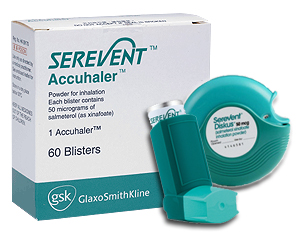
Serevent
View Options
This website provides general information about medicines for educational purposes only. Always consult your doctor or pharmacist before taking any medication.
Choose Your Medicine
Select dosage and quantity
Online Consultation
Reviewed by a qualified physician
Fast, Discreet Delivery
Delivered to your door
Medical Information
About This Medicine
Serevent is a long-acting beta-2 agonist (LABA) inhaler containing salmeterol 50 mcg per actuation. It is used as an add-on bronchodilator therapy in asthma and chronic obstructive pulmonary disease (COPD) to provide sustained airway relaxation over a 12-hour period. Serevent is available as a dry powder Accuhaler and must always be prescribed alongside an inhaled corticosteroid (ICS) when used in asthma.
Mechanism of Action
Salmeterol works by selectively binding to beta-2 adrenoceptors in bronchial smooth muscle, producing prolonged relaxation of the airway walls. Unlike short-acting beta-2 agonists such as salbutamol, salmeterol has a long lipophilic side chain that anchors it near the receptor, enabling a duration of action of approximately 12 hours. This sustained bronchodilation reduces airway resistance, improves airflow, and diminishes the effort of breathing throughout the day and night.
The onset of bronchodilation after Serevent is slower than that of salbutamol, typically 10 to 20 minutes, which is why it is entirely unsuitable for the treatment of acute asthma attacks or sudden breathlessness. Patients must understand this distinction clearly to avoid potentially life-threatening errors in emergency situations.
Role in Asthma Management
In asthma, salmeterol should never be used without a concomitant inhaled corticosteroid. The addition of a LABA to an ICS improves symptom control and reduces exacerbation rates more effectively than doubling the ICS dose alone. However, LABA monotherapy in asthma is associated with an increased risk of severe and fatal asthma attacks. Serevent is therefore indicated only as a step-up treatment when asthma remains insufficiently controlled despite regular ICS use. Many prescribers prefer a fixed-dose combination inhaler such as Seretide, which ensures that both components are taken together.
Use in COPD
In COPD, Serevent may be used as a standalone bronchodilator or alongside other agents. It improves FEV1, reduces dynamic hyperinflation, and enhances exercise capacity. While tiotropium and newer long-acting muscarinic antagonists are often preferred as first-line LABA/LAMA combination partners, salmeterol retains a role particularly in patients with co-existing asthma-COPD overlap syndrome. Regular review of treatment response and inhaler technique is essential to ensure ongoing benefit.
Usage & Dosage
Serevent Accuhaler is inhaled twice daily, morning and evening, approximately 12 hours apart. Consistent timing is important to maintain steady-state bronchodilation throughout the 24-hour period and to minimise the risk of nocturnal symptoms or early morning dips in lung function.
Correct Use of the Accuhaler
To use the Serevent Accuhaler, hold it in a level, flat position and slide the lever to load the dose. Breathe out gently, away from the mouthpiece, then place the mouthpiece between the lips and inhale steadily and deeply. Hold the breath for around 10 seconds to allow the powder to deposit in the airways, then exhale slowly. Unlike corticosteroid inhalers, there is no specific requirement to rinse the mouth after Serevent, though it is generally good practice in patients who also use an ICS.
Important Safety Considerations
Patients using Serevent for asthma must take their prescribed inhaled corticosteroid every day without fail. Serevent does not treat the underlying inflammation of asthma and offers no protection against an asthma attack in the absence of adequate anti-inflammatory therapy. If asthma symptoms worsen, or if the short-acting reliever inhaler is needed more frequently than usual, this should be reported to a doctor promptly rather than simply increasing Serevent use. Serevent should not be used to treat exercise-induced bronchospasm as a standalone indication if the patient has persistent asthma requiring ICS therapy.
The standard dose of Serevent Accuhaler for adults and adolescents aged 12 and over is one inhalation (50 mcg salmeterol) twice daily for both asthma and COPD. In severe COPD, some patients may use two inhalations twice daily (100 mcg twice daily), though this should be guided by a specialist.
For children aged 4 to 12 years with asthma, the dose is one inhalation (50 mcg) twice daily, always with a concomitant ICS. Serevent is not recommended in children under 4 years. No dose adjustment is required for elderly patients or those with renal impairment. Patients with severe hepatic impairment should be monitored, as plasma levels may be elevated. If symptoms are not adequately controlled at the standard dose, the overall asthma or COPD management plan should be reviewed rather than simply increasing the Serevent dose.
Side Effects
Common Side Effects
- Tremor, typically affecting the hands, due to beta-2 receptor stimulation in skeletal muscle
- Headache
- Palpitations or awareness of the heartbeat
- Muscle cramps
- Throat irritation or dry mouth
- Mild tachycardia (increased heart rate)
- Nervousness or restlessness
Serious Side Effects
- Paradoxical bronchospasm, sudden worsening of breathing immediately after inhalation; discontinue immediately and use a short-acting reliever
- Severe asthma deterioration, using LABA without ICS in asthma significantly increases risk of fatal attacks
- Hypokalaemia (low potassium), particularly at high doses or when combined with other potassium-lowering agents
- Cardiac arrhythmias including atrial fibrillation and ventricular ectopics, especially in patients with pre-existing cardiac disease
- Hypersensitivity reactions including urticaria, angioedema, and anaphylaxis (rare)
Warnings & Precautions
Serevent must not be used as a rescue medication or for the treatment of acute asthma attacks. It does not act quickly enough to reverse sudden airway narrowing and its use in an acute attack, instead of a short-acting reliever, could have fatal consequences. Patients must always have salbutamol or another short-acting beta-2 agonist available.
Asthma Safety Warning
The use of a LABA without a concomitant ICS in asthma is associated with an increased risk of severe asthma-related adverse events, including death. This risk is the basis for regulatory warnings in multiple countries, including the UK. Serevent must always be prescribed and taken alongside an adequate dose of inhaled corticosteroid in any patient with asthma. Prescribers and patients should be aware that if asthma control deteriorates, this represents a medical emergency requiring prompt assessment, not an indication to simply increase Serevent use.
Cardiovascular and Metabolic Cautions
Salmeterol stimulates beta-2 receptors, which can affect the heart and metabolism as well as the airways. It should be used with caution in patients with known ischaemic heart disease, arrhythmias, hypertrophic obstructive cardiomyopathy, or uncontrolled hypertension. The risk of hypokalaemia is heightened when salmeterol is combined with xanthines (such as theophylline), corticosteroids, or diuretics. Potassium levels should be monitored in high-risk patients. Diabetic patients should be aware that high-dose beta-agonists can cause transient increases in blood glucose. Concurrent use of non-selective beta-blockers, including ophthalmic formulations, should be avoided.
Contraindications
- Hypersensitivity to salmeterol, lactose, or any other excipient in the formulation
- Use as monotherapy in asthma without a concomitant inhaled corticosteroid
- Treatment of acute asthma attacks or acute bronchospasm
- Use in children under 4 years of age
- Concurrent use of non-selective beta-blockers (e.g. propranolol) except where essential
- Hyperthyroidism (thyrotoxicosis) -- use with extreme caution
- Rare hereditary galactose intolerance or glucose-galactose malabsorption (contains lactose)
- Severe cardiovascular disease where any sympathomimetic stimulation poses unacceptable risk
Frequently Asked Questions
Can I use Serevent to treat a sudden asthma attack?
Do I still need to use my steroid inhaler if I am taking Serevent?
How is Serevent different from salbutamol?
What should I do if I miss a dose of Serevent?
Can Serevent be used in COPD without an ICS?
Dr. Ross Elledge
General Practitioner · General & Family Medicine
Verified Healthcare Professional
TopDoctors Profile