
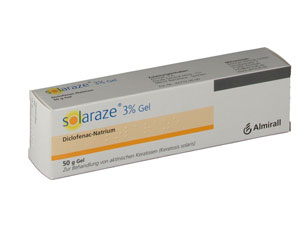
Solaraze
View Options
This website provides general information about medicines for educational purposes only. Always consult your doctor or pharmacist before taking any medication.
Choose Your Medicine
Select dosage and quantity
Online Consultation
Reviewed by a qualified physician
Fast, Discreet Delivery
Delivered to your door
Medical Information
About This Medicine
Solaraze Gel is a topical anti-inflammatory preparation containing diclofenac sodium 3% in a hyaluronic acid gel vehicle. It is used for the treatment of actinic keratoses, also known as solar keratoses, dry, scaly, sometimes rough patches on the skin caused by years of cumulative sun damage. These lesions occur predominantly on sun-exposed areas such as the scalp, face, ears, back of the hands, and forearms, and are considered precancerous lesions with the potential to develop into squamous cell carcinoma if left untreated.
How Solaraze Works
Diclofenac sodium is a non-steroidal anti-inflammatory drug (NSAID) that inhibits cyclo-oxygenase (COX) enzymes, reducing the synthesis of prostaglandins and other inflammatory mediators in the skin. In the context of actinic keratoses, prostaglandin E2 is thought to play a role in the abnormal keratinocyte proliferation and dysplasia characteristic of these lesions. By suppressing local prostaglandin production, diclofenac reduces cellular proliferation and promotes regression of the keratotic tissue.
The hyaluronic acid gel vehicle is specifically formulated to enhance skin penetration and hydration, improving drug delivery to the affected keratinocyte layers while minimising systemic absorption. This dual action, anti-inflammatory and antiproliferative, makes Solaraze a well-tolerated outpatient treatment option for actinic keratoses when cryotherapy or other destructive treatments are not preferred or appropriate.
Treatment Course and Expected Outcomes
Treatment typically involves applying Solaraze twice daily to the affected area for 60 to 90 days. Clinical trials have demonstrated meaningful reduction or clearance of actinic keratoses after completing the full course. Some lesions may not fully resolve and may require an alternative treatment approach such as cryotherapy, photodynamic therapy, or topical fluorouracil. Regular dermatological review is important to monitor response and assess for any progression of remaining lesions.
Usage & Dosage
Solaraze Gel is applied directly to the affected skin areas twice daily, typically morning and evening. A sufficient amount of gel should be applied to cover the entire actinic keratosis and a small margin of surrounding normal skin, gently smoothing it in until absorbed. Hands should be washed thoroughly before and after application to prevent inadvertent contact with the eyes or mucous membranes.
Application Technique and Sun Protection
The gel should not be applied to open wounds, broken skin, or areas affected by eczema or dermatitis. It should be kept away from the eyes, nose, mouth, and genitals. If accidental contact occurs with the eyes, they should be rinsed immediately with water. It is important to apply an appropriate high-factor sunscreen (SPF 50+) to treated areas during the course of treatment, as diclofenac may increase skin photosensitivity.
Patients should be advised to avoid direct sun exposure to treated areas as much as possible during the treatment period, wear protective clothing, and seek shade during peak UV hours (10 am to 4 pm). This not only reduces the risk of skin reactions but also addresses the underlying cause of actinic keratoses.
Duration and Review
The full treatment course of 60 to 90 days should be completed even if the lesions appear to improve earlier, as premature discontinuation reduces the likelihood of sustained clearance. A dermatological review at the end of treatment helps assess response, identify any residual or new lesions, and plan further management if needed.
The recommended dose of Solaraze Gel is a thin layer applied twice daily to the affected areas and a small margin of surrounding skin. The amount used per application should be proportional to the area being treated, typically approximately 0.5 g per 5 cm squared of affected skin. Treatment should continue for a minimum of 60 days and up to 90 days for optimal effect.
The total treatment area should not normally exceed 25 cm squared at any one time. If treating multiple areas, they should be treated sequentially rather than simultaneously to limit potential systemic absorption. Solaraze Gel is approved for use in adults only and is not intended for use in children. Elderly patients may use the standard dose but should be monitored for any local skin reactions, which may be more pronounced due to thinner skin. Systemic absorption is low, but caution is advised in patients with renal or hepatic impairment, and use should be avoided in the third trimester of pregnancy.
Side Effects
Common Side Effects
- Local skin reactions at the application site: redness, itching, burning, or stinging sensation
- Dry skin, scaling, or peeling at the treated area
- Contact dermatitis or rash
- Skin discolouration (hyperpigmentation or hypopigmentation) in some patients
- Oedema (swelling) at the application site
- Photosensitivity, increased sensitivity to sunlight on treated skin
- Exfoliation or crusting during the treatment course
Serious Side Effects
- Severe local allergic reactions including extensive rash, vesicle formation, or skin breakdown; discontinue and seek medical review
- Systemic NSAID effects, though rare with topical use: gastrointestinal irritation, renal effects, or elevated liver enzymes in patients applying to large areas or with compromised skin barrier
- Anaphylaxis or severe hypersensitivity (rare; more likely in patients with known NSAID allergy)
- Eye irritation or corneal damage if accidental contact with eyes occurs
- Risk of asthma exacerbation in patients with NSAID-sensitive asthma (aspirin-exacerbated respiratory disease)
Warnings & Precautions
Solaraze Gel should not be used by patients with a known allergy to diclofenac, aspirin, or other NSAIDs. Patients with aspirin-exacerbated respiratory disease -- sometimes called Samter's triad -- characterised by asthma, nasal polyps, and aspirin sensitivity, may experience bronchospasm when using topical NSAIDs and should avoid Solaraze without specialist guidance.
Avoiding Systemic NSAID Risks
Although systemic absorption of diclofenac from Solaraze Gel is low under normal conditions, it increases significantly when applied to large areas, inflamed or broken skin, or under occlusive dressings. In these circumstances, the systemic effects and risks associated with oral NSAIDs -- including gastrointestinal ulceration, renal impairment, and cardiovascular effects -- become more relevant. Solaraze should not be used simultaneously with oral NSAIDs unless carefully supervised.
Solaraze Gel should not be used during the third trimester of pregnancy, as inhibition of prostaglandin synthesis at this stage may adversely affect the foetal cardiovascular system and renal function. Use in earlier pregnancy should only occur if strictly necessary.
Sun Exposure and Long-Term Skin Care
Patients should be counselled that actinic keratoses are markers of cumulative sun damage, and that ongoing sun protection is essential to prevent new lesions from developing. Even after successful clearance of current lesions, individuals with a history of actinic keratoses remain at elevated lifetime risk of skin cancer and should undergo regular dermatological surveillance. Daily broad-spectrum SPF 50+ sunscreen, protective clothing, and sun avoidance during peak hours are all important components of long-term management.
Contraindications
- Hypersensitivity to diclofenac sodium, aspirin, or other NSAIDs
- Aspirin-exacerbated respiratory disease (asthma, nasal polyps, NSAID sensitivity)
- Third trimester of pregnancy
- Application to open wounds, broken skin, infected areas, or areas of eczema or dermatitis
- Contact with eyes, mouth, nose, or genitals
- Use in children under 18 years
- Application under occlusive dressings without medical supervision
- Patients already receiving systemic NSAID therapy without medical review
Frequently Asked Questions
How long does it take for Solaraze Gel to work on actinic keratoses?
Can I use Solaraze Gel on my face?
Do I need to use sunscreen while using Solaraze Gel?
Can I use Solaraze Gel and take ibuprofen or other NSAIDs at the same time?
Will my actinic keratoses come back after using Solaraze Gel?
Dr. Ross Elledge
General Practitioner · General & Family Medicine
Verified Healthcare Professional
TopDoctors Profile