
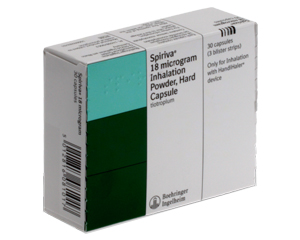
Spiriva
View Options
This website provides general information about medicines for educational purposes only. Always consult your doctor or pharmacist before taking any medication.
Choose Your Medicine
Select dosage and quantity
Online Consultation
Reviewed by a qualified physician
Fast, Discreet Delivery
Delivered to your door
Medical Information
About This Medicine
Spiriva is a long-acting muscarinic antagonist (LAMA) bronchodilator containing tiotropium bromide, used in the maintenance treatment of chronic obstructive pulmonary disease (COPD). It is considered a gold-standard component of COPD pharmacotherapy, with extensive clinical trial evidence demonstrating improvements in lung function, exercise capacity, quality of life, and reductions in exacerbation frequency. Spiriva is available in two delivery systems: the HandiHaler (dry powder inhalation, 18 mcg tiotropium per capsule) and the Respimat Soft Mist inhaler (2.5 mcg per actuation; standard dose is two actuations delivering 5 mcg tiotropium daily).
Mechanism of Action
Tiotropium is a selective long-acting antagonist of all five muscarinic receptor subtypes, with particularly sustained binding at M3 receptors in airway smooth muscle and glands. In COPD, excessive vagal tone contributes to airway narrowing through muscarinic receptor activation. By blocking these receptors, tiotropium prevents acetylcholine from causing bronchoconstriction and excessive mucous secretion, leading to prolonged bronchodilation, improved airflow, and reduced dynamic hyperinflation. The duration of action exceeds 24 hours, making once-daily dosing both practical and clinically effective.
The reduction in dynamic hyperinflation, the trapping of air behind narrowed, collapsing airways, is a particularly important mechanism in COPD, as hyperinflation limits exercise tolerance, flattens the diaphragm, and worsens dyspnoea. By keeping airways more open throughout the respiratory cycle, tiotropium allows more complete exhalation and reduces the work of breathing.
Position in COPD Guidelines
GOLD guidelines recommend LAMA therapy as a core component of initial pharmacotherapy in COPD, particularly for patients with significant symptoms or exacerbation risk. Spiriva monotherapy is appropriate for many patients with moderate COPD, while combination with a LABA (such as in Spiolto Respimat) is recommended when monotherapy provides insufficient control. Unlike asthma, where inhaled corticosteroids are essential, ICS add-on in COPD is reserved for specific indications such as frequent exacerbations with elevated blood eosinophils.
Usage & Dosage
Spiriva HandiHaler is used once daily at the same time each day. A single tiotropium capsule is loaded into the HandiHaler device, which pierces the capsule when the side button is pressed. The patient then inhales deeply through the mouthpiece, drawing the powder into the airways. The mouthpiece should be held between the teeth without biting, and the inhaled breath held for 10 seconds to maximise lung deposition. To ensure complete dose delivery, most patients benefit from repeating the inhalation from the same capsule immediately after the first breath.
Using the HandiHaler Device
The HandiHaler capsules must only be used in the HandiHaler device and must never be swallowed. After use, the spent capsule should be removed from the device and discarded. The mouthpiece should be cleaned once a month by opening it and rinsing the mouthpiece, piercing button, and chamber with warm water. The inhaler should be left to dry in the air for at least 24 hours before use. Capsules should be stored in the blister pack until immediately before use and protected from moisture.
Spiriva Respimat is used as two actuations once daily, as described for Spiolto Respimat. Patients should not use both HandiHaler and Respimat simultaneously, as this doubles the tiotropium dose.
Daily Consistency and Expectations
Spiriva provides 24-hour bronchodilation with consistent once-daily dosing. While some patients notice improvement within the first few days, the full clinical benefit, including reduced exacerbation frequency, typically becomes apparent over several weeks to months of continuous use. It should not be used to treat sudden breathlessness.
Spiriva HandiHaler: one capsule (18 mcg tiotropium) inhaled once daily using the HandiHaler device. The dose should be taken at the same time each day.
Spiriva Respimat: two actuations (2.5 mcg per actuation, delivering 5 mcg tiotropium) once daily.
No dose adjustment is required for elderly patients or those with mild-to-moderate renal impairment. In severe renal impairment (creatinine clearance below 50 ml/min), tiotropium should be used with caution, as drug levels may increase due to reduced renal clearance; close monitoring for anticholinergic side effects is recommended. No dose adjustment is required for hepatic impairment as tiotropium undergoes minimal hepatic metabolism. Spiriva HandiHaler contains lactose and is not appropriate for patients with severe lactose intolerance or rare hereditary galactose intolerance.
Side Effects
Common Side Effects
- Dry mouth, the most common side effect; generally mild and improves with continued use
- Constipation
- Urinary tract infection
- Sinusitis
- Nasopharyngitis
- Headache
- Blurred vision, transient, related to anticholinergic effect on ciliary muscle
- Dyspepsia and nausea
Serious Side Effects
- Urinary retention, particularly in men with benign prostatic hyperplasia; seek immediate medical attention if unable to urinate
- Acute angle-closure glaucoma, if aerosol contacts the eye with Respimat; sudden severe eye pain and visual changes are an emergency
- Paradoxical bronchospasm, rare but potentially severe; discontinue and use short-acting reliever
- Atrial fibrillation and supraventricular tachycardia, particularly in patients with cardiac disease
- Severe hypersensitivity reactions including angioedema, anaphylaxis, and Stevens-Johnson syndrome (rare)
Warnings & Precautions
Spiriva is a maintenance bronchodilator for COPD and is not licensed for asthma. Patients with asthma should not be prescribed Spiriva without specialist guidance, as LAMA monotherapy does not adequately control asthmatic inflammation and there are alternative, more appropriate agents for that condition.
Urinary and Ocular Precautions
The anticholinergic properties of tiotropium can precipitate urinary retention, particularly in men with pre-existing lower urinary tract symptoms, benign prostatic hyperplasia, or bladder outflow obstruction. Patients should report any new difficulty passing urine immediately. Similarly, Spiriva Respimat carries a risk of provoking acute angle-closure glaucoma if the aerosol is inadvertently directed at the eye. Patients must take care when using the Respimat device and report any sudden eye pain or visual disturbance immediately.
Cardiac Monitoring
Large-scale clinical trials of tiotropium in COPD demonstrated a slight increase in adverse cardiovascular events in some analyses, though subsequent data including the TIOSPIR trial have been reassuring. Spiriva should nonetheless be used with caution in patients with clinically significant arrhythmias, particularly those recently diagnosed with or treated for atrial fibrillation or flutter.
Drug Interactions
Concurrent use of other anticholinergic medicines (ipratropium, aclidinium, glycopyrronium, or systemic anticholinergics) is not recommended due to additive effects. Spiolto Respimat already contains tiotropium, so patients should not use Spiriva and Spiolto simultaneously. Patients should carry an up-to-date medicines list and inform all healthcare professionals of their current inhalers to avoid duplication.
Contraindications
- Hypersensitivity to tiotropium bromide, atropine or its derivatives, or any excipient
- Use as a reliever for acute bronchospasm or acute COPD exacerbation
- Use in asthma (not licensed)
- Concurrent use with other LAMA-containing inhalers (e.g. Spiolto Respimat, Ultibro Breezhaler) -- duplication of class
- Uncontrolled narrow-angle glaucoma without ophthalmological supervision
- Urinary retention or symptomatic bladder outflow obstruction (relative contraindication; use with extreme caution)
- Children and adolescents under 18 years
- Rare hereditary galactose intolerance or lactose intolerance (HandiHaler formulation)
Frequently Asked Questions
What is the difference between Spiriva HandiHaler and Spiriva Respimat?
Can I use Spiriva and another COPD inhaler at the same time?
How should I store the Spiriva HandiHaler capsules?
Is Spiriva effective for reducing COPD exacerbations?
Why does Spiriva cause dry mouth and what can I do about it?
Dr. Ross Elledge
General Practitioner · General & Family Medicine
Verified Healthcare Professional
TopDoctors Profile