
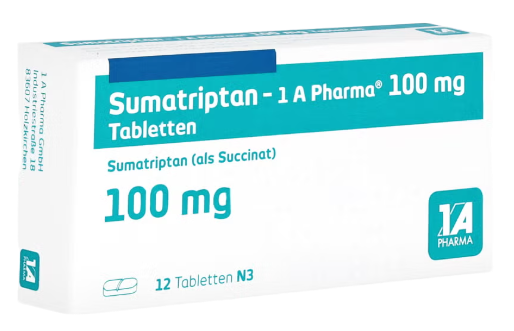
Sumatriptan
View Options
This website provides general information about medicines for educational purposes only. Always consult your doctor or pharmacist before taking any medication.
Choose Your Medicine
Select dosage and quantity
Online Consultation
Reviewed by a qualified physician
Fast, Discreet Delivery
Delivered to your door
Medical Information
About This Medicine
Sumatriptan is a prescription triptan medicine used to treat acute migraine attacks, with or without aura. It belongs to a class of drugs known as serotonin (5-HT1) receptor agonists, which work by narrowing blood vessels around the brain and blocking the release of certain natural substances that trigger pain, nausea, and other migraine symptoms. Unlike painkillers, sumatriptan does not prevent migraines - it acts specifically during an attack to relieve symptoms quickly and effectively.
How Sumatriptan Works
Migraines are associated with the dilation of blood vessels in the brain and the release of inflammatory neuropeptides. Sumatriptan selectively stimulates 5-HT1B and 5-HT1D receptors, causing vasoconstriction of these dilated vessels and inhibiting the trigeminal nerve pathway responsible for migraine pain. This targeted mechanism means it works best when taken early in a migraine attack, ideally at the onset of headache rather than during the aura phase.
Available Forms and Brands
Sumatriptan is available in several formulations to suit different needs. The most commonly prescribed form is the oral tablet, available in 50 mg and 100 mg strengths, sold under the brand name Imigran. For those who experience severe nausea or vomiting during migraines and cannot swallow tablets, a 20 mg nasal spray and a 6 mg subcutaneous injection are also available. The nasal spray typically acts within 15 to 30 minutes, while tablets usually begin working within 30 to 60 minutes. The injection offers the fastest onset, often providing relief within 10 to 15 minutes.
Effectiveness and Use
Sumatriptan is one of the most widely studied and prescribed migraine treatments. Clinical trials consistently show it relieves moderate to severe migraine headache within two hours in the majority of patients. It also helps alleviate associated symptoms such as nausea, sensitivity to light, and sensitivity to sound. The maximum recommended dose in a 24-hour period is 300 mg for tablets, and patients should not take a second dose for the same attack unless the first provided partial relief and at least two hours have passed. Sumatriptan is not suitable for use in hemiplegic migraine, basilar migraine, or for general headache prevention.
Usage & Dosage
Sumatriptan should be taken as soon as a migraine headache begins. Although it will not prevent the attack, taking it promptly at the onset of head pain - rather than during the aura - is associated with better outcomes. Tablets should be swallowed whole with water and may be taken with or without food.
How to Take Each Form
For tablets, the usual starting dose is 50 mg, with 100 mg reserved for those who do not respond adequately at the lower dose. If the migraine returns after an initial response, a second dose may be taken after at least two hours, provided the total dose does not exceed 300 mg in 24 hours. The nasal spray should be administered into one nostril only, holding the other nostril closed and breathing gently through the mouth after administration. For the subcutaneous injection, the pen device is designed for self-injection into the outer thigh or upper arm.
Special Considerations
Sumatriptan is intended only for diagnosed migraine and should not be used for tension-type headache or as a general painkiller. Frequent use of sumatriptan - more than 10 days per month - can lead to medication overuse headache, a paradoxical condition where the treatment itself causes chronic daily headache. Patients should keep a migraine diary to monitor frequency of use. If migraines are occurring more than four times per month, a preventative therapy should be discussed with a doctor.
Standard adult dosing:
- Tablets: 50 mg at onset; may increase to 100 mg if needed. Second dose (50 or 100 mg) after at least 2 hours if migraine returns. Maximum 300 mg per 24 hours.
- Nasal spray: 20 mg into one nostril at onset. Second dose after 2 hours if migraine returns. Maximum 40 mg per 24 hours.
- Subcutaneous injection: 6 mg at onset. Second injection after at least 1 hour if needed. Maximum 12 mg per 24 hours.
Sumatriptan is not recommended for children under 18 or for adults over 65 without specialist advice. Dose reduction is required in patients with hepatic impairment. It should not be taken within 24 hours of another triptan or within 2 weeks of stopping a monoamine oxidase inhibitor (MAOI).
Side Effects
Common Side Effects
- Tingling, warmth, or flushing sensations in the face, neck, or limbs
- Feelings of heaviness, tightness, or pressure in the chest, throat, or jaw
- Dizziness or drowsiness
- Nausea or vomiting
- Fatigue or weakness
- Dry mouth
- Pain or redness at the injection site (injection form)
- Unpleasant taste (nasal spray)
Serious Side Effects
- Chest pain or tightness indicating cardiac ischaemia - seek urgent medical attention
- Stroke or transient ischaemic attack (TIA) - very rare but reported
- Serotonin syndrome when combined with other serotonergic drugs - fever, agitation, rapid heart rate, muscle twitching
- Severe allergic reaction (anaphylaxis) - rash, swelling, difficulty breathing
- Hypertensive crisis in patients with uncontrolled blood pressure
- Colonic ischaemia - abdominal pain and bloody diarrhoea
Warnings & Precautions
Sumatriptan is contraindicated in patients with a history of heart attack, angina, coronary artery disease, stroke, or transient ischaemic attack. Because the drug causes vasoconstriction, it must not be used in anyone with uncontrolled hypertension or peripheral vascular disease.
Cardiovascular Risk
Patients with multiple cardiovascular risk factors - such as diabetes, smoking, obesity, strong family history, or hypertension - should have a cardiovascular evaluation before being prescribed sumatriptan. Although cardiac events are rare, they have been reported, particularly in patients with undisclosed risk factors. Do not take sumatriptan if you have known coronary artery disease.
Drug Interactions and Overuse
Combining sumatriptan with other triptans within 24 hours is contraindicated. It must not be used alongside ergotamine-containing medicines. Concurrent use with SSRIs, SNRIs, lithium, or MAOIs increases the risk of serotonin syndrome and should be used with caution or avoided. Overuse (more than 10 days per month) leads to medication overuse headache. Sumatriptan passes into breast milk - women who are breastfeeding should avoid nursing for 12 hours after a dose. It is not recommended during pregnancy unless the benefit clearly outweighs the risk.
Contraindications
- Known hypersensitivity to sumatriptan or any excipient
- History of myocardial infarction or ischaemic heart disease
- Coronary vasospasm or Prinzmetal's angina
- Peripheral vascular disease
- Previous stroke or transient ischaemic attack
- Severe or uncontrolled hypertension
- Hemiplegic or basilar migraine
- Use within 24 hours of another triptan or ergotamine-containing medicine
- Use within 14 days of a monoamine oxidase inhibitor (MAOI)
- Severe hepatic impairment
Frequently Asked Questions
Can I take sumatriptan every time I get a migraine?
How quickly does sumatriptan work?
Is sumatriptan the same as Imigran?
Can sumatriptan be taken with ibuprofen or paracetamol?
Why should I avoid sumatriptan if I have heart problems?
Dr. Ross Elledge
General Practitioner · General & Family Medicine
Verified Healthcare Professional
TopDoctors Profile