
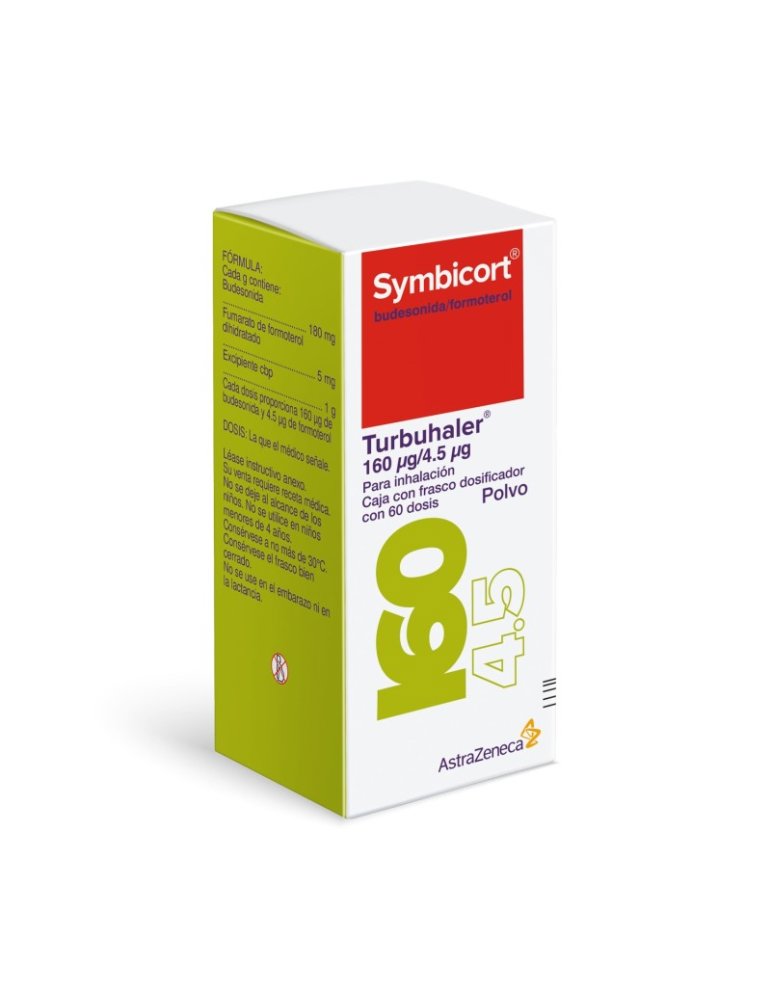
Symbicort Turbuhaler
View Options
This website provides general information about medicines for educational purposes only. Always consult your doctor or pharmacist before taking any medication.
Choose Your Medicine
Select dosage and quantity
Online Consultation
Reviewed by a qualified physician
Fast, Discreet Delivery
Delivered to your door
Medical Information
About This Medicine
Symbicort is a combination inhaler containing two active ingredients: budesonide, an inhaled corticosteroid (ICS), and formoterol, a long-acting beta-2 agonist (LABA). Together these medicines provide both anti-inflammatory control and bronchodilation, making Symbicort suitable for the management of asthma and chronic obstructive pulmonary disease (COPD) in adults and adolescents. It is one of the most widely prescribed inhalers in the UK and Europe.
How Each Component Works
Budesonide reduces inflammation in the airways by suppressing the release of inflammatory mediators such as histamine, leukotrienes, and cytokines. Over time, regular use reduces airway swelling and mucus production, which lowers the risk of asthma attacks. Formoterol works by relaxing the smooth muscle surrounding the airways, causing bronchodilation and improving airflow. Crucially, formoterol has a rapid onset of action (within 1 to 3 minutes) compared with other LABAs such as salmeterol, which is why Symbicort can be used as a reliever inhaler in addition to a maintenance inhaler.
SMART Therapy for Asthma
Symbicort is the only combination inhaler licensed for SMART therapy (Single inhaler Maintenance And Reliever Therapy). This approach uses Symbicort as both the regular maintenance inhaler taken every day and as a reliever inhaler taken at the onset of symptoms. SMART therapy has been shown in clinical trials to significantly reduce severe asthma exacerbations and hospitalisations compared with a fixed-dose ICS/LABA plus a separate SABA reliever. It is recommended for asthma patients on Step 3 or above of the BTS/SIGN guidelines.
Use in COPD
In COPD, Symbicort (400/12 strength) is used as a regular maintenance treatment to reduce symptoms, improve lung function, and lower the frequency of exacerbations. It is typically used alongside a long-acting muscarinic antagonist (LAMA) such as tiotropium in more severe disease. Symbicort does not replace a short-acting reliever for sudden breathlessness in COPD patients using the standard maintenance-only approach.
Usage & Dosage
Symbicort is available in two inhaler types: the Turbuhaler (a dry powder inhaler) and the pressurised metered-dose inhaler (pMDI). The appropriate device and dose strength should be chosen by a clinician based on the patient's diagnosis, severity, and inhaler technique.
Using Symbicort for Asthma
For maintenance therapy in asthma, adults and adolescents aged 12 and over typically inhale one or two puffs twice daily of the 100/6 or 200/6 strength, adjusting based on asthma control. Under the SMART approach, the same inhaler is used for symptom relief - patients take one additional inhalation as needed when symptoms occur. The total daily dose including both maintenance and reliever use should not exceed 8 inhalations (SMART) or 4 inhalations (maintenance only) without medical guidance.
Using Symbicort for COPD
For COPD maintenance, the recommended dose is usually two inhalations of Symbicort 400/12 twice daily. This strength is not appropriate for children. Patients should continue to use a short-acting bronchodilator for acute relief if they are not using Symbicort under the SMART approach. After each inhalation, patients should rinse their mouth with water and spit it out to minimise the risk of oral candidiasis caused by the inhaled corticosteroid component.
Asthma (adults and adolescents 12+):
- Maintenance: 1-2 inhalations of 100/6 or 200/6 twice daily
- SMART approach: 1-2 maintenance inhalations twice daily plus up to 6 additional relief inhalations per day (max 8 total)
COPD (adults):
- 2 inhalations of 400/12 twice daily
Symbicort Turbuhaler strengths available: 100/6, 200/6, 400/12 micrograms (budesonide/formoterol per dose)
Do not use more than prescribed without medical advice. Always rinse mouth after use. Review inhaler technique and asthma control at least annually.
Side Effects
Common Side Effects
- Oral candidiasis (thrush in the mouth or throat) - reduced by rinsing mouth after use
- Hoarseness or voice changes
- Mild throat irritation or cough
- Headache
- Palpitations or increased heart rate
- Tremor, particularly of the hands
- Muscle cramps
Serious Side Effects
- Paradoxical bronchospasm - wheeze and breathlessness immediately after inhaling; stop use and seek medical help
- Adrenal suppression with high doses or prolonged use, particularly in children
- Hypokalaemia (low potassium), especially with high doses or concurrent use of diuretics or xanthines
- Severe allergic reaction - rash, facial swelling, difficulty breathing
- Increased intraocular pressure or cataracts with prolonged high-dose use
- Psychiatric effects including depression, agitation, or behavioural changes (more common in children)
Warnings & Precautions
Symbicort must not be used as the sole therapy for acute severe asthma attacks. Patients should always seek emergency medical care if a severe attack occurs. Do not abruptly discontinue Symbicort without consulting a doctor, as this can cause a deterioration in asthma control.
Systemic Corticosteroid Effects
Although inhaled budesonide has a lower systemic bioavailability than oral steroids, prolonged use at high doses can cause adrenal suppression. Patients switching from systemic corticosteroids to Symbicort should be monitored carefully as adrenal insufficiency may become apparent. Carry a steroid card if you have been on high doses or systemic steroids.
Cardiovascular and Metabolic Monitoring
Formoterol can cause clinically significant hypokalaemia, particularly when used in high doses concurrently with thiazide diuretics, xanthine derivatives, or corticosteroids. Serum potassium should be monitored in susceptible patients. Caution is required in patients with thyrotoxicosis, hypertrophic obstructive cardiomyopathy, or prolonged QT interval. Symbicort contains lactose - patients with rare hereditary galactose intolerance or lactase deficiency should consult their doctor.
Contraindications
- Known hypersensitivity to budesonide, formoterol, or any excipient (including lactose)
- Not indicated as first-line treatment for mild asthma adequately controlled by a short-acting reliever alone
- Not approved for use in children under 6 years
- Not for use in acute severe asthma attacks as the sole treatment
- Caution in patients with active or quiescent pulmonary tuberculosis
- Caution in severe cardiovascular disorders including recent myocardial infarction
- Caution in diabetes mellitus (formoterol can raise blood glucose)
- Caution in hyperthyroidism
- Caution in severe hepatic impairment
Frequently Asked Questions
What is the difference between Symbicort and Ventolin?
Can I use Symbicort as a reliever in an asthma attack?
How long does it take for Symbicort to work?
Does Symbicort cause weight gain?
Why do I need to rinse my mouth after using Symbicort?
Dr. Ross Elledge
General Practitioner · General & Family Medicine
Verified Healthcare Professional
TopDoctors Profile