
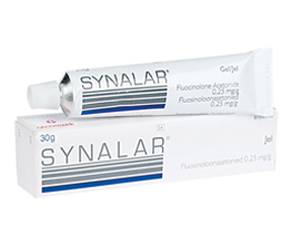
Synalar
View Options
This website provides general information about medicines for educational purposes only. Always consult your doctor or pharmacist before taking any medication.
Choose Your Medicine
Select dosage and quantity
Online Consultation
Reviewed by a qualified physician
Fast, Discreet Delivery
Delivered to your door
Medical Information
About This Medicine
Synalar is a moderately potent topical corticosteroid containing fluocinolone acetonide at a concentration of 0.025%. It is used to treat a range of inflammatory and pruritic skin conditions where less potent steroids have proved insufficient. Synalar is available in cream, gel, and ointment formulations, and is applied directly to the affected area of skin. It is a prescription-only medicine in the UK.
How Synalar Works
Fluocinolone acetonide exerts its anti-inflammatory effect by binding to intracellular glucocorticoid receptors, which modulates the transcription of genes involved in the inflammatory response. This reduces the production of prostaglandins, cytokines, and other inflammatory mediators, leading to decreased redness, swelling, itch, and discomfort in the affected skin. The vasoconstriction it causes also contributes to the reduction in erythema. As a moderately potent steroid, Synalar sits in the mid-range of the UK topical steroid potency classification, making it more effective than hydrocortisone but less powerful than very potent agents such as clobetasol propionate.
Conditions Treated
Synalar is indicated for the treatment of eczema (atopic, contact, and seborrhoeic), psoriasis affecting the body and scalp, discoid lupus erythematosus, and other steroid-responsive dermatoses. The cream formulation is generally preferred for moist, weeping skin and flexural areas, while the ointment is more appropriate for dry, thickened, or lichenified skin. Synalar gel is particularly useful for hairy areas of the scalp.
Limitations of Use
Synalar is not suitable for use on the face, where prolonged application of moderately potent steroids can cause skin thinning, perioral dermatitis, and rosacea-like reactions. It must not be applied to broken or infected skin without concurrent antimicrobial treatment, as topical steroids can mask signs of infection and facilitate its spread. Long-term continuous use should be avoided in favour of short courses followed by regular reassessment.
Usage & Dosage
Synalar should be applied thinly and evenly to the affected area of skin, rubbing gently until absorbed. A thin layer is sufficient - using more does not improve efficacy but significantly increases the risk of side effects. The Fingertip Unit (FTU) method provides a useful guide: one FTU (the amount squeezed from a tube from the tip of an adult index finger to the first crease) is sufficient to cover an area roughly twice the size of an adult hand.
Frequency and Duration
Synalar is typically applied twice daily, morning and evening. Once the condition is under control, frequency should be stepped down gradually - first to once daily, then to alternate days - before stopping entirely. This reduces the risk of rebound flares. Treatment courses should be as short as possible. For most adults, a course of two to four weeks is appropriate; children should be treated for the shortest possible time, with regular review.
Application to Different Areas
When applying to the scalp, the gel formulation makes penetration through hair easier. Avoid getting Synalar in the eyes or mucous membranes. Do not apply under occlusive dressings unless specifically advised by a dermatologist, as this markedly increases systemic absorption. Hands should be washed after application unless the hands are the site being treated.
Standard adult dose: Apply a thin layer to the affected area twice daily. Reduce frequency once symptoms improve.
Children: Use only under medical supervision. Avoid prolonged courses. Nappies act as occlusive dressings and increase absorption - use caution in infants.
Elderly: Skin is thinner and more susceptible to atrophy. Use the lowest effective dose for the shortest possible duration.
Maximum treatment area: Avoid applying to large areas of the body. Systemic absorption increases with surface area covered. Review need for treatment after 2-4 weeks.
Side Effects
Common Side Effects
- Skin thinning (atrophy) with prolonged use
- Stretch marks (striae), particularly in flexural areas
- Telangiectasia (visible small blood vessels)
- Perioral dermatitis with facial application
- Contact sensitisation to the active ingredient or preservatives
- Burning, stinging, or itching on application
- Folliculitis
Serious Side Effects
- Hypothalamic-pituitary-adrenal (HPA) axis suppression with extensive or prolonged use, especially under occlusion
- Cushing's syndrome features with excessive long-term use
- Skin infections masked or worsened - bacterial, fungal, or viral (e.g., herpes)
- Glaucoma or cataracts with periocular use or inadvertent eye contact
- Hypersensitivity reactions including allergic contact dermatitis
Warnings & Precautions
Synalar must not be applied to the face, broken skin, or to areas of active untreated infection. Topical steroids can suppress the local immune response, allowing infections to spread undetected beneath a superficially improved appearance. If infection is present, appropriate antimicrobial therapy must be started before or alongside steroid treatment.
Children and Pregnancy
Children are particularly susceptible to systemic absorption of topical corticosteroids due to their higher skin surface area to body weight ratio and thinner skin. Prolonged use in children can suppress growth and cause HPA axis suppression. Use the minimum effective dose for the shortest necessary duration. Nappies and plastic pants should be avoided when Synalar is applied to the nappy area, as they act as occlusive dressings. During pregnancy, particularly in the first trimester, topical steroids should be used only when clearly necessary.
Monitoring and Stopping Treatment
Patients using Synalar for longer than four weeks should be reviewed by their doctor. Abrupt discontinuation after prolonged use can cause a rebound flare of the original skin condition. A step-down approach - reducing frequency gradually - is recommended. Patients should be counselled about the risks of skin thinning with overuse and encouraged to use simple emollients as the primary treatment for dry skin conditions.
Contraindications
- Known hypersensitivity to fluocinolone acetonide or any excipient
- Rosacea, perioral dermatitis, or acne vulgaris (topical steroids worsen these)
- Untreated bacterial, fungal, or viral skin infections
- Application to the face (except under specialist direction)
- Perianal and genital pruritus without concurrent antimicrobial therapy
- Tuberculous or syphilitic skin lesions
- Varicella or other viral skin infections
- Use in and around the eyes without specialist supervision
- Children under 1 year of age
Frequently Asked Questions
How strong is Synalar compared with other topical steroids?
Can I use Synalar on my face?
How long can I use Synalar for?
Is Synalar safe during pregnancy?
Dr. Ross Elledge
General Practitioner · General & Family Medicine
Verified Healthcare Professional
TopDoctors Profile