
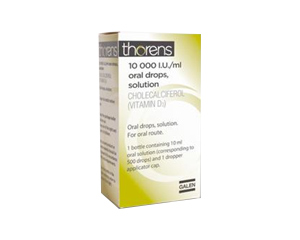
Thorens
View Options
This website provides general information about medicines for educational purposes only. Always consult your doctor or pharmacist before taking any medication.
Choose Your Medicine
Select dosage and quantity
Online Consultation
Reviewed by a qualified physician
Fast, Discreet Delivery
Delivered to your door
Medical Information
About This Medicine
Thorens is a brand of colecalciferol (vitamin D3) supplement used in the treatment and prevention of vitamin D deficiency and related conditions. It is available in a range of strengths - from 800 IU for daily supplementation to higher doses such as 25,000 IU for the treatment of established deficiency - making it a versatile option for different clinical scenarios. Vitamin D plays an essential role in the body's regulation of calcium and phosphate, which are critical for bone mineralisation, muscle function, and immune health.
Why Vitamin D Matters
Vitamin D deficiency is prevalent in the UK, where limited sunlight exposure for much of the year means that endogenous synthesis through the skin is insufficient for many people. NICE and Public Health England recommend vitamin D supplementation for all adults, particularly during autumn and winter. Groups at greatest risk of deficiency include people with darker skin tones (who require longer sun exposure to synthesise adequate vitamin D), those who cover their skin for cultural or religious reasons, the elderly, people with limited outdoor exposure, and individuals with malabsorption conditions such as Crohn's disease or coeliac disease.
Colecalciferol vs. Ergocalciferol
There are two main forms of supplemental vitamin D: colecalciferol (D3, derived from animal sources) and ergocalciferol (D2, derived from plant sources). Evidence consistently demonstrates that colecalciferol is more effective at raising and sustaining serum 25-hydroxyvitamin D (25(OH)D) levels than ergocalciferol at equivalent doses. Thorens uses colecalciferol, making it the preferred form for treating deficiency. Once absorbed, colecalciferol is hydroxylated in the liver to 25(OH)D and then in the kidneys to the active metabolite 1,25-dihydroxyvitamin D (calcitriol), which acts on vitamin D receptors throughout the body.
Benefits Beyond Bone Health
While vitamin D's role in calcium absorption and bone mineralisation is its most established function, it also plays important roles in muscle strength (reducing falls risk in the elderly), immune modulation, and may have a role in conditions as varied as depression, cardiovascular health, and autoimmunity, though evidence for these broader effects is still evolving.
Usage & Dosage
Thorens should be taken as directed by a doctor or pharmacist. The appropriate dose and frequency depend on the clinical indication - whether it is being used for routine prevention, maintenance supplementation, or treatment of established deficiency.
Prevention and Maintenance
For routine daily supplementation in adults and children over 12, lower-strength formulations (800 to 1,000 IU per day) are appropriate. The NHS recommends a daily supplement of 400 IU for infants and children, and 400 IU for adults at risk of deficiency. Thorens 800 IU or 1,000 IU once daily is a commonly prescribed maintenance dose for adults who are vitamin D deficient or at risk of deficiency.
Treatment of Established Deficiency
For the treatment of clinically confirmed vitamin D deficiency (serum 25(OH)D below 25 nmol/L), higher loading doses may be prescribed - often as weekly or twice-weekly high-dose tablets (such as 20,000 or 25,000 IU) for six to ten weeks, followed by maintenance dosing. Thorens is typically taken orally with a meal containing some fat, as vitamin D is a fat-soluble vitamin and its absorption is enhanced by dietary lipids. Do not exceed the prescribed dose or duration without medical advice.
Prevention (adults at risk): 800-1,000 IU once daily.
Treatment of deficiency: Higher loading doses (e.g., 20,000-25,000 IU once or twice weekly for 6-10 weeks) as directed by a doctor, followed by maintenance dosing.
Thorens available strengths: 800 IU, 1,000 IU, 5,000 IU, 10,000 IU, 25,000 IU (strengths may vary by product line).
Monitor serum 25(OH)D levels after loading courses to confirm correction of deficiency. Target level: 50-75 nmol/L. Avoid exceeding the upper tolerable intake level of 4,000 IU per day long-term unless under specialist supervision.
Side Effects
Common Side Effects
- Hypercalcaemia with excessive dosing - nausea, vomiting, constipation, confusion (dose-related, not at recommended doses)
- Headache
- Fatigue
- Dry mouth
- Increased thirst or urination (signs of hypercalcaemia - seek medical advice)
- Abdominal pain or discomfort
Serious Side Effects
- Hypercalcaemia - elevated blood calcium causing confusion, muscle weakness, cardiac arrhythmias; requires dose reduction and medical review
- Hypercalciuria - elevated urinary calcium increasing risk of kidney stones, particularly in patients with sarcoidosis or primary hyperparathyroidism
- Nephrocalcinosis with prolonged excessive dosing
- Hypervitaminosis D - toxicity from chronic overdose
Warnings & Precautions
Thorens should not be taken in doses exceeding those recommended by a doctor. Vitamin D is a fat-soluble vitamin, meaning it accumulates in body fat and can reach toxic levels with prolonged excessive supplementation. Hypervitaminosis D typically results from chronic intake far exceeding the recommended dose over months or years, rather than from a single large dose, but high loading doses in certain patient groups require monitoring.
Hypercalcaemia Risk
Patients with conditions associated with dysregulated calcium metabolism - including sarcoidosis, primary hyperparathyroidism, and certain granulomatous diseases - are at increased risk of developing hypercalcaemia from vitamin D supplementation. These patients require specialist-supervised dosing and regular monitoring of serum calcium. Similarly, patients with nephrolithiasis (kidney stones) or hypercalciuria should use vitamin D supplements with caution.
Drug Interactions
Thiazide diuretics (such as bendroflumethiazide) reduce urinary calcium excretion and can potentiate hypercalcaemia when combined with vitamin D supplements. Corticosteroids reduce vitamin D absorption and antagonise its effects on calcium. Some anticonvulsants (phenytoin, carbamazepine) and rifampicin increase hepatic metabolism of vitamin D, requiring higher doses in patients taking these medicines. Digoxin toxicity is potentiated by hypercalcaemia - patients on digoxin should have calcium levels monitored if starting high-dose vitamin D supplementation.
Contraindications
- Hypercalcaemia (elevated blood calcium) of any cause
- Hypervitaminosis D (vitamin D toxicity)
- Hypercalciuria without concurrent management
- Known hypersensitivity to colecalciferol or any excipient
- Nephrolithiasis (kidney stones) - caution required; specialist advice needed
- Sarcoidosis or other granulomatous disease - risk of hypercalcaemia
- Primary hyperparathyroidism - calcium regulation already impaired
- Renal osteodystrophy with hyperphosphataemia - colecalciferol not appropriate; active metabolites required
Frequently Asked Questions
How do I know if I need a vitamin D supplement?
What is the difference between vitamin D2 and vitamin D3?
Can I take too much vitamin D?
How long does it take for vitamin D supplements to work?
Is Thorens suitable for vegetarians or vegans?
Dr. Ross Elledge
General Practitioner · General & Family Medicine
Verified Healthcare Professional
TopDoctors Profile