
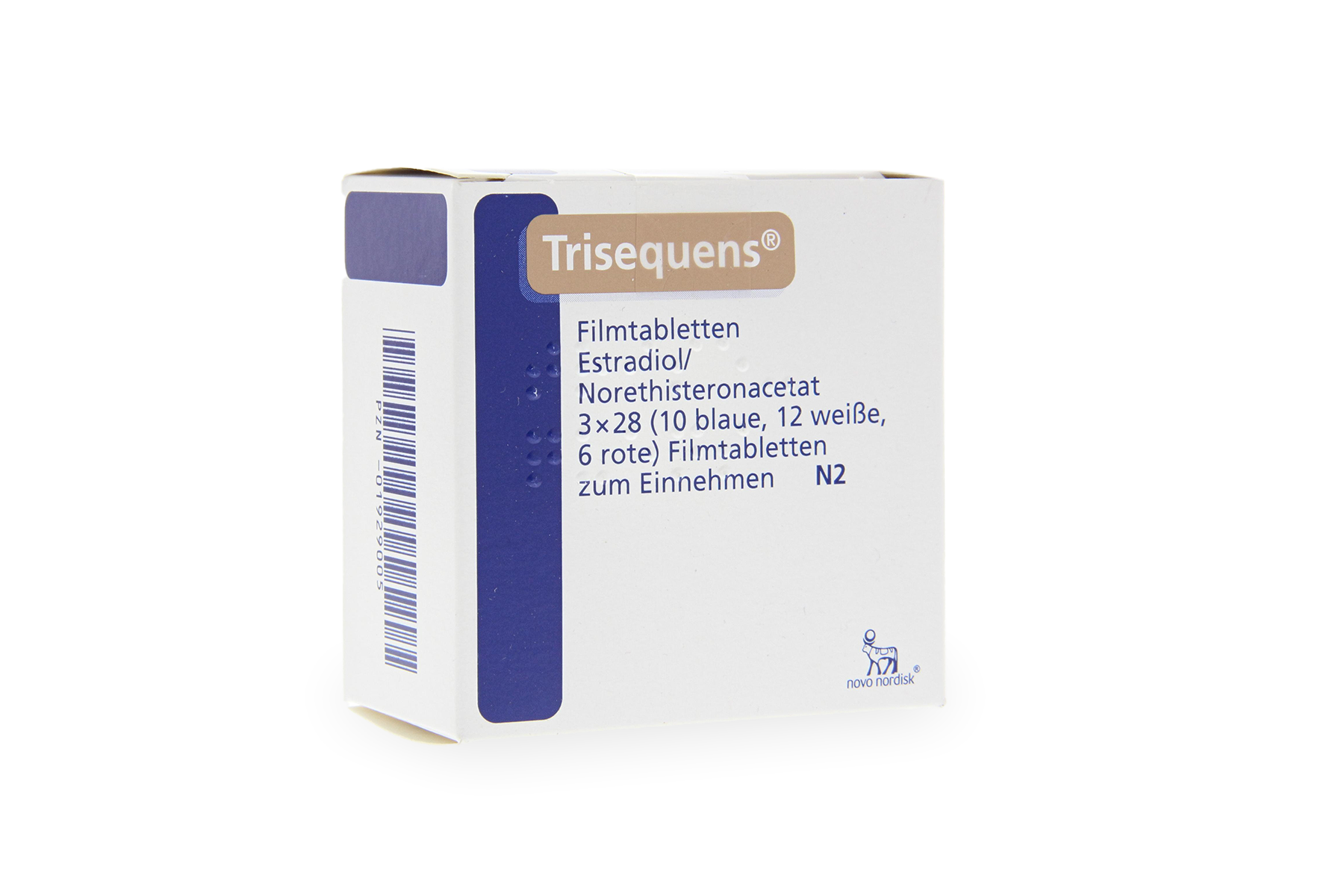
Trisequens
View Options
This website provides general information about medicines for educational purposes only. Always consult your doctor or pharmacist before taking any medication.
Choose Your Medicine
Select dosage and quantity
Online Consultation
Reviewed by a qualified physician
Fast, Discreet Delivery
Delivered to your door
Medical Information
About This Medicine
Trisequens is a triphasic, sequential hormone replacement therapy (HRT) tablet used to manage menopausal symptoms in women who have not had a hysterectomy. It contains two hormones: estradiol (a natural oestrogen) and norethisterone acetate (a synthetic progestogen). The "triphasic" formulation means that the hormone doses change in three distinct phases across the 28-day cycle, mimicking aspects of the natural menstrual hormone pattern.
How Trisequens Works
Trisequens delivers oestrogen throughout the full 28-day cycle to relieve menopausal symptoms caused by falling oestrogen levels. For the last 10 days of each cycle, norethisterone acetate is added to protect the womb lining (endometrium) from the overgrowth that can occur with unopposed oestrogen. This progestogen phase triggers a monthly withdrawal bleed when norethisterone is stopped at the end of the cycle, making Trisequens a sequential rather than a continuous-combined HRT regimen.
The withdrawal bleed associated with Trisequens is expected and is not a sign of menstrual return in women who have already experienced the menopause. It differs from a true menstrual period in that it is a pharmacological response to progestogen withdrawal.
Who Uses Trisequens
Trisequens is particularly suited to perimenopausal women, those who are still within a few years of their last natural period and may still have some residual ovarian activity. In this group, continuous-combined HRT (which does not produce a withdrawal bleed) is more likely to cause irregular breakthrough bleeding, making a sequential regimen more appropriate. Trisequens effectively treats hot flushes, night sweats, vaginal dryness, mood changes, sleep disturbance, and other symptoms attributable to oestrogen deficiency. It may also help prevent osteoporosis in women at risk of bone loss.
Usage & Dosage
Taking Trisequens in Sequence
Trisequens must be taken continuously and in strict sequence, following the colour-coded tablet strips exactly. The 28-tablet calendar pack is divided into three sections:
- Blue tablets (estradiol 2 mg only): days 1 to 12
- White tablets (estradiol 2 mg + norethisterone acetate 1 mg): days 13 to 22
- Red tablets (estradiol 1 mg only): days 23 to 28
After completing the 28-day pack, start the next pack immediately the following day without a break. A withdrawal bleed typically occurs during or after the red tablet phase at the end of the pack.
Starting Trisequens
If you are not currently taking HRT, start Trisequens on any convenient day. If switching from another sequential HRT, start the day after finishing your previous pack. Take one tablet at the same time each day, swallowed whole with water.
Trisequens follows a fixed triphasic dosing schedule that cannot be adjusted by the patient. The sequence is set by the manufacturer and encoded in the colour-coded 28-tablet blister pack.
Phase 1 (days 1-12): Blue tablets -- estradiol 2 mg once daily.
Phase 2 (days 13-22): White tablets -- estradiol 2 mg plus norethisterone acetate 1 mg once daily.
Phase 3 (days 23-28): Red tablets -- estradiol 1 mg once daily.
After the final red tablet, a new pack is started immediately. Treatment is continuous with no tablet-free intervals.
Tablets: One tablet daily at approximately the same time each day. If a stronger or weaker oestrogen dose is required, an alternative HRT preparation should be considered. Trisequens is not dose-adjustable; dose matching is achieved by switching to a different product rather than altering tablet numbers.
The need for continued HRT should be reviewed with the prescribing doctor at least annually, and the lowest effective dose for the shortest appropriate duration used.
Side Effects
Common Side Effects
The following are commonly reported, particularly in the first few months as your body adjusts to the hormones:
- Breast tenderness or swelling (often settles after a few months)
- Headache
- Nausea, especially in the early weeks
- Abdominal bloating and mild cramping
- Withdrawal bleeding (expected during the red tablet phase)
- Irregular spotting between expected bleeds in the first cycles
Long-term Risks
All combined HRT carries a small increased risk of breast cancer, blood clots (venous thromboembolism), and stroke with prolonged use. The absolute risk depends on your age, health, and how long you use HRT. Your doctor will review your treatment periodically. Report new breast lumps, persistent leg pain or swelling, chest pain, or sudden severe headache promptly.
Warnings & Precautions
Trisequens carries important warnings that should be understood before and during treatment.
Cardiovascular and Thrombotic Risk
All forms of combined oral HRT carry an increased risk of venous thromboembolism compared with no HRT use. The risk is greatest in women who are obese, have a personal or family history of blood clots, are immobile for extended periods, or smoke. Women considering Trisequens should discuss their individual cardiovascular risk profile with their doctor. If a woman is hospitalised for surgery or is immobile for a prolonged period, she should discuss whether to temporarily stop Trisequens to reduce thrombotic risk. Transdermal (patch or gel) HRT is associated with a lower thrombotic risk than oral tablets and may be preferable in women with risk factors.
Cancer Risk and Monitoring
The combined oestrogen-progestogen component of Trisequens is associated with a small increased risk of breast cancer that increases with duration of use. All women on HRT should be breast aware and attend routine mammography screening. Any new breast lumps, nipple changes, or skin dimpling should be reported promptly. The endometrial protection provided by norethisterone in Trisequens reduces the risk of womb cancer to approximately that of women not taking HRT, provided the tablets are taken correctly and in sequence.
Trisequens should not be used in women with undiagnosed vaginal bleeding. Any unexpected bleeding that does not conform to the anticipated withdrawal bleed pattern should be reported to the doctor for investigation.
Contraindications
- Known, suspected, or previous breast cancer
- Known or suspected oestrogen-dependent tumours (e.g., endometrial cancer)
- Unexplained vaginal bleeding
- Untreated endometrial hyperplasia
- Previous or current venous thromboembolism (DVT or pulmonary embolism)
- Known thrombophilic disorders (e.g., protein C deficiency, Factor V Leiden mutation)
- Active or recent arterial thromboembolic disease (angina, myocardial infarction, stroke)
- Acute or severe liver disease, or previous liver disease where liver function tests have not returned to normal
- Porphyria cutanea tarda
- Hypersensitivity to estradiol, norethisterone acetate, or any excipient
- Women who have had a hysterectomy (Trisequens is sequential combined HRT designed for women with a uterus)
Frequently Asked Questions
Why does Trisequens cause a monthly bleed?
Can I use Trisequens if I have already reached the menopause?
How long can I safely take Trisequens?
Does Trisequens protect against osteoporosis?
Will Trisequens affect my risk of breast cancer?
Dr. Ross Elledge
General Practitioner · General & Family Medicine
Verified Healthcare Professional
TopDoctors Profile