
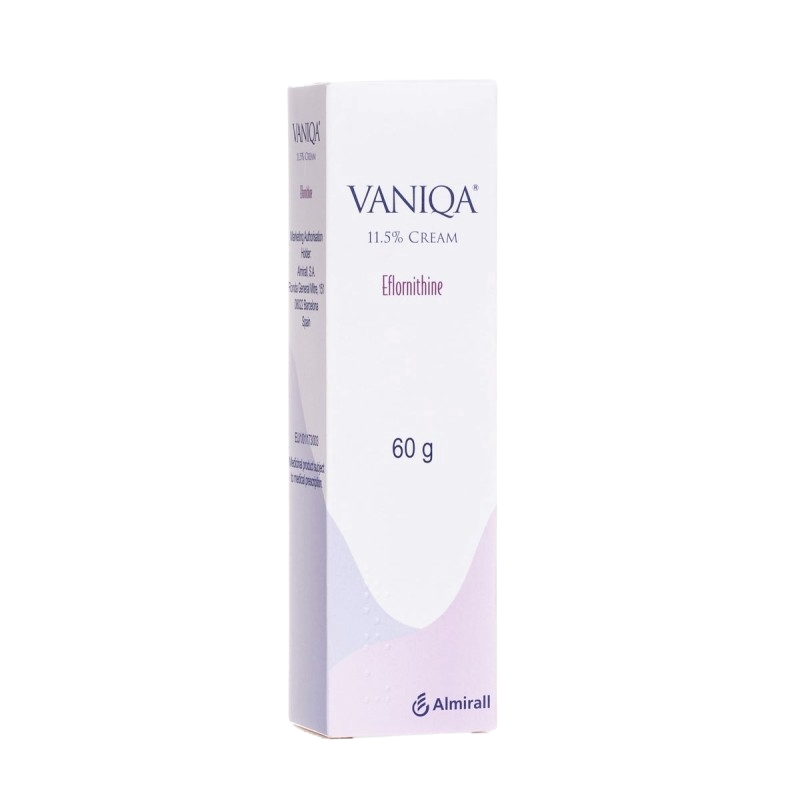
Vaniqa
View Options
This website provides general information about medicines for educational purposes only. Always consult your doctor or pharmacist before taking any medication.
Choose Your Medicine
Select dosage and quantity
Online Consultation
Reviewed by a qualified physician
Fast, Discreet Delivery
Delivered to your door
Medical Information
About This Medicine
Vaniqa is a prescription cream containing eflornithine 11.5%, a topical treatment specifically developed to slow the growth of unwanted facial hair (hirsutism) in women. It is the only prescription medicine licensed in the UK for this indication. Vaniqa is not a hair removal product, it does not remove hair or act as a depilatory. Instead, it slows the rate at which new hair grows, reducing the frequency and quantity of hair removal required and improving the cosmetic result between removal sessions.
How Vaniqa Works
Eflornithine acts by irreversibly inhibiting ornithine decarboxylase (ODC), an enzyme that plays a critical role in cell proliferation within the hair follicle. ODC is required for the synthesis of polyamines, which are necessary for rapid cell division during the active growth (anagen) phase of the hair cycle. By inhibiting ODC in follicular cells, eflornithine slows the rate of follicular cell division, which in turn reduces the speed at which the hair shaft grows. Hair does not disappear, it continues to grow, but more slowly and finely, and the time between hair removal sessions is extended.
Clinical Use and Expectations
Vaniqa is indicated for women experiencing facial hirsutism, which may arise from conditions such as polycystic ovary syndrome (PCOS), congenital adrenal hyperplasia, idiopathic hirsutism, or as a side effect of certain medicines or anabolic hormones. It is not a treatment for the underlying hormonal cause of hirsutism, hormonal causes should be addressed separately. Vaniqa is used alongside, not instead of, regular hair removal methods such as shaving, threading, waxing, or laser hair removal.
Most women notice a visible slowing of hair regrowth within four to eight weeks of consistent twice-daily application. In clinical trials, a meaningful proportion of women reported at least moderate improvement within 24 weeks. If no improvement is seen after six months of correct use, continuing treatment is unlikely to provide benefit.
Usage & Dosage
How to Apply Vaniqa
Apply a thin layer of Vaniqa (eflornithine) cream to the affected facial areas twice daily, at least eight hours apart, after completing your usual hair removal routine (shaving, threading, or other methods). Rub the cream in thoroughly until it is absorbed. Do not wash the treated area for at least four hours after application — washing it too soon removes the cream before it can act on the hair follicles.
Apply to clean, dry skin, avoiding the eyes and mucous membranes. Wash your hands after applying unless your hands are being treated.
What to Expect
Vaniqa slows the regrowth of unwanted facial hair but does not permanently remove it. Most women notice results after eight weeks of consistent use. The effect depends on continued use — hair regrowth returns to its previous rate within about eight weeks of stopping. Continue regular hair removal alongside the cream, as they work best in combination.
Standard dose: Apply a thin layer of Vaniqa cream twice daily to affected areas of the face and under the chin, at least eight hours apart.
Do not wash the treated area for at least four hours after each application.
Duration for assessment: A meaningful therapeutic assessment requires at least six months of consistent twice-daily application. If no improvement is seen after six months, Vaniqa is unlikely to be beneficial and should be discontinued.
Maintenance: Once improvement is achieved, twice-daily application should be continued to maintain the effect. If Vaniqa is stopped, hair regrowth typically returns to its pre-treatment rate within approximately eight weeks.
Quantity: A 60 g tube is the standard pack size for approximately two months of use when applied to standard facial areas.
Vaniqa is for external use only. It should not be swallowed. It is not indicated for use in men, or for hair removal from areas other than the face.
Side Effects
Common Side Effects
- Acne or folliculitis (inflamed hair follicles) at the application site, particularly in the first few weeks
- Stinging, burning, or tingling of the skin on application
- Redness (erythema) or skin rash at the treated area
- Dry skin, peeling, or flaking
- Pseudofolliculitis barbae (ingrown hairs)
Managing Side Effects
Mild irritation and folliculitis often improve as the skin adjusts. Apply a thin layer only — using too much increases local irritation without improving results. If irritation is significant, try reducing application to once daily temporarily. Seek medical advice if you develop a severe or spreading rash, as this may indicate an allergic reaction that requires stopping the cream.
Warnings & Precautions
Vaniqa is a well-tolerated topical treatment, but users should be aware of a number of important points.
Realistic Expectations and Continued Hair Removal
Vaniqa is not a permanent hair removal solution and is not a depilatory. Women who start treatment expecting hair to disappear will be disappointed. The cream slows hair growth, making existing hair removal methods more effective and less frequent. Hair removal must be continued alongside Vaniqa. If treatment is stopped for any reason, hair regrowth returns to baseline levels within six to eight weeks.
The response to Vaniqa varies considerably between individuals. Some women see a significant slowing of regrowth within four weeks; others require the full six-month assessment period. Treatment should not be abandoned prematurely.
Skin Irritation and Application Technique
Skin irritation, including stinging, redness, and acne-like breakouts, is common in the early weeks of treatment. In most women these effects settle with continued use. To minimise irritation: apply to completely dry skin after hair removal, use a thin layer only, and allow the cream to fully absorb before applying cosmetics or sunscreen. If the skin is broken, abraded (from recent waxing for example), or significantly inflamed, delay application until the skin recovers.
Vaniqa should not be applied to eyes, lips, nostrils, or any mucosal surface. It is for external facial use only. Avoid prolonged contact with clothing until the cream is fully absorbed. Women who are pregnant or breastfeeding should discuss use with their doctor before starting treatment, as there are no adequate data on fetal safety.
Contraindications
- Hypersensitivity to eflornithine or any excipient in the cream
- Application to broken, abraded, or significantly inflamed skin
- Application around eyes, nostrils, or mucous membranes
- Children under 12 years of age (insufficient data)
- Pregnancy and breastfeeding (insufficient safety data; avoid unless benefit clearly outweighs risk)
- Not indicated for use in men
- Not for use on areas of the body other than the face
Frequently Asked Questions
How long does it take for Vaniqa to work?
Do I still need to remove hair while using Vaniqa?
What happens if I stop using Vaniqa?
Can Vaniqa be used on body hair?
Is Vaniqa suitable if I have PCOS?
Dr. Ross Elledge
General Practitioner · General & Family Medicine
Verified Healthcare Professional
TopDoctors Profile