
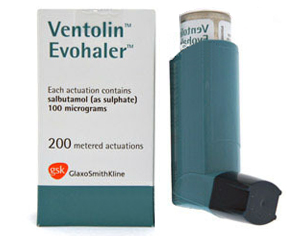
Ventolin
View Options
This website provides general information about medicines for educational purposes only. Always consult your doctor or pharmacist before taking any medication.
Choose Your Medicine
Select dosage and quantity
Online Consultation
Reviewed by a qualified physician
Fast, Discreet Delivery
Delivered to your door
Medical Information
About This Medicine
Ventolin is one of the most recognised medicines in the UK, a salbutamol pressurised metered-dose inhaler (pMDI) that delivers 100 micrograms of salbutamol per actuation. Commonly known as the blue reliever inhaler, Ventolin belongs to the short-acting beta-2 agonist (SABA) class of bronchodilators and is used to provide rapid relief of the breathlessness and wheeze caused by bronchoconstriction in asthma and chronic obstructive pulmonary disease (COPD).
How Ventolin Works
Salbutamol selectively stimulates beta-2 adrenoceptors in the smooth muscle of the airways. Activation of these receptors triggers a cascade that increases intracellular cyclic AMP, causing rapid relaxation of the bronchial smooth muscle. This dilation of the airways reduces airway resistance and improves airflow within minutes of inhalation. The onset of bronchodilation typically occurs within one to three minutes of inhaling salbutamol, with peak effect at around 15 minutes and a duration of action of three to five hours.
Role in Asthma Management
Ventolin is classified as a reliever inhaler, it is used to rapidly reverse symptoms of bronchoconstriction when they occur and to prevent exercise-induced bronchoconstriction when taken immediately before physical activity. It does not treat the underlying airway inflammation that causes asthma and should not be used as a sole controller therapy.
A key principle of modern asthma management is that frequent or escalating use of a Ventolin inhaler is a warning sign of poorly controlled asthma. Patients who are using their blue inhaler more than two days per week for symptom relief (excluding pre-exercise use) have suboptimally controlled asthma and require a review of their preventer therapy. Over-reliance on a SABA without appropriate preventer treatment is associated with an increased risk of severe asthma attacks and asthma-related mortality.
COPD Application
In COPD, Ventolin is used as an as-needed reliever alongside longer-acting bronchodilators. It provides useful short-term symptomatic relief during acute exacerbations and for day-to-day management of variable breathlessness.
Usage & Dosage
How to Use Your Ventolin Inhaler
Good inhaler technique makes all the difference. Poor technique is one of the most common reasons asthma is not well controlled. Shake the Ventolin inhaler well before each use. Remove the mouthpiece cap, breathe out gently to empty your lungs (but without forcing), place the mouthpiece in your mouth and form a tight seal with your lips. Begin breathing in slowly and steadily, and press the canister down once at the start of your breath. Continue inhaling slowly and deeply, then hold your breath for up to 10 seconds. Breathe out slowly.
If a second puff is needed, wait 30 seconds before repeating.
When to Use It
Ventolin is a short-acting reliever inhaler used to quickly open the airways during symptoms of breathlessness, wheezing, or coughing. Use it when you need it. If you are using Ventolin more than three times a week for symptom relief, speak to your doctor — this suggests your asthma is not well controlled and a preventer inhaler may be needed or adjusted.
Adult and children aged 4 years and over:
Acute relief: 1-2 puffs (100-200 mcg) as needed. If 2 puffs are required to relieve symptoms, allow 1 minute between puffs. Use the lowest dose needed to control symptoms.
Maximum as-needed frequency: No more than 4 times in 24 hours for routine use. Needing to use more than this is a sign of worsening asthma and requires medical review.
Prevention of exercise-induced bronchoconstriction: 1-2 puffs 15-20 minutes before exercise.
Severe acute asthma (emergency use with spacer): 2-10 puffs via spacer every 20 minutes, administered while awaiting emergency medical services. This is an emergency dose and should not substitute for calling 999.
Children under 4 years: Only under specialist guidance with a spacer and face mask.
COPD: 1-2 puffs up to 4 times daily as needed.
Ventolin inhalers contain 200 actuations. Patients should keep a spare inhaler in case of emergency.
Side Effects
Common Side Effects
- Tremor, particularly of the hands (a dose-related effect of beta-2 stimulation)
- Headache
- Palpitations or a fast heartbeat, usually mild and short-lived
- Feeling restless, nervous, or agitated
- Muscle cramps, especially in the legs
- Dry mouth or throat irritation
When to Seek Urgent Help
Side effects are usually mild and settle quickly. If your breathing does not improve after using Ventolin, or if you need it much more frequently than usual, this may indicate a worsening of your asthma that requires urgent medical review. Do not simply use more puffs without seeking advice. In a severe attack, use your inhaler and call emergency services if there is no rapid improvement.
Warnings & Precautions
Ventolin is generally safe and well tolerated, but several important principles must guide its use.
Over-Reliance and Asthma Control
Frequent use of Ventolin is a warning sign, not a solution. Current asthma guidelines (GINA and NICE) emphasise that needing to use a reliever inhaler more than twice per week indicates that asthma is not adequately controlled by current preventive treatment. Every patient with asthma should be prescribed a preventer inhaler (typically an inhaled corticosteroid) if they need their reliever more than occasionally, and should have their preventer therapy reviewed if their reliever use is escalating. Patients who carry only a Ventolin inhaler without a preventer are at substantially increased risk of a severe or fatal asthma attack.
The MHRA and clinical guidelines also highlight that patients who have been prescribed a MART (Maintenance and Reliever Therapy) regimen using a combined ICS/LABA inhaler such as budesonide/formoterol should not use Ventolin alongside it, as the reliever component is already built into their MART inhaler.
Drug Interactions and Special Populations
Beta-blockers (including topical eye drops used for glaucoma) can antagonise the bronchodilator effect of salbutamol and may precipitate severe bronchoconstriction. Non-selective beta-blockers such as propranolol are contraindicated in asthma. Selective beta-1 blockers should be used with caution. Salbutamol use in pregnancy is generally considered safe for acute relief, and it is not associated with significant teratogenicity. However, high-dose or prolonged use in late pregnancy may affect fetal heart rate and should be managed with caution. Ventolin is compatible with breastfeeding.
Contraindications
- Hypersensitivity to salbutamol or any excipient (including lactose -- patients with severe milk protein allergy should be aware)
- Non-selective beta-blockers (e.g., propranolol, nadolol) should not be used concurrently in patients with asthma
- Threatened abortion or risk of miscarriage (high-dose salbutamol may have uterine relaxant effects)
- Concurrent use of other sympathomimetic agents without careful monitoring
- Patients being managed with a MART regimen (the MART inhaler already contains the reliever component)
- Pre-term labour management (this requires parenteral salbutamol under specialist obstetric supervision, not a pMDI)
Frequently Asked Questions
How often should I be using my Ventolin inhaler?
Should I use a spacer with my Ventolin inhaler?
Can I use Ventolin every day?
What should I do if my Ventolin is not helping my breathing?
Is it safe to use Ventolin in pregnancy?
Dr. Ross Elledge
General Practitioner · General & Family Medicine
Verified Healthcare Professional
TopDoctors Profile