
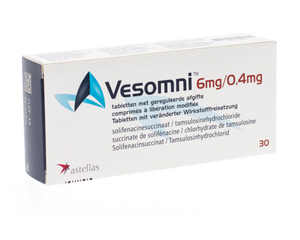
Vesomni
View Options
This website provides general information about medicines for educational purposes only. Always consult your doctor or pharmacist before taking any medication.
Choose Your Medicine
Select dosage and quantity
Online Consultation
Reviewed by a qualified physician
Fast, Discreet Delivery
Delivered to your door
Medical Information
About This Medicine
Vesomni is a combination prescription medicine containing two active ingredients: solifenacin 6mg (an antimuscarinic) and tamsulosin hydrochloride 0.4mg (an alpha-1 adrenoceptor blocker), in a modified-release formulation. It is indicated for the treatment of moderate to severe lower urinary tract symptoms (LUTS) in adult men who do not respond adequately to treatment with either drug alone. LUTS in men is most commonly caused by benign prostatic hyperplasia (BPH), an age-related non-cancerous enlargement of the prostate gland.
Storage and Voiding Symptoms of LUTS
Lower urinary tract symptoms in men are broadly divided into two categories. Storage symptoms include urgency (a sudden compelling urge to urinate), frequency (passing urine more than eight times a day), nocturia (waking from sleep to urinate), and urge incontinence. Voiding symptoms arise from the mechanical obstruction caused by an enlarged prostate and include hesitancy, a weak or intermittent urinary stream, straining to void, and a feeling of incomplete bladder emptying. Many men experience a mixture of both types of symptom, and Vesomni addresses both simultaneously with its dual-mechanism formulation.
How the Two Active Ingredients Complement Each Other
Tamsulosin relaxes the smooth muscle in the prostate and the bladder neck, reducing the mechanical obstruction to urine flow and improving voiding symptoms. Solifenacin acts on the bladder wall, reducing involuntary detrusor muscle contractions and thereby improving storage symptoms such as urgency and frequency. By combining these two mechanisms in a single once-daily tablet, Vesomni provides comprehensive symptomatic relief across the full spectrum of LUTS. The modified-release formulation ensures a gradual and sustained delivery of both active ingredients, which improves tolerability and maintains consistent drug levels throughout the day.
Clinical Evidence
Clinical studies have demonstrated that Vesomni is significantly more effective than either solifenacin or tamsulosin used alone for men with combined storage and voiding symptoms. In trials, the combination reduced urgency episodes, improved maximum urinary flow rate, and produced greater improvements in quality of life scores compared with monotherapy. Treatment response is typically assessed after four weeks, with further dose titration possible if required.
Usage & Dosage
Vesomni tablets must be swallowed whole and must not be chewed, divided, or crushed, as this would destroy the modified-release mechanism and result in an excessive initial dose. Each tablet should be taken once daily, with or after breakfast.
Why Vesomni Should Be Taken with Breakfast
Taking Vesomni after a meal, particularly breakfast, is important for two reasons. First, food increases the bioavailability of tamsulosin in this formulation, ensuring optimal drug absorption. Second, taking the tablet with food reduces the risk of the postural hypotension (a sudden drop in blood pressure upon standing) that can occur with alpha-blockers. It is advisable to avoid operating heavy machinery or driving shortly after the first few doses until you know how the medicine affects you.
Monitoring and Treatment Duration
Your doctor will review your response to Vesomni after approximately four weeks of treatment. If symptoms have improved but remain troublesome, and if the medication has been well tolerated, the treatment can be continued. Regular monitoring of prostate-specific antigen (PSA) levels and assessment of post-void residual urine volume may be recommended during the course of treatment to ensure bladder emptying is not being compromised. Vesomni is intended for long-term management but its continued use should be reviewed at regular intervals, typically every six to twelve months.
One tablet (solifenacin 6mg / tamsulosin 0.4mg MR) taken once daily, with or immediately after breakfast. Tablets must be swallowed whole and must not be broken, chewed, or crushed.
Vesomni should not be used in patients with severe renal impairment (creatinine clearance below 30 mL/min) or any degree of hepatic impairment. No dose adjustment is required in patients with mild to moderate renal impairment, but close monitoring is recommended. Vesomni is contraindicated in women and children. The maximum dose is one tablet daily; do not exceed this dose without specific medical advice.
Side Effects
Common Side Effects
- Dry mouth
- Constipation
- Dizziness or light-headedness (postural hypotension)
- Headache
- Blurred vision
- Nausea
- Urinary tract infection
- Retrograde ejaculation (ejaculation into the bladder)
Serious Side Effects
- Urinary retention: inability to pass urine - requires urgent medical assessment
- Angioedema (rapid swelling of the face, lips, or throat): seek emergency care immediately
- Severe hypotension (marked drop in blood pressure) particularly after the first dose
- Severe skin reactions (Stevens-Johnson syndrome): stop treatment and seek emergency care
- Intraoperative floppy iris syndrome (if eye surgery is planned, inform your ophthalmologist)
Warnings & Precautions
Vesomni has several important safety considerations that should be discussed with your prescriber before starting treatment.
Cardiovascular Considerations
Tamsulosin, the alpha-blocker component of Vesomni, can cause a drop in blood pressure, particularly upon standing from a sitting or lying position (postural hypotension). This risk is highest after the first dose and may be exacerbated if Vesomni is taken with other antihypertensive medicines, phosphodiesterase-5 (PDE5) inhibitors such as sildenafil, or alcohol. Patients should be warned to rise slowly from sitting or lying positions and to seek medical advice if they experience fainting or severe dizziness. Vesomni should not be used together with other alpha-blockers.
Intraoperative Floppy Iris Syndrome
Alpha-1 blockers, including tamsulosin, have been associated with a complication during cataract surgery called intraoperative floppy iris syndrome (IFIS), in which the iris behaves abnormally during the procedure, increasing the risk of surgical complications. It is essential to inform your ophthalmologist that you are taking or have ever taken Vesomni or any alpha-blocker before undergoing any eye surgery. If eye surgery is planned, discuss with your prescriber whether Vesomni should be temporarily discontinued prior to the procedure. Patients should not start Vesomni if eye surgery is imminent.
Contraindications
- Known hypersensitivity to solifenacin, tamsulosin, or any excipient (including soya or peanut allergy, as the capsules contain soya lecithin)
- Urinary retention (current or history of)
- Severe gastrointestinal conditions (toxic megacolon, etc.)
- Narrow-angle glaucoma not adequately controlled
- Myasthenia gravis
- Severe hepatic impairment (any degree)
- Severe renal impairment (CrCl below 30 mL/min)
- Orthostatic hypotension (history of)
- Concurrent use with potent CYP3A4 inhibitors (e.g. ketoconazole)
- Women and children
Frequently Asked Questions
Why does Vesomni need to be taken after breakfast?
Can I take Vesomni with Viagra or other erectile dysfunction medicines?
How is Vesomni different from taking solifenacin and tamsulosin separately?
What happens if I miss a dose of Vesomni?
Can Vesomni cause problems if I need eye surgery?
Dr. Ross Elledge
General Practitioner · General & Family Medicine
Verified Healthcare Professional
TopDoctors Profile