
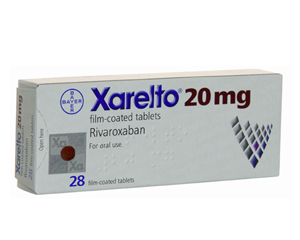
Xarelto
View Options
This website provides general information about medicines for educational purposes only. Always consult your doctor or pharmacist before taking any medication.
Choose Your Medicine
Select dosage and quantity
Online Consultation
Reviewed by a qualified physician
Fast, Discreet Delivery
Delivered to your door
Medical Information
About This Medicine
Xarelto is a prescription anticoagulant (blood-thinning medicine) containing rivaroxaban, used to prevent and treat serious clotting conditions. It belongs to the class of direct oral anticoagulants (DOACs), also referred to as novel oral anticoagulants (NOACs), and works by directly and selectively inhibiting Factor Xa, a key enzyme in the coagulation cascade responsible for generating thrombin and subsequent clot formation. Xarelto is manufactured by Bayer and is available in multiple strengths (2.5mg, 10mg, 15mg, and 20mg) for use across a wide range of indications.
Licensed Indications
Xarelto is licensed in the UK for a broad range of indications. It is used for the prevention of stroke and systemic embolism in patients with non-valvular atrial fibrillation (AF), the treatment and secondary prevention of deep vein thrombosis (DVT) and pulmonary embolism (PE), the prevention of venous thromboembolism (VTE) following elective hip or knee replacement surgery, and the prevention of atherothrombotic events in patients with acute coronary syndrome (ACS), where it is used at a low dose of 2.5mg twice daily alongside antiplatelet therapy. In children and adolescents, Xarelto is also licensed for the treatment and prevention of recurrent VTE.
Advantages Over Warfarin
Unlike warfarin, which has been the mainstay of anticoagulation for decades, Xarelto does not require routine INR monitoring, has fewer food and drug interactions, and has a predictable pharmacokinetic profile. This makes it considerably more convenient for patients and allows for flexible, fixed dosing without frequent blood tests. The major limitation of warfarin - the need to manage fluctuating INR levels and regular monitoring clinic visits - is eliminated with rivaroxaban. However, Xarelto has a shorter half-life than warfarin, meaning that missed doses may result in a more rapid loss of anticoagulant effect.
Reversal Agent
In the event of serious bleeding or emergency surgery requiring rapid reversal of anticoagulation, the specific reversal agent for rivaroxaban is andexanet alfa (brand name Ondexa). This provides an important safety advantage over older anticoagulants, where reversal options were less targeted. Idarucizumab is the reversal agent for dabigatran (another DOAC) and is not effective for rivaroxaban.
Usage & Dosage
Xarelto should be taken exactly as prescribed, with the dose and timing depending on the specific indication for which it has been prescribed. The correct dose and frequency must be confirmed with the prescribing doctor before starting treatment.
Dosing by Indication and the Importance of Taking with Food
For atrial fibrillation and treatment of DVT/PE (after initial treatment): 20mg once daily with the evening meal. For initial DVT/PE treatment: 15mg twice daily with food for the first three weeks, then 20mg once daily with the evening meal. For VTE prevention after hip or knee surgery: 10mg once daily, with or without food. For secondary prevention of ACS (with antiplatelet therapy): 2.5mg twice daily, with or without food. Taking the higher doses (15mg and 20mg) with the largest meal of the day is clinically important, as food significantly increases bioavailability and ensures adequate drug absorption.
Adherence and Missed Doses
Consistency in taking Xarelto as directed is essential for maintaining therapeutic anticoagulation. If a dose is missed, take it as soon as you remember on the same day; do not take a double dose the following day to compensate. Carry a patient alert card at all times explaining that you are taking an anticoagulant, as this is important information in the event of any medical emergency, accident, or surgical procedure.
Dosing depends on indication:
- AF stroke prevention: 20mg once daily with evening meal
- DVT/PE treatment (acute): 15mg twice daily with food for 21 days, then 20mg once daily with food
- DVT/PE extended prevention: 10mg once daily (after at least 6 months of treatment)
- Post-hip replacement: 10mg daily for 35 days; post-knee replacement: 10mg daily for 14 days
- ACS (with aspirin and/or clopidogrel): 2.5mg twice daily
Dose reduction to 15mg once daily for AF in patients with moderate renal impairment (CrCl 15-49 mL/min) on concurrent P-glycoprotein and moderate CYP3A4 inhibitors. Xarelto should be used with caution in patients with CrCl 15-29 mL/min and is contraindicated when CrCl is below 15 mL/min.
Side Effects
Common Side Effects
- Bleeding (bruising, nosebleeds, prolonged wound bleeding)
- Anaemia (resulting from bleeding)
- Nausea
- Abdominal pain
- Dizziness
- Headache
- Skin rash or itching
- Elevated liver enzymes (transaminases)
Serious Side Effects
- Major bleeding (intracranial, gastrointestinal, retroperitoneal, or intraocular haemorrhage): seek emergency care immediately
- Severe allergic reaction or angioedema: call 999
- Haemoptysis (coughing up blood)
- Haemarthrosis (bleeding into joints)
- Spinal or epidural haematoma (in patients receiving neuraxial anaesthesia or spinal puncture): can cause permanent paralysis
Warnings & Precautions
Xarelto is associated with a risk of serious and potentially life-threatening bleeding, which is the most important adverse effect of all anticoagulant medicines.
Bleeding Risk and Drug Interactions
The risk of bleeding is increased when Xarelto is combined with other medicines that affect haemostasis, including aspirin, NSAIDs (such as ibuprofen and naproxen), other antiplatelet agents, other anticoagulants, and selective serotonin reuptake inhibitors (SSRIs). Patients must not take Xarelto concurrently with strong combined inhibitors of CYP3A4 and P-glycoprotein, such as azole antifungals (ketoconazole, itraconazole) and HIV protease inhibitors (ritonavir), as these significantly increase rivaroxaban plasma concentrations and bleeding risk. Strong inducers of these pathways (such as rifampicin, phenytoin, and St John's Wort) conversely reduce rivaroxaban levels and may render anticoagulation inadequate.
Surgical and Invasive Procedures
Xarelto should be temporarily discontinued before any planned surgery or invasive procedure. For patients with low bleeding risk undergoing non-major surgery, Xarelto should be stopped at least 24 hours before the procedure. For major surgery or high bleeding risk procedures, at least 48 hours should elapse. The timing should be confirmed with both the prescribing doctor and the operating surgical team. Spinal and epidural anaesthesia carries a particular risk of haematoma formation in patients taking DOACs; specific timing guidelines for catheter insertion and removal must be adhered to strictly.
Contraindications
- Clinically significant active bleeding
- Lesions or conditions at significant risk of major bleeding (e.g. active gastrointestinal ulcer, recent intracranial haemorrhage, recent brain, spinal, or ophthalmic surgery)
- Known hypersensitivity to rivaroxaban or any excipient
- Hepatic disease associated with coagulopathy and clinically relevant bleeding risk, including cirrhotic patients with Child-Pugh B and C
- Renal impairment with CrCl below 15 mL/min
- Concurrent use of strong combined CYP3A4 and P-gp inhibitors (e.g. ketoconazole, ritonavir)
- Pregnancy and breastfeeding (potential foetal risk)
- Prosthetic heart valves requiring anticoagulation
- Antiphospholipid syndrome (particularly triple-positive)
Frequently Asked Questions
Why must I take Xarelto 20mg with food?
Do I need regular blood tests while taking Xarelto?
What should I do if I miss a dose of Xarelto?
Is Xarelto safe to take long term?
Can I take ibuprofen or aspirin with Xarelto?
Dr. Ross Elledge
General Practitioner · General & Family Medicine
Verified Healthcare Professional
TopDoctors Profile