
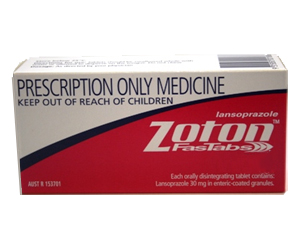
Zoton FasTab
View Options
This website provides general information about medicines for educational purposes only. Always consult your doctor or pharmacist before taking any medication.
Choose Your Medicine
Select dosage and quantity
Online Consultation
Reviewed by a qualified physician
Fast, Discreet Delivery
Delivered to your door
Medical Information
About This Medicine
Zoton FasTab is an orodispersible tablet formulation of lansoprazole, a proton pump inhibitor (PPI). It is available in two strengths: 15mg and 30mg. Unlike standard lansoprazole capsules, Zoton FasTab disintegrates rapidly on the tongue to form a flavoured suspension that can be swallowed with saliva, or it can be dispersed in a small amount of water and administered via a nasogastric (NG) tube or PEG tube. This makes it particularly useful for patients who have difficulty swallowing tablets or capsules, and for those requiring enteral tube administration.
How Lansoprazole Works
Lansoprazole is a substituted benzimidazole that irreversibly inhibits the hydrogen-potassium ATPase enzyme (the proton pump) on the surface of gastric parietal cells. This enzyme is responsible for the final step of acid secretion into the stomach. By blocking the proton pump, lansoprazole dramatically reduces gastric acid production, regardless of the stimulus, whether it is histamine, acetylcholine, or gastrin-mediated.
The reduction in gastric acidity allows the oesophageal mucosa, gastric lining, or duodenal tissue to heal when damaged by acid, and significantly reduces symptoms of acid reflux, heartburn, and dyspepsia.
Clinical Applications
Zoton FasTab is indicated for the treatment of gastro-oesophageal reflux disease (GORD), duodenal and gastric ulcers, erosive oesophagitis, and Zollinger-Ellison syndrome. It is also used as part of Helicobacter pylori eradication regimens in combination with appropriate antibiotics, and prophylactically in patients at risk of NSAID-induced ulcers.
The FasTab formulation offers all the same indications as standard lansoprazole capsules, with the additional advantage of flexible administration for patients with dysphagia, NG tubes, or paediatric use where swallowing solid capsules is not possible.
Usage & Dosage
Zoton FasTab tablets can be administered in two ways: placed directly on the tongue and allowed to disperse in saliva, or dispersed in approximately 10mL of water and swallowed or administered via nasogastric or PEG tube.
Direct Oral Administration
Place one Zoton FasTab tablet on the tongue and allow it to disperse. The tablet has a strawberry flavour. Once dispersed, swallow with saliva. The tablet should not be chewed or swallowed whole, as this defeats the purpose of the orodispersible formulation.
Nasogastric or Tube Administration
Disperse one Zoton FasTab tablet in approximately 10mL of water. Stir gently until dispersed (approximately 2-3 minutes). Draw up the suspension and administer via the tube, then flush with an additional 10mL of water. Do not use other liquids such as fruit juice, as they may damage the enteric granules.
Timing
Zoton FasTab should ideally be taken 30 minutes before a meal for optimal acid suppression. PPIs achieve their greatest effect when the proton pumps are active in the pre-meal period. Consistent daily timing is important for sustained symptom control.
Zoton FasTab is available as 15mg and 30mg orodispersible tablets.
GORD: 15-30mg once daily for 4-8 weeks; maintenance 15mg once daily.
Erosive oesophagitis: 30mg once daily for 4 weeks (may extend to 8 weeks).
Duodenal ulcer: 30mg once daily for 4 weeks.
Gastric ulcer: 30mg once daily for 4-8 weeks.
NSAID-induced ulcer prophylaxis: 15-30mg once daily.
H. pylori eradication: 30mg twice daily for 7 days with two antibiotics.
Zollinger-Ellison syndrome: starting dose 60mg once daily, adjusted according to acid output.
In severe hepatic impairment, the maximum dose is 30mg daily. No dose adjustment is required for renal impairment or age. Zoton FasTab contains aspartame -- use with caution in patients with phenylketonuria.
Side Effects
Common Side Effects
- Headache
- Diarrhoea or loose stools
- Nausea or abdominal discomfort
- Constipation
- Dizziness
- Dry mouth
- Skin rash or pruritus
Serious Side Effects
- Clostridium difficile-associated diarrhoea: prolonged PPI use increases susceptibility, seek medical review for persistent or severe diarrhoea
- Hypomagnesaemia: low magnesium after prolonged use, can cause muscle cramps, fatigue, and arrhythmia; magnesium monitoring recommended in long-term users
- Bone fractures: long-term high-dose PPI use associated with increased risk of hip, wrist, and spine fractures
- Interstitial nephritis (rare): unexplained renal impairment
- Severe skin reactions: Stevens-Johnson syndrome (very rare)
Warnings & Precautions
Zoton FasTab should not be used long-term without periodic clinical review. Proton pump inhibitors are among the most widely prescribed medicines in the UK, and there is a well-documented risk of inappropriate long-term use without reassessment. PPIs should be prescribed at the lowest effective dose for the shortest necessary duration.
Masking of Symptoms
PPIs can mask symptoms of gastric cancer. Before initiating Zoton FasTab in patients over 55 with new or persistent upper gastrointestinal symptoms, the possibility of gastric malignancy should be considered and investigated as appropriate (e.g. via endoscopy).
Long-Term Use Risks
Prolonged PPI use has been associated with hypomagnesaemia, vitamin B12 deficiency, increased susceptibility to Clostridium difficile infection, and a modestly increased risk of community-acquired pneumonia. Patients on long-term therapy should have periodic review of their indication, and magnesium and B12 levels should be monitored. The risk of hip fracture is slightly elevated with long-term high-dose use. Zoton FasTab contains aspartame, which releases phenylalanine upon metabolism -- caution in patients with phenylketonuria.
Contraindications
- Known hypersensitivity to lansoprazole, any other PPI, or any excipient
- Concomitant use with nelfinavir (HIV protease inhibitor)
- Phenylketonuria (Zoton FasTab contains aspartame)
- Atazanavir-based HIV regimens (unless unavoidable and with specialist supervision)
- Severe hepatic impairment at doses above 30mg daily
Frequently Asked Questions
Why is Zoton FasTab prescribed instead of standard lansoprazole capsules?
How should I take Zoton FasTab if I have a nasogastric tube?
Can I take Zoton FasTab with food?
How long does it take for Zoton FasTab to work?
Is it safe to take lansoprazole long-term?
Dr. Ross Elledge
General Practitioner · General & Family Medicine
Verified Healthcare Professional
TopDoctors Profile