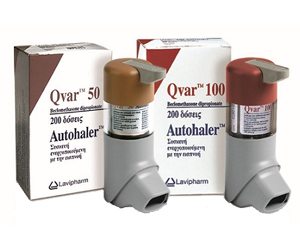
QVAR
Incl. online consultation, medicine and discreet delivery
View Options
The medical information on this site is provided for educational purposes. It does not replace a face-to-face consultation with your GP or specialist. Always follow the advice of your prescribing doctor and read the patient information leaflet supplied with your medication.
Choose Your Medicine
Select dosage and quantity
Online Consultation
Reviewed by a qualified physician
Fast, Discreet Delivery
Delivered to your door
Medical Information
About This Medicine
Qvar is an inhaler that contains beclometasone dipropionate in an extra-fine particle formulation. It comes as a breath-actuated or a pressurised metered-dose inhaler.
Doctors prescribe it as a preventer treatment for asthma in adults and children. It calms swelling in the airways. It works at lower nominal doses than older beclometasone inhalers.
The extra-fine formulation in Qvar makes smaller aerosol particles, about 1 micron across. Standard beclometasone inhalers make larger particles.
These finer particles travel deeper into the small airways. More of the medicine reaches the lungs, so it calms swelling better where it is needed.
This is why Qvar usually needs about half the microgram dose of older beclometasone inhalers to control asthma just as well.
Beclometasone dipropionate is a prodrug. This means the body changes it into its active form, beclometasone-17-monopropionate, inside the lungs.
This active form lowers the chemicals that cause swelling. It also reduces swelling of the lining and cuts back on too much mucus.
As a result, it helps stop the airways from tightening and improves airflow.
Like all inhaled corticosteroid preventers, Qvar only works if you use it every single day. This keeps you protected. It is not a rescue inhaler. Do not use it to treat a sudden asthma attack.
Usage & Dosage
Inhale Qvar twice daily, spaced evenly apart, exactly as your doctor tells you. If you use the breath-actuated Easi-Breathe device, open the cap and breathe in steadily through the mouthpiece.
The dose then releases on its own. If you use the standard press-and-breathe inhaler, press the canister at the same time as you breathe in slowly and deeply.
After each dose, rinse your mouth with water and spit it out. This lowers your risk of oral thrush, a fungal infection in the mouth.
Do not stop using Qvar without asking your prescriber first, even when your asthma feels well controlled. If you miss a dose, take it as soon as you remember. Then go back to your normal schedule.
The recommended adult dose of Qvar is 100 to 400 micrograms a day, split into two doses.
Thanks to the extra-fine formulation, 100 micrograms of Qvar works about as well as 200 micrograms of a standard beclometasone inhaler.
Children aged 5 to 12 years usually take 50 to 100 micrograms twice daily. Your doctor will aim for the lowest dose that still keeps symptoms under control.
The dose is usually reviewed every three months.
Side Effects
Oral candidiasis (thrush, a fungal infection in the mouth) and a hoarse voice affect about 5 to 10 per cent of users. You can mostly prevent both by rinsing your mouth and using a spacer.
A spacer is a tube that fits onto the inhaler. A sore throat and a cough when you inhale are also common.
Clinical trials have noted headache, mild nausea, and a changed sense of taste. You may also bruise a little more easily if you use Qvar for a long time.
High doses taken over a long time can cause effects in the rest of the body.
These include adrenal suppression (when the adrenal glands make less of their own steroid), thinning bones (osteoporosis), slowed growth in children, and cataracts (clouding of the eye lens).
These are uncommon at standard preventer doses.
Very rarely, the inhaler can tighten the airways instead of opening them. This is called paradoxical bronchospasm.
If your breathing gets worse right after you inhale, stop using the inhaler, use your reliever, and get medical advice.
Warnings & Precautions
Qvar does not take the place of a short-acting bronchodilator for sudden symptom relief.
If you find yourself reaching for your reliever inhaler more often than usual, your asthma may be getting worse. See your doctor for a review.
If you are moving from oral corticosteroids (steroid tablets) to Qvar, your tablet dose must be lowered slowly.
Stopping steroid tablets suddenly can trigger an adrenal crisis, a serious drop in steroid hormones.
Qvar sends more of the medicine to the lungs than older inhalers. So if you switch from a standard beclometasone product, your prescriber needs to work out your new dose.
This avoids taking too much by accident.
Contraindications
Do not use Qvar if you are allergic to beclometasone dipropionate or any of the other ingredients.
It is not the right treatment on its own for sudden airway tightening (acute bronchospasm) or for a severe, lasting asthma attack (status asthmaticus).
If you have active or dormant tuberculosis in the lungs, see your doctor before starting an inhaled corticosteroid.
Any untreated fungal, bacterial, or viral infection in the body should also be treated first.