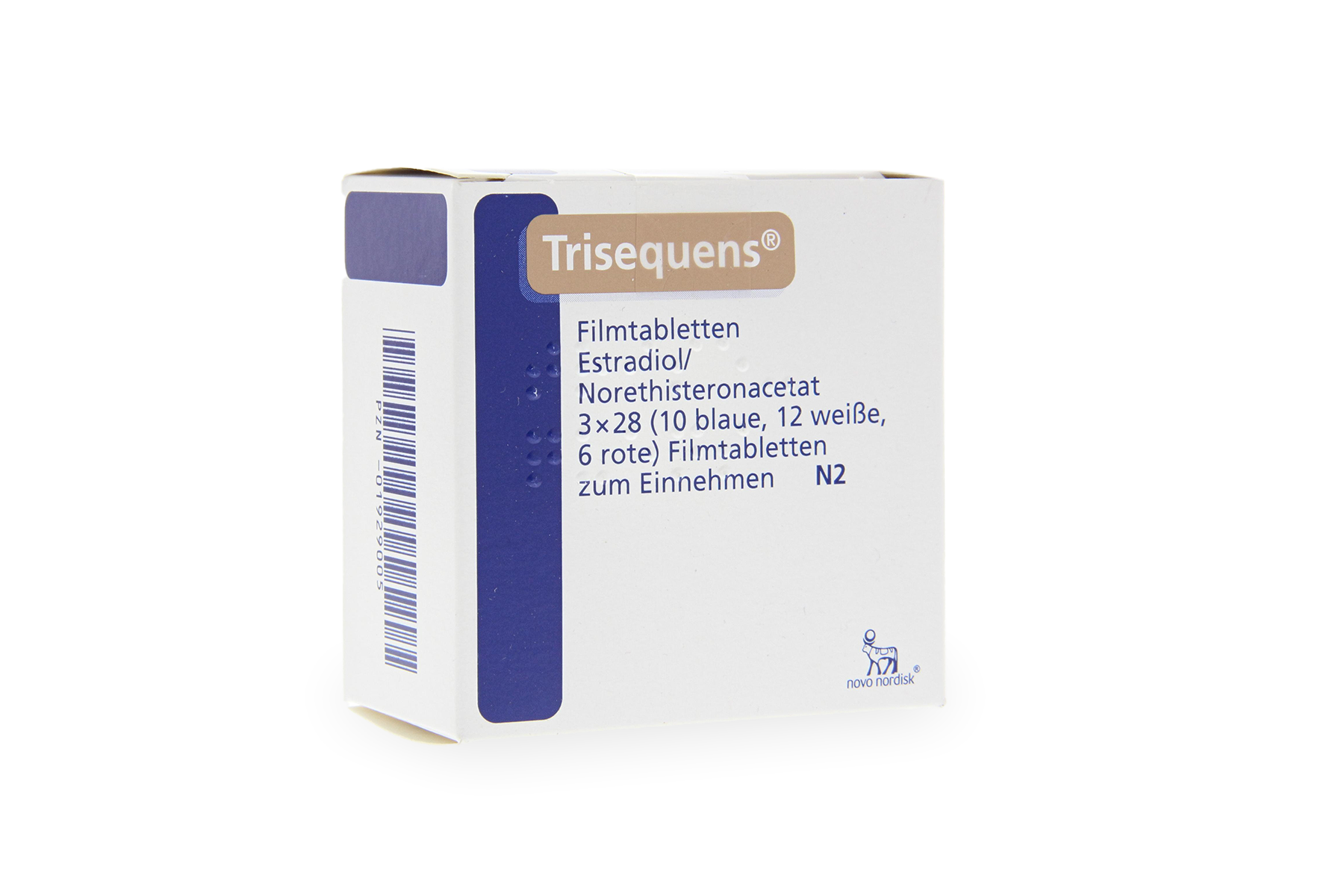
Trisequens
Incl. online consultation, medicine and discreet delivery
View Options
The medical information on this site is provided for educational purposes. It does not replace a face-to-face consultation with your GP or specialist. Always follow the advice of your prescribing doctor and read the patient information leaflet supplied with your medication.
Choose Your Medicine
Select dosage and quantity
Online Consultation
Reviewed by a qualified physician
Fast, Discreet Delivery
Delivered to your door
Medical Information
About This Medicine
Trisequens is a sequential combined hormone replacement therapy (HRT) that provides oestradiol and norethisterone acetate in a cyclical regimen.
It is prescribed for the relief of menopausal symptoms and for the prevention of postmenopausal osteoporosis in women with an intact uterus who are perimenopausal or in the early postmenopausal period.
The preparation follows a triphasic dosing schedule: 12 days of oestradiol alone, followed by 10 days of oestradiol combined with norethisterone acetate, and then 6 days of a lower dose of oestradiol.
This cyclical pattern mimics a more natural hormonal fluctuation and induces a predictable monthly withdrawal bleed during or shortly after the progestogen phase, which helps to protect the endometrium.
Trisequens is particularly suitable for perimenopausal women and those in the early postmenopausal years who may still experience some natural hormonal cyclicity.
The oestradiol component relieves vasomotor symptoms, urogenital atrophy, and other oestrogen-deficiency related complaints, while the progestogen phase prevents endometrial hyperplasia.
Usage & Dosage
Take one tablet daily by mouth at approximately the same time each day, following the sequence marked on the calendar pack.
Start with the blue tablets, then move to the white tablets, followed by the red tablets. Begin a new pack immediately after finishing the previous one without any break.
A withdrawal bleed typically occurs during or after the red tablet phase. If you miss a tablet, take it as soon as you remember on the same day, then continue as normal.
One tablet daily for 28 days, taken in the prescribed sequence: oestradiol 2 mg for 12 days, oestradiol 2 mg plus norethisterone acetate 1 mg for 10 days, then oestradiol 1 mg for 6 days.
Packs are taken consecutively. Treatment should use the lowest effective dose for the shortest necessary duration. Your doctor will review the need for continued treatment at least annually.
Side Effects
Common (1 in 10 to 1 in 100): breast tenderness, withdrawal bleeding, headache, nausea, abdominal bloating, weight fluctuation, mood changes.
Uncommon (1 in 100 to 1 in 1,000): migraine, depression, leg cramps, fluid retention, altered libido.
Rare (1 in 1,000 to 1 in 10,000): venous thromboembolism, gallbladder disease, changes in liver function tests. Very rare (less than 1 in 10,000): stroke, myocardial infarction, erythema multiforme.
Breast tenderness and bloating generally improve after the first two to three cycles.
Warnings & Precautions
All combined HRT carries a small increased risk of breast cancer, venous thromboembolism, stroke, and, in women starting HRT more than 10 years after menopause, coronary heart disease.
Attend routine breast cancer screening and cervical smears.
Treatment should be stopped if venous thromboembolism, thromboembolic disorders, jaundice, significant rise in blood pressure, or new-onset migraine occurs.
Inform your doctor before surgery, as HRT may need to be temporarily discontinued. The benefits and risks should be discussed at least annually.
Contraindications
Trisequens is contraindicated in women with known or suspected breast cancer, other oestrogen-dependent malignancies, undiagnosed vaginal bleeding, untreated endometrial hyperplasia, active or previous venous or arterial thromboembolism, active liver disease, porphyria, and known hypersensitivity to any component.
It should not be used in women who have undergone hysterectomy, as an oestrogen-only preparation would be more appropriate.