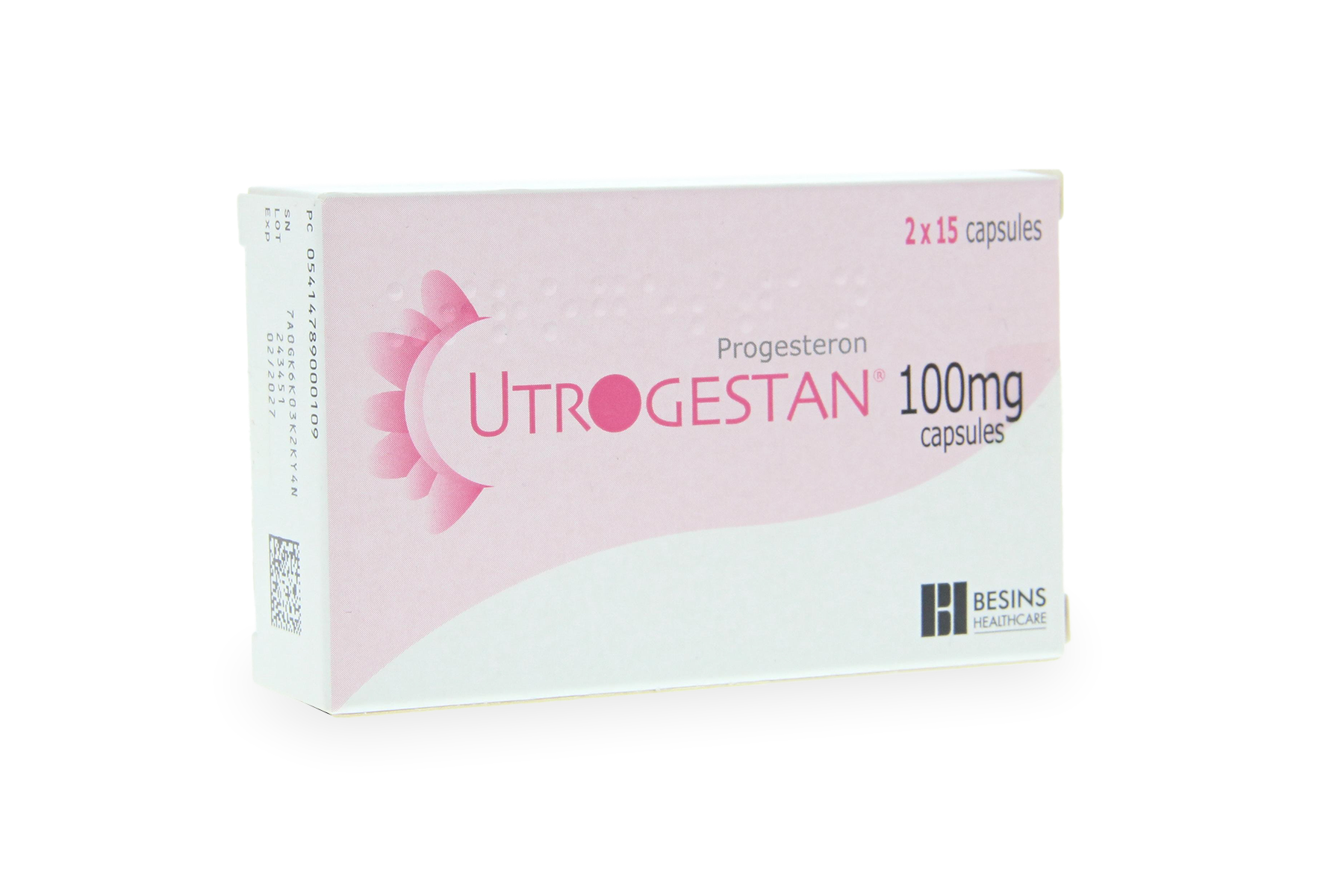
Utrogestan
Incl. online consultation, medicine and discreet delivery
View Options
The medical information on this site is provided for educational purposes. It does not replace a face-to-face consultation with your GP or specialist. Always follow the advice of your prescribing doctor and read the patient information leaflet supplied with your medication.
Choose Your Medicine
Select dosage and quantity
Online Consultation
Reviewed by a qualified physician
Fast, Discreet Delivery
Delivered to your door
Medical Information
About This Medicine
Utrogestan contains micronised natural progesterone. Its molecular structure is identical to the progesterone your body makes from the corpus luteum (the gland the ovary forms after releasing an egg).
It is licensed for hormone replacement therapy (HRT). In HRT, it acts as the progestogen part for women who still have a womb and who take oestrogen.
It is also licensed for luteal insufficiency (when the body makes too little progesterone after ovulation) in assisted reproductive technology (ART) cycles.
Many clinicians prefer micronised progesterone over synthetic progestogens.
Evidence points to a more favourable safety profile, especially for breast cancer risk and venous thromboembolism (blood clots in the veins).
The NICE menopause guideline (NG23) lists micronised progesterone as one option to protect the womb lining during HRT. You can take it by mouth or use it vaginally.
Vaginal use is off-label for HRT in the UK, but on-label for ART. When taken by mouth, the liver breaks down much of the dose on its first pass.
This produces the active metabolite allopregnanolone, which has a calming, sedative effect. Because of this, a bedtime dose works well.
Utrogestan is also used in some protocols to support the luteal phase in fertility treatment, and to manage certain causes of abnormal womb bleeding.
Usage & Dosage
For HRT (protecting the womb lining): Take 200 mg by mouth at bedtime on days 1-12 (or 1-14) of each 28-day oestrogen cycle. This is the sequential regimen.
As an alternative, take 100 mg daily without a break alongside continuous oestrogen. This is the continuous combined regimen. Swallow the capsules whole with water on an empty stomach.
Food can raise the amount your body absorbs in an unpredictable way. A bedtime dose limits drowsiness from the sedative metabolite allopregnanolone.
For ART (luteal phase support): Insert 200-400 mg vaginally each day. This usually starts on the day of embryo transfer or egg collection.
Continue for 10-12 weeks, or as your fertility specialist directs.
Do not chew or break the capsules. If you miss an oral dose, take it when you remember. Skip it if your next dose is almost due.
Sequential HRT: 200 mg by mouth at bedtime for 12-14 days per 28-day cycle.
Continuous combined HRT: 100 mg by mouth at bedtime each day.
Luteal phase support (ART): 200-400 mg vaginally each day, taken as one or two doses.
Split oral doses above 200 mg. For example, take 100 mg in the morning and 200 mg at bedtime. A single 200 mg bedtime dose is standard. In liver problems, the amount absorbed by mouth may change.
Vaginal use skips the liver's first-pass step, so it may be the better choice. You do not need to change the dose for kidney problems.
Side Effects
These side effects come from SmPC data and clinical experience.
Common (≥1/100 to <1/10): Drowsiness and sleepiness, mainly with oral dosing and caused by allopregnanolone.
Also headache, dizziness, abdominal bloating, nausea, breast tenderness, and a change in your bleeding pattern.
Uncommon (≥1/1,000 to <1/100): Depression, trouble sleeping, acne, itching, hives (urticaria), cholestatic jaundice (yellow skin from slowed bile flow), and a change in sex drive.
Rare (≥1/10,000 to <1/1,000): Chloasma (dark patches on the skin), anaphylaxis (a severe allergic reaction), and thromboembolism (a blood clot).
Observational data suggest this clot risk is lower with micronised progesterone than with synthetic progestogens.
Vaginal use can cause local irritation and discharge, but fewer whole-body effects such as drowsiness.
At bedtime, the calming effect of an oral dose is usually seen as a benefit rather than a problem.
Warnings & Precautions
Use Utrogestan as part of a combined HRT regimen if you still have a womb. Oestrogen taken on its own raises the risk of endometrial hyperplasia (a thickened womb lining) and cancer.
The MHRA advises that all HRT be prescribed at the lowest dose that works, for the shortest time needed, with regular review at least once a year.
Data from the E3N cohort study and the KEEPS trial suggest micronised progesterone may carry a lower breast cancer risk than synthetic progestogens.
Even so, no progestogen can be called completely safe. If you have porphyria (a rare disorder that affects how the body makes haem), use progesterone with caution.
Do not use it if you have vaginal bleeding with no known cause until a doctor finds the reason.
Contraindications
Do not use Utrogestan if you have known or suspected breast cancer, or any known or suspected cancer that depends on sex hormones.
Also do not use it if you have vaginal bleeding with no known cause, an active or recent arterial blood clot, or an active venous blood clot or a history of one (unless you take anticoagulants).
Avoid it if you have severe liver problems or active liver disease, or if you are allergic to progesterone or any ingredient.
The capsules contain soya lecithin and peanut oil, so they are not for anyone with a peanut or soya allergy. Do not use it if you have porphyria.