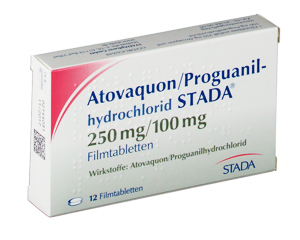
Atovaquone/Proguanil
Incl. online consultation, medicine and discreet delivery
View Options
The medical information on this site is provided for educational purposes. It does not replace a face-to-face consultation with your GP or specialist. Always follow the advice of your prescribing doctor and read the patient information leaflet supplied with your medication.
Choose Your Medicine
Select dosage and quantity
Online Consultation
Reviewed by a qualified physician
Fast, Discreet Delivery
Delivered to your door
Medical Information
About This Medicine
Malarone (atovaquone-proguanil) is a fixed-dose antimalarial combination used for the prevention and treatment of Plasmodium falciparum malaria.
It is one of the most widely recommended prophylactic agents for travellers to regions where chloroquine-resistant malaria is prevalent, and it is also effective for the treatment of uncomplicated falciparum malaria.
Atovaquone inhibits the mitochondrial electron transport chain of the malaria parasite by blocking the cytochrome bc1 complex, disrupting the parasite's energy metabolism.
Proguanil, through its active metabolite cycloguanil, inhibits dihydrofolate reductase, preventing DNA synthesis.
The combination is synergistic, and cross-resistance between the two mechanisms is uncommon, which supports its sustained efficacy against resistant strains.
Malarone has the practical advantage of a short lead-in time (starting one to two days before entering a malaria zone) and a short tail period (continuing for only seven days after leaving the area), compared with mefloquine or doxycycline.
This makes it convenient for short trips and improves adherence.
Usage & Dosage
For prophylaxis: take one tablet daily with food or a milky drink, starting one to two days before entering the malaria area, continuing daily while there, and for seven days after leaving.
Take at approximately the same time each day. If vomiting occurs within one hour of taking a dose, take a replacement dose.
For treatment: take four tablets as a single daily dose with food for three consecutive days. Food significantly improves atovaquone absorption and should not be omitted.
Prophylaxis (adults): one tablet (atovaquone 250 mg / proguanil 100 mg) daily. Start 1 to 2 days before travel, continue daily during exposure, and for 7 days after leaving the endemic area.
Treatment of uncomplicated P. falciparum malaria: four tablets as a single dose once daily for 3 days (total 12 tablets).
Paediatric doses are weight-based; junior strength tablets are available for children weighing 11 to 40 kg.
Side Effects
Common (1 in 10 to 1 in 100): headache, nausea, vomiting, abdominal pain, diarrhoea. Uncommon: mouth ulcers, dizziness, insomnia, abnormal dreams, cough, elevated liver enzymes, rash, pruritus.
Rare: Stevens-Johnson syndrome, hepatitis, pancytopenia, seizures.
Overall, Malarone is one of the best-tolerated antimalarials, with a side-effect profile in prophylactic studies that was comparable to placebo.
Neuropsychiatric side effects are notably less common than with mefloquine.
Warnings & Precautions
Malarone is not effective against Plasmodium vivax malaria (which requires additional treatment with primaquine for radical cure of hepatic stages).
Vomiting or severe diarrhoea may reduce absorption and compromise efficacy; consider alternative prophylaxis if persistent GI disturbance occurs.
Monitor in severe renal impairment (creatinine clearance below 30 mL/min), where prophylactic use is not recommended.
Concomitant use with metoclopramide, tetracycline, or rifampicin may reduce atovaquone levels. Travellers should also use personal protective measures against mosquito bites.
Contraindications
Contraindicated in known hypersensitivity to atovaquone, proguanil, or any excipient. Prophylactic use is not recommended in severe renal impairment (creatinine clearance below 30 mL/min).
Treatment use is possible in renal impairment but requires close monitoring.