Combodart
Incl. online consultation, medicine and discreet delivery
View Options
The medical information on this site is provided for educational purposes. It does not replace a face-to-face consultation with your GP or specialist. Always follow the advice of your prescribing doctor and read the patient information leaflet supplied with your medication.
Choose Your Medicine
Select dosage and quantity
Online Consultation
Reviewed by a qualified physician
Fast, Discreet Delivery
Delivered to your door
Medical Information
About This Medicine
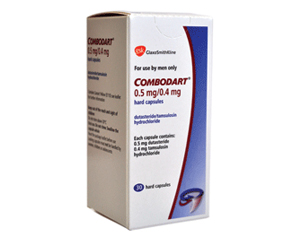
Combodart is a capsule that combines two medicines in one fixed dose: dutasteride and tamsulosin hydrochloride. Doctors prescribe it for men who have an enlarged prostate gland.
It treats moderate to severe symptoms of benign prostatic hyperplasia (BPH), the medical name for a non-cancerous enlarged prostate.
Dutasteride is a dual 5-alpha reductase inhibitor. This means it blocks the change of testosterone into dihydrotestosterone (DHT) in the prostate. DHT is the main hormone that makes the prostate grow.
When DHT levels fall, the gland slowly shrinks over several months. Tamsulosin is an alpha-1A adrenoceptor antagonist. It relaxes the muscle in the prostate and bladder neck.
This helps urine flow more freely and eases symptoms fairly quickly.
The two medicines tackle BPH in two different ways. Dutasteride works on the static part of the problem, the enlarged gland itself. Tamsulosin works on the dynamic part, the muscle tone.
Together they reduce the blockage that makes it hard to pass urine. A clinical trial called the CombAT study showed that taking both medicines worked better than taking either one alone.
The combination reduced symptoms more, improved urine flow more, and lowered the risk of sudden inability to pass urine (acute urinary retention) and the need for BPH surgery.
Doctors usually prescribe Combodart for men whose prostate volume is 30 mL or greater and who are at risk of the disease getting worse.
Usage & Dosage
Take one capsule each day, about 30 minutes after the same meal every day. Swallow the capsule whole. Do not chew it or open it.
If dutasteride touches the inside of your mouth and throat, it can irritate the lining (the oropharyngeal mucosa).
Take Combodart at the same time each day and keep taking it long-term. The full effect of dutasteride on prostate size may take six months or longer to show.
Tamsulosin eases symptoms more quickly, within days to weeks.
Do not stop taking Combodart unless your prescriber tells you to. If you have a PSA test, tell the healthcare professional who orders it that you take dutasteride.
This is because dutasteride roughly halves your PSA level.
Take one capsule a day, about 30 minutes after a meal. Each capsule contains dutasteride 0.5 mg and tamsulosin 0.4 mg (modified release).
You cannot adjust the dose, because both medicines are fixed in this one capsule.
Take care if you have moderate liver problems (moderate hepatic impairment). Doctors do not recommend Combodart if you have severe liver or severe kidney problems.
Older patients do not need a different dose based on age alone.
Side Effects
The most common sexual side effect is impotence (erectile dysfunction). It affects about 5 to 7 per cent of men.
Other known effects include reduced sex drive (decreased libido), problems with ejaculation (such as less semen or semen going backward into the bladder, called retrograde ejaculation), and tender or larger breasts (gynaecomastia).
Tamsulosin can cause dizziness, especially when you stand up (postural hypotension). This may affect about 3 to 5 per cent of patients.
The alpha-blocker part of the medicine can also cause headache, a blocked nose, and a runny or stuffy nose (rhinitis).
During cataract surgery, men who take or used to take tamsulosin may get intraoperative floppy iris syndrome (IFIS). Tell your eye surgeon (ophthalmologist) before any eye surgery.
Mood changes, including depression, have been reported but rarely. One large study of dutasteride found more cases of high-grade prostate cancer. Doctors still debate what this means.
Warnings & Precautions
Dutasteride lowers PSA levels by about 50 per cent after six months. Your doctor must take this into account during any PSA-based screening for prostate cancer.
If your PSA rises in a confirmed way while you take dutasteride, your doctor should investigate it.
Dutasteride can pass through the skin and may harm an unborn baby boy. Women who are pregnant or who might become pregnant must not handle leaking capsules.
If your partner is pregnant or might be, use a condom during sex while you take dutasteride.
Get up slowly from sitting or lying down, because tamsulosin may cause a sudden drop in blood pressure. Tell your eye surgeon (ophthalmologist) that you take tamsulosin before cataract surgery.
Contraindications
Combodart must not be used by women, children, or teenagers.
Do not use it if you are allergic to dutasteride, to other 5-alpha reductase inhibitors, to tamsulosin, or to any of the other ingredients, including soya lecithin.
You should also not use Combodart if you have severe liver problems (severe hepatic impairment), a history of dizziness when standing up (orthostatic hypotension), or if you take strong CYP3A4 inhibitors (medicines that slow how your body clears certain drugs).