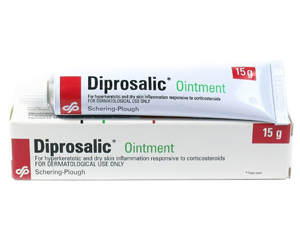
Diprosalic
Incl. online consultation, medicine and discreet delivery
View Options
The medical information on this site is provided for educational purposes. It does not replace a face-to-face consultation with your GP or specialist. Always follow the advice of your prescribing doctor and read the patient information leaflet supplied with your medication.
Choose Your Medicine
Select dosage and quantity
Online Consultation
Reviewed by a qualified physician
Fast, Discreet Delivery
Delivered to your door
Medical Information
About This Medicine
Diprosalic is a topical preparation combining betamethasone dipropionate, a potent corticosteroid, with salicylic acid, a keratolytic agent.
It is prescribed for the treatment of hyperkeratotic and scaly inflammatory skin conditions, particularly psoriasis and chronic eczema where thick scaling prevents adequate penetration of corticosteroid alone.
The salicylic acid component softens and helps remove the thick, adherent scale characteristic of conditions such as plaque psoriasis, allowing the betamethasone to penetrate more effectively into the underlying inflamed skin.
This combined approach delivers faster and more complete clearance of scaly plaques than either ingredient used in isolation.
Diprosalic is available as an ointment and as a scalp application. The ointment is used on the body, while the scalp application is a liquid formulation designed to spread easily through hair.
Treatment is intended for short-term use to control acute flares, after which less potent maintenance therapies should be considered.
Usage & Dosage
Apply a thin layer of Diprosalic ointment to the affected areas once or twice daily. For the scalp application, part the hair and apply a few drops directly to the scaly patches, rubbing in gently.
Wash your hands after use unless the hands are being treated. Avoid contact with the eyes, mouth, and mucous membranes.
Once the scale has cleared and inflammation has settled, your prescriber will typically step down to a less potent steroid or a non-steroidal maintenance therapy such as an emollient or vitamin D analogue.
Apply the ointment thinly to affected areas once or twice daily. For the scalp application, apply a few drops to the affected areas of the scalp morning and evening.
Treatment courses should generally be limited to four weeks. Do not apply to more than 30% of the body surface area at any one time.
If no improvement occurs within two weeks, the diagnosis and treatment plan should be reviewed.
Side Effects
Common side effects include mild stinging or burning on application, particularly on broken or fissured skin. Salicylic acid may occasionally cause local irritation or dryness.
Prolonged use of the betamethasone component may lead to skin thinning, striae, telangiectasia, and acneiform changes.
Systemic absorption, though uncommon with short courses, may occur with extensive application, occlusive dressings, or use on thin-skinned areas.
Rarely, salicylate toxicity may arise if applied over very large areas.
Warnings & Precautions
Diprosalic contains a potent corticosteroid and should be used for the shortest effective duration.
Avoid prolonged application to the face, axillae, and groin, where the skin is particularly susceptible to thinning. Do not apply under occlusive dressings unless directed by your prescriber.
In children, use should be limited and supervised by a specialist. Salicylic acid can enhance the penetration of other topical agents, so be cautious about using additional products concurrently.
Avoid use on large open wounds or extensively broken skin to minimise systemic salicylate absorption.
Contraindications
Diprosalic is contraindicated in patients with untreated bacterial, viral, or fungal skin infections, acne vulgaris, rosacea, perioral dermatitis, and in individuals with hypersensitivity to betamethasone, salicylic acid, or any excipient.
It should not be used in children under one year. Caution is required in patients with impaired renal function due to the risk of salicylate accumulation.