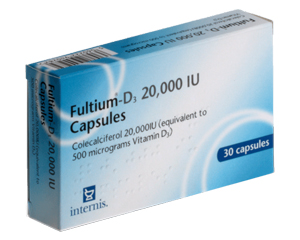
Fultium D3
Incl. online consultation, medicine and discreet delivery
View Options
The medical information on this site is provided for educational purposes. It does not replace a face-to-face consultation with your GP or specialist. Always follow the advice of your prescribing doctor and read the patient information leaflet supplied with your medication.
Choose Your Medicine
Select dosage and quantity
Online Consultation
Reviewed by a qualified physician
Fast, Discreet Delivery
Delivered to your door
Medical Information
About This Medicine
Fultium-D3 is a vitamin D3 (colecalciferol) supplement available in capsule form, prescribed for the prevention and treatment of vitamin D deficiency and for use as an adjunct in the management of osteoporosis.
Vitamin D is essential for the absorption of calcium from the gut and for maintaining healthy bones, teeth, and muscle function.
Deficiency is common in the United Kingdom, particularly during the autumn and winter months, in people who spend little time outdoors, in those with darker skin, and in elderly or institutionalised individuals.
Colecalciferol is the same form of vitamin D that the body produces naturally when the skin is exposed to sunlight.
When taken as a supplement, it is converted in the liver to calcidiol and then in the kidneys to calcitriol, the active hormonal form that regulates calcium and phosphate metabolism.
Adequate vitamin D status helps prevent rickets in children and osteomalacia in adults.
Fultium-D3 is available in several strengths, including 800 IU and 3,200 IU capsules, as well as higher-dose 20,000 IU capsules for loading regimens.
The appropriate strength and duration depend on the severity of deficiency and the clinical context.
Usage & Dosage
Swallow the capsules whole with water, with or without food. For daily maintenance, take one 800 IU capsule once daily, or as directed by your prescriber.
For treatment of proven deficiency, higher doses may be prescribed initially as a loading course. Do not exceed the dose recommended by your doctor.
Vitamin D supplementation is typically continued long-term, especially in individuals at ongoing risk of deficiency.
Your prescriber may check blood levels of 25-hydroxyvitamin D periodically to guide dosing.
For prevention of deficiency: 800 to 2,000 IU daily, depending on risk factors.
For treatment of deficiency: loading regimens vary; a common approach is 3,200 IU daily for several weeks, or intermittent high-dose capsules (e.g. 20,000 IU twice weekly for seven weeks).
Maintenance dose after correction: 800 to 1,600 IU daily. Dosing should be guided by blood levels of 25-hydroxyvitamin D.
In patients with impaired renal function, activated vitamin D analogues rather than colecalciferol may be required.
Side Effects
Side effects at recommended doses are uncommon.
Excessive intake over prolonged periods may lead to hypercalcaemia (raised blood calcium), with symptoms including nausea, vomiting, thirst, excessive urination, constipation, and in severe cases, kidney stones and renal impairment.
Mild gastrointestinal discomfort such as bloating or constipation is occasionally reported. Allergic reactions to the capsule ingredients are rare.
If you experience symptoms of hypercalcaemia, stop taking the supplement and seek medical advice.
Warnings & Precautions
Do not exceed the prescribed dose.
Patients with sarcoidosis, other granulomatous diseases, or a history of calcium-containing kidney stones should use vitamin D only under medical supervision, as these conditions can increase the risk of hypercalcaemia.
Inform your prescriber if you are taking calcium supplements, thiazide diuretics, or cardiac glycosides, as interactions may alter calcium levels.
Regular monitoring of serum calcium and renal function may be warranted in patients on higher doses or with predisposing conditions.
Contraindications
Fultium-D3 is contraindicated in patients with hypercalcaemia, hypercalciuria, nephrolithiasis (kidney stones), severe renal impairment (unless under specialist supervision), hypervitaminosis D, and known hypersensitivity to colecalciferol, peanuts, soya, or any excipient.
Note: Fultium-D3 capsules contain peanut oil (arachis oil).