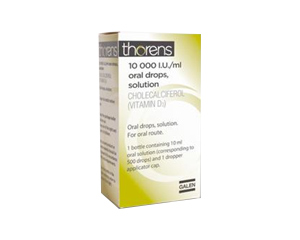
Thorens
Incl. online consultation, medicine and discreet delivery
View Options
The medical information on this site is provided for educational purposes. It does not replace a face-to-face consultation with your GP or specialist. Always follow the advice of your prescribing doctor and read the patient information leaflet supplied with your medication.
Choose Your Medicine
Select dosage and quantity
Online Consultation
Reviewed by a qualified physician
Fast, Discreet Delivery
Delivered to your door
Medical Information
About This Medicine
Thorens is a vitamin D3 supplement containing colecalciferol, used to prevent and treat vitamin D deficiency.
The medicine is supplied as oral drops, which allow precise dosing and make it particularly suitable for patients who find it difficult to swallow capsules.
The physiological role of vitamin D
Vitamin D plays a central part in calcium and phosphate metabolism and is essential for normal bone formation and maintenance.
It also supports the immune system, muscle function and the regulation of cell growth.
Vitamin D deficiency is common in northern countries because the UV radiation in sunlight is insufficient to stimulate adequate production in the skin during the winter months.
Indications for treatment
Thorens is used in documented vitamin D deficiency, the prevention of rickets in children, osteomalacia in adults and as an adjunct in the treatment of osteoporosis.
It is also prescribed for at-risk groups such as older people in residential care, pregnant and breastfeeding women, people with darker skin and those with limited sun exposure.
Advantages of the drop formulation
The drop form of Thorens allows flexible dosing and is particularly beneficial for infants, young children and older patients.
The drops can be mixed with food or drink, which makes them easier to take for anyone who has difficulty swallowing capsules or tablets.
Usage & Dosage
Thorens is given as oral drops and can be mixed with a small amount of food or liquid to make it easier to take, especially for young children.
Daily dose and routine
Take Thorens every day at the same time to build a simple routine.
The drops can be placed directly on the tongue, mixed with a spoonful of milk feed for infants, or stirred into a small amount of food or drink.
It is advisable to take vitamin D together with a meal that contains some fat, as it is fat soluble and is absorbed better in the presence of fat.
Monitoring and dose adjustment
Your doctor will take blood tests to check your 25-hydroxyvitamin D level and adjust the dose accordingly.
During high-dose treatment to correct severe deficiency, testing every two months may be appropriate.
Tell your doctor if you are taking any other products that contain vitamin D, in order to avoid an overdose.
Special groups
Breastfed infants should receive a vitamin D supplement from the first month of life, as breast milk contains only a small amount of vitamin D. Discuss the correct dose with your child's doctor.
Pregnant and breastfeeding women should also take vitamin D as recommended by their doctor.
The dose of Thorens is expressed in IU (international units):
Infants 0 to 12 months:
- 400 to 1,000 IU daily (from the first month of life if breastfed)
Children 1 to 6 years:
- 600 to 1,000 IU daily
Children 7 to 12 years and adolescents:
- 600 to 1,200 IU daily
Adults:
- Prevention: 800 to 2,000 IU daily
- Treatment of deficiency: 1,500 to 4,000 IU daily until the deficiency is corrected
Older people over 70 years:
- 800 to 2,000 IU daily because of reduced skin production and poorer absorption
Pregnant and breastfeeding women:
- 1,000 to 2,000 IU daily
One drop of Thorens usually contains 400 to 500 IU depending on the pack. Your doctor will adjust the dose based on your blood test results.
Side Effects
Thorens is very well tolerated at the recommended doses. Side effects are rare and usually occur only with an overdose.
Common side effects
At normal doses, side effects are extremely rare. Mild stomach upset may occur in a small number of patients. These symptoms are usually temporary and do not affect continued treatment.
Serious side effects
Hypercalcaemia as a result of overdose is the most serious side effect. Symptoms include abnormal thirst, an increased need to pass urine, nausea, vomiting, constipation, weakness and confusion.
Seek medical attention immediately if these symptoms occur. Prolonged hypercalcaemia can lead to calcification of the soft tissues and to kidney stones.
Warnings & Precautions
Thorens should not be taken in doses above your doctor's recommendation without a medical reason and appropriate monitoring.
Patients with sarcoidosis, primary hyperparathyroidism, kidney stones or other conditions that raise calcium levels should use vitamin D with particular caution and under medical supervision.
Do not combine Thorens with other vitamin D supplements without telling your doctor.
Contraindications
Thorens is contraindicated in hypercalcaemia and hypervitaminosis D, as further vitamin D intake can worsen these conditions.
Patients with these diagnoses must bring their levels back to normal before starting any new vitamin D treatment.
Severe kidney failure (chronic kidney disease stage 4 to 5) requires specialist assessment, as the kidneys cannot convert vitamin D into its active form and the patient may need an active vitamin D analogue instead of colecalciferol.
Hypersensitivity to colecalciferol or to any of the excipients in the preparation is an absolute contraindication.
Sarcoidosis and other granulomatous diseases are relative contraindications, as these conditions can increase the conversion of vitamin D and lead to hypercalcaemia even at normal doses.