Evra Patches
Incl. online consultation, medicine and discreet delivery
View Options
The medical information on this site is provided for educational purposes. It does not replace a face-to-face consultation with your GP or specialist. Always follow the advice of your prescribing doctor and read the patient information leaflet supplied with your medication.
Choose Your Medicine
Select dosage and quantity
Online Consultation
Reviewed by a qualified physician
Fast, Discreet Delivery
Delivered to your door
Medical Information
About This Medicine
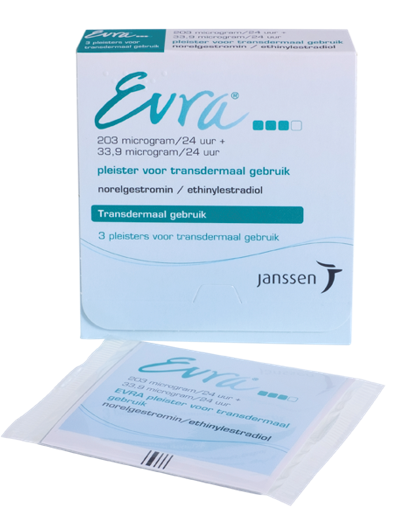
Evra is a combined hormonal contraceptive patch that delivers norelgestromin and ethinylestradiol through the skin.
It provides a convenient alternative to the daily oral contraceptive pill, requiring only once-weekly application. When used correctly, Evra is over 99% effective at preventing pregnancy.
The patch releases a continuous dose of both hormones through the skin into the bloodstream. Norelgestromin is the active metabolite of norgestimate, a third-generation progestogen.
The contraceptive mechanism is the same as combined oral contraceptives: suppression of ovulation, thickening of cervical mucus, and thinning of the endometrial lining.
Evra is applied in a three-week-on, one-week-off cycle. A new patch is applied each week for three consecutive weeks, followed by a patch-free week during which a withdrawal bleed typically occurs.
The transdermal route bypasses first-pass hepatic metabolism, resulting in more stable hormone levels compared with oral administration, which may reduce fluctuation-related side effects in some women.
Usage & Dosage
Apply one patch to clean, dry, hairless skin on the buttock, abdomen, upper arm, or upper torso. Avoid applying to the breast. Press firmly for at least 10 seconds to ensure adhesion.
Change the patch on the same day each week for three consecutive weeks. During week four, do not apply a patch; a withdrawal bleed should occur.
Start the new cycle on the usual change day, regardless of when bleeding began or ended.
If a patch falls off for less than 24 hours, reapply it or apply a new one; no additional contraception is needed.
One patch per week for three weeks, followed by one patch-free week. Each cycle lasts 28 days.
If starting for the first time, apply the first patch on the first day of menstruation for immediate protection.
If starting on any other day, use additional barrier contraception for the first seven days.
If a patch has been detached for more than 24 hours, or if the change day has been missed, use backup contraception for seven days.
Side Effects
Very common (more than 1 in 10): headache, application site reactions (irritation, erythema, pruritus).
Common (1 in 10 to 1 in 100): nausea, mood changes, breast tenderness, dysmenorrhoea, abdominal pain, acne, weight gain, dizziness, migraine, vomiting, diarrhoea, fatigue, vaginal discharge.
Uncommon (1 in 100 to 1 in 1,000): venous thromboembolism, arterial thromboembolism, hypertension, alopecia, urticaria.
Rare (1 in 1,000 to 1 in 10,000): hepatic adenoma, cholestatic jaundice. The risk of venous thromboembolism is comparable to that of combined oral contraceptives containing similar hormone doses.
Warnings & Precautions
As with all combined hormonal contraceptives, Evra carries a small increased risk of venous and arterial thromboembolism. Do not use if you smoke and are over 35.
Have your blood pressure checked before starting and at regular intervals. The patch may be less effective in women weighing 90 kg or more.
Stop using Evra and seek urgent medical advice if you develop sudden severe headache, visual disturbances, leg swelling, chest pain, or breathlessness.
The patch does not protect against sexually transmitted infections.
Contraindications
Evra is contraindicated in women with a history of venous or arterial thromboembolism, migraine with aura, severe hepatic disease, known or suspected sex-steroid-sensitive malignancies, undiagnosed vaginal bleeding, pancreatitis associated with severe hypertriglyceridaemia, and hypersensitivity to any component.
It must not be used during pregnancy or by women over 35 who smoke.