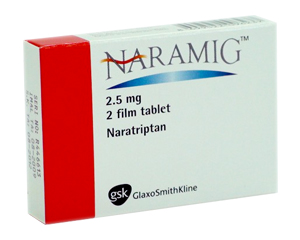
Naramig
Incl. online consultation, medicine and discreet delivery
View Options
The medical information on this site is provided for educational purposes. It does not replace a face-to-face consultation with your GP or specialist. Always follow the advice of your prescribing doctor and read the patient information leaflet supplied with your medication.
Choose Your Medicine
Select dosage and quantity
Online Consultation
Reviewed by a qualified physician
Fast, Discreet Delivery
Delivered to your door
Medical Information
About This Medicine
Naramig contains naratriptan. This is a triptan, a medicine that acts on serotonin (5-HT1B/1D) receptors. It treats the headache phase of a migraine attack, with or without aura, in adults.
It does not prevent migraine attacks. You should not use it to stop attacks before they start.
Naratriptan acts on serotonin receptors in blood vessels in the head. This narrows the vessels again. During a migraine, these vessels widen too much, which is thought to cause part of the pain.
Naratriptan also calms the trigeminal nerve, so it releases fewer substances that cause swelling and inflammation.
The result is relief from headache, nausea, light sensitivity, and sound sensitivity.
Naratriptan starts to work more slowly than some other triptans. But it stays in the body longer. Because of this, the headache is less likely to come back within 24 hours.
Doctors often choose it for people who have long migraine attacks. It also suits people whose headache returns soon after a faster triptan. Naratriptan is usually easier to tolerate too.
It causes fewer chest problems and fewer effects on the brain and nerves.
Usage & Dosage
Take one Naramig tablet as soon as the headache phase of a migraine starts. Swallow it whole with water. You can take it with or without food.
If the headache gets better but then comes back, you may take a second tablet. Wait at least four hours after the first dose. Do not take more than two tablets (5 mg) in any 24-hour period.
If the first tablet does not help at all, do not take a second tablet for the same attack. It is unlikely to work. Treat that attack with a different medicine. Then tell your doctor how you responded.
Do not use Naramig for hemiplegic or basilar migraine.
The usual adult dose is 2.5 mg. Take it as a single tablet when the migraine headache starts. If your symptoms come back, you may take a second 2.5 mg dose. Wait at least four hours between doses.
The most you may take in 24 hours is 5 mg, which is two tablets. If you have mild to moderate kidney or liver problems, the most you may take is 2.5 mg in 24 hours.
Do not use naratriptan if you have severe kidney or liver problems. It is also not advised for people over 65 or children under 18.
Side Effects
Common side effects affect 1 in 10 to 1 in 100 people. They include tiredness, drowsiness, nausea, and feeling generally unwell.
Some people sometimes feel tingling, warmth, or heaviness in the arms, legs, or body.
Uncommon effects include dizziness, flushing, changes in vision, and a slow heartbeat (bradycardia). Chest symptoms can happen now and then. These include tightness, pressure, or heaviness.
They usually do not come from the heart. But if they are severe or do not go away, they should be checked.
Rare but serious effects can also occur.
These include spasm of the heart arteries (coronary vasospasm), reduced blood flow to the heart or a heart attack, poor blood flow to the limbs, poor blood flow to the bowel, and serotonin syndrome (a harmful build-up of serotonin).
The heart risk is higher in people who have heart disease without knowing it. Serotonin syndrome is more likely if you also take SSRIs, SNRIs, or other medicines that raise serotonin.
Get medical help straight away for severe chest pain, sudden stomach pain, or signs of too much serotonin, such as restlessness, shaking, or a high body temperature.
Warnings & Precautions
Do not take Naramig within 24 hours of medicines that contain ergotamine, or within 24 hours of another triptan. It is not meant to prevent migraine and is not for cluster headache.
If your headache has not been diagnosed, it should be checked properly first. Some people have a higher risk of reduced blood flow to the heart.
This includes people with high blood pressure, high cholesterol, diabetes, a family history of heart disease, men over 40, and women past the menopause, as well as smokers.
These people should have a heart check before they use Naramig for the first time. If you get chest symptoms, stop taking it and see a doctor.
Contraindications
Do not take Naramig if you have a history of reduced blood flow to the heart, spasm of the heart arteries (including Prinzmetal's angina), disease of the blood vessels in the brain, poor blood flow in the limbs, high blood pressure that is not controlled, or severe kidney or liver problems.
Do not take it if you are allergic to naratriptan or to any other ingredient. Do not take it at the same time as ergotamine or another triptan.