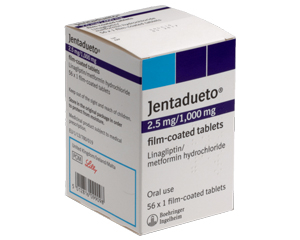
Jentadueto
Incl. online consultation, medicine and discreet delivery
View Options
The medical information on this site is provided for educational purposes. It does not replace a face-to-face consultation with your GP or specialist. Always follow the advice of your prescribing doctor and read the patient information leaflet supplied with your medication.
Choose Your Medicine
Select dosage and quantity
Online Consultation
Reviewed by a qualified physician
Fast, Discreet Delivery
Delivered to your door
Medical Information
About This Medicine
Jentadueto is a fixed-dose combination tablet containing linagliptin and metformin hydrochloride, used for the treatment of type 2 diabetes mellitus in adults.
It is prescribed when treatment with metformin alone does not provide sufficient glycaemic control, or for patients already being treated with the combination of linagliptin and metformin as separate tablets.
Linagliptin is a dipeptidyl peptidase-4 (DPP-4) inhibitor that works by preventing the breakdown of incretin hormones GLP-1 and GIP.
These hormones stimulate insulin secretion and suppress glucagon release in a glucose-dependent fashion, thereby lowering blood glucose without significantly increasing the risk of hypoglycaemia.
Metformin primarily reduces hepatic glucose output and improves peripheral insulin sensitivity.
The combination of these two agents provides complementary glucose-lowering mechanisms in a single tablet, simplifying the treatment regimen.
Linagliptin is unique among DPP-4 inhibitors in that it is predominantly eliminated via the biliary route rather than the kidneys, meaning no dose adjustment is required for renal impairment for the linagliptin component.
Usage & Dosage
Take Jentadueto by mouth twice daily with meals. Swallow tablets whole with a glass of water.
Taking the medication with food helps to reduce the gastrointestinal side effects associated with metformin. Maintain your prescribed diet and exercise regimen alongside this medication.
Monitor your blood glucose levels as advised by your healthcare team. Do not alter your dose without consulting your doctor.
Jentadueto is available as 2.5 mg/500 mg, 2.5 mg/850 mg, and 2.5 mg/1,000 mg tablets (linagliptin/metformin).
The usual dose is one tablet twice daily, providing a total daily linagliptin dose of 5 mg.
The metformin component should be titrated according to tolerance and glycaemic response, up to a maximum of 2,000 mg daily.
Dose adjustment of the metformin component is required in patients with moderate renal impairment.
Side Effects
Common (1 in 10 to 1 in 100): diarrhoea, nausea, vomiting, nasopharyngitis, hypoglycaemia (when combined with sulphonylurea or insulin).
Uncommon (1 in 100 to 1 in 1,000): cough, pancreatitis, decreased appetite, pruritus.
Rare (1 in 1,000 to 1 in 10,000): lactic acidosis (attributable to metformin), bullous pemphigoid, hypersensitivity reactions, angioedema.
Very rare (less than 1 in 10,000): hepatic dysfunction, vitamin B12 deficiency with prolonged metformin use. Seek urgent medical attention if you develop persistent severe abdominal pain.
Warnings & Precautions
The metformin component carries a risk of lactic acidosis, particularly in the setting of renal impairment, dehydration, sepsis, or excessive alcohol intake.
Renal function should be checked before starting and regularly during treatment. Jentadueto should be temporarily withheld around surgical procedures and contrast media investigations.
Cases of pancreatitis have been reported with DPP-4 inhibitors; patients should be informed of symptoms. Bullous pemphigoid has been reported rarely; treatment should be discontinued if suspected.
Contraindications
Jentadueto is contraindicated in patients with type 1 diabetes, diabetic ketoacidosis, severe renal failure (eGFR below 30 ml/min), acute conditions predisposing to lactic acidosis (such as cardiogenic shock, acute myocardial infarction, sepsis), severe hepatic impairment, and known hypersensitivity to linagliptin, metformin, or any excipient.