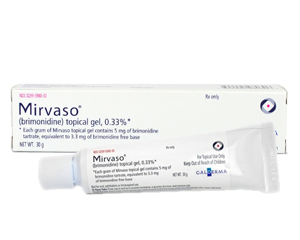
Mirvaso
Incl. online consultation, medicine and discreet delivery
View Options
The medical information on this site is provided for educational purposes. It does not replace a face-to-face consultation with your GP or specialist. Always follow the advice of your prescribing doctor and read the patient information leaflet supplied with your medication.
Choose Your Medicine
Select dosage and quantity
Online Consultation
Reviewed by a qualified physician
Fast, Discreet Delivery
Delivered to your door
Medical Information
About This Medicine
Mirvaso contains brimonidine, a selective alpha-2 adrenergic receptor agonist (a medicine that narrows blood vessels). It comes as a gel you put on your skin.
It treats facial redness (erythema) caused by rosacea in adults. Brimonidine works by tightening the small blood vessels near the surface of your face.
These vessels cause the lasting redness seen in erythematotelangiectatic rosacea. The gel starts to work within 30 minutes. The effect peaks at about 3-6 hours and can last up to 12 hours.
In phase III clinical trials, more patients who used brimonidine gel saw at least a 2-grade improvement than those who used a placebo.
This was measured on the Clinician's Erythema Assessment and Patient Self-Assessment scales. Mirvaso is the first skin treatment licensed just for the facial redness linked to rosacea.
It treats redness only. It does not treat the spots and bumps (the papulopustular part) of rosacea.
Those need separate treatment, such as topical metronidazole, ivermectin, or antibiotics taken by mouth. Mirvaso treats the symptom, not the cause.
You should still find and avoid the things that trigger your rosacea.
Usage & Dosage
Put a pea-sized amount of gel on each of the five areas of your face: forehead, chin, nose, and each cheek. Use this once a day. Spread it in a thin, even layer.
Keep it away from your eyes, eyelids, lips, mouth, and the inside of your nose. Wash your hands straight after you apply it. Let the gel dry before you put on sunscreen, moisturiser, or makeup.
Stay away from things that make rosacea worse, such as alcohol, spicy food, very hot or cold weather, and hot drinks. Do not use more than the advised amount.
Using too much can raise the risk of rebound redness. Do not put Mirvaso on skin that is irritated, broken, or sunburned.
Use no more than 1 g of gel a day. That is about 5 pea-sized amounts, applied once daily to the face. Do not go over the advised daily amount. Older patients do not need a different dose.
However, there is limited experience in patients over 65 years. Mirvaso has not been tested in patients with severe liver or kidney problems, so use it with care in these cases.
It is not advised for children under 18 years. If you miss a dose, skip it. Apply the next day's dose as normal. Do not use a double dose.
Side Effects
These side effects are grouped by how often they happen, based on the SmPC and reports gathered after the medicine went on sale.
Common (≥1/100 to <1/10): Redness (erythema) that gets worse or rebounds, flushing, a burning feeling on the skin, and contact dermatitis (a skin rash) where you apply it.
Uncommon (≥1/1,000 to <1/100): A feeling of warmth on the skin, itching (pruritus), acne, pain where you apply it, dry skin, a blocked nose, small bumps (papules), and swelling (oedema) where you apply it.
Rare (≥1/10,000 to <1/1,000): Swelling under the skin (angioedema), a slow heart rate (bradycardia), low blood pressure (hypotension), and dizziness.
These can happen if the medicine is taken up into the body.
Rebound redness is the main concern. Once the vessel-tightening effect wears off, your face may briefly turn redder than it was before.
This has been reported in up to 10-20% of patients since the medicine went on sale. It usually happens in the first 2 weeks. You can manage it by starting slowly.
Apply it to a small area first and use a thinner layer.
Warnings & Precautions
The MHRA has had reports of rebound redness and flushing that is worse than before Mirvaso was used. Tell patients this can happen before they start treatment.
Think about a test patch on a small area of the face for a few days before using it on the whole face. Brimonidine is an alpha-2 agonist and can have effects on the body.
The amount taken up through healthy skin is very small.
Even so, use it with care in patients with severe or unstable heart disease, Raynaud's phenomenon, depression, or poor blood flow to the brain or heart.
Also take care in patients taking certain other medicines: blood pressure tablets, cardiac glycosides (heart medicines), or CNS depressants (medicines that slow the nervous system).
Keep the gel away from the eyes. Brimonidine is also used as eye drops for glaucoma, and getting it in the eye may cause a small pupil (miosis) and a pulled-up eyelid (lid retraction).
Contraindications
Do not use Mirvaso if you are allergic to brimonidine tartrate or any other ingredient. It also must not be used in children under 2 years of age, as it can cause serious effects on the body.
Use it with care, and only after weighing the risks and benefits, in patients taking MAO inhibitors or tricyclic or tetracyclic antidepressants.
These medicines may change how alpha-adrenergic receptors work.