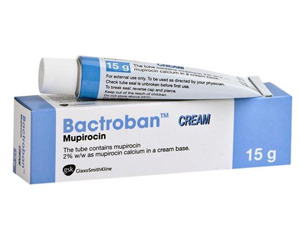
Bactroban
Incl. online consultation, medicine and discreet delivery
View Options
The medical information on this site is provided for educational purposes. It does not replace a face-to-face consultation with your GP or specialist. Always follow the advice of your prescribing doctor and read the patient information leaflet supplied with your medication.
Choose Your Medicine
Select dosage and quantity
Online Consultation
Reviewed by a qualified physician
Fast, Discreet Delivery
Delivered to your door
Medical Information
About This Medicine
Bactroban contains mupirocin, a topical antibiotic with a unique mechanism of action that makes it effective against Gram-positive skin pathogens, including methicillin-sensitive and methicillin-resistant Staphylococcus aureus (MRSA) and Streptococcus pyogenes.
Mupirocin inhibits bacterial protein synthesis by binding to bacterial isoleucyl-tRNA synthetase, an enzyme with no close mammalian equivalent.
This distinctive target means cross-resistance with other antibiotic classes is exceptionally rare.
Clinical Uses
Bactroban cream and ointment are prescribed for localised bacterial skin infections such as impetigo, folliculitis, infected eczema, and small infected wounds.
Bactroban nasal ointment is used specifically for the elimination of nasal carriage of MRSA - an important infection control measure in hospitals and before certain surgical procedures.
Resistance Considerations
Although mupirocin resistance is still relatively uncommon, it can develop with prolonged or widespread use.
Treatment courses should be kept short - typically no more than 10 days for skin infections and five days for nasal decolonisation.
Usage & Dosage
Skin Infections (Cream or Ointment)
Clean and dry the affected area. Apply a small amount of Bactroban to the infected skin three times daily. You may cover the area with a sterile dressing if appropriate.
Wash your hands before and after application.
Nasal MRSA Decolonisation (Nasal Ointment)
Apply a small amount (a matchstick-head quantity) to the inside of each nostril two to three times daily for five days.
Close the nostrils by pressing together and massage gently to distribute the ointment.
Course Duration
Skin infection: up to 10 days. Nasal decolonisation: 5 days. If no improvement is seen by the end of the course, seek clinical review.
Skin Infections - Adults and Children
- Apply Bactroban cream or ointment to the affected area three times daily
- Course: up to 10 days
Nasal Decolonisation - Adults
- Apply a small amount of nasal ointment (2%) to the inside of each nostril 2-3 times daily for 5 days
No Dose Adjustment
- No systemic dose considerations as absorption is minimal
- Not intended for large open wounds or mucous membranes (except the nasal variant)
Review
- Reassess if infection has not resolved within 10 days
Side Effects
Common (up to 1 in 10 patients)
- Localised burning, stinging, or itching at the application site
Uncommon (up to 1 in 100 patients)
- Skin dryness, redness, or rash
- Contact dermatitis
- Nausea (with nasal ointment, from post-nasal drip)
Rare (up to 1 in 1,000 patients)
- Allergic reactions including urticaria
- Cutaneous sensitisation
Very Rare (fewer than 1 in 10,000 patients)
- Systemic allergic reactions (generalised rash, angioedema)
Local irritation is usually mild and transient. If a severe skin reaction or rash develops, stop the ointment and consult your prescriber.
Warnings & Precautions
Avoid Eyes and Mucous Membranes
Bactroban cream and skin ointment must not be applied to the eyes or inserted into the nose. Only the dedicated nasal ointment formulation is suitable for intranasal use.
Resistance
Limit courses to the shortest effective duration. Prolonged use promotes mupirocin resistance, which would reduce its value for future MRSA decolonisation.
Polyethylene Glycol (PEG) Absorption
Bactroban ointment (not the cream) contains a polyethylene glycol base. In patients with large open wounds or burns, significant PEG absorption can occur, and this is nephrotoxic.
Do not apply the ointment to extensive open wounds. Use the cream formulation instead for broken skin.
Pregnancy and Breastfeeding
Limited data in pregnancy. Systemic absorption is minimal, so topical use on small areas is generally considered low risk. Discuss with your prescriber.
Contraindications
Do not use Bactroban if you have a known allergy to mupirocin or any excipient in the formulation.
Bactroban ointment (PEG-based) must not be used on large open wounds, burns, or conditions where significant absorption of polyethylene glycol is possible, especially in patients with renal impairment.
Bactroban nasal ointment should not be applied to the eyes or used on the skin (different formulation).