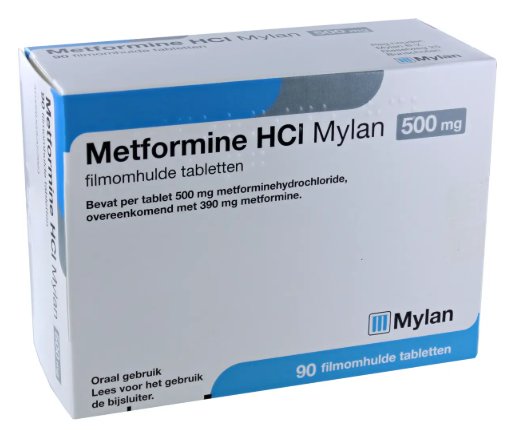
Metformin
Incl. online consultation, medicine and discreet delivery
View Options
The medical information on this site is provided for educational purposes. It does not replace a face-to-face consultation with your GP or specialist. Always follow the advice of your prescribing doctor and read the patient information leaflet supplied with your medication.
Choose Your Medicine
Select dosage and quantity
Online Consultation
Reviewed by a qualified physician
Fast, Discreet Delivery
Delivered to your door
Medical Information
About This Medicine
Metformin is a biguanide, a type of oral medicine that lowers blood sugar. It is the standard first-choice medicine for type 2 diabetes mellitus across the world. It works in three ways.
It lowers the amount of glucose your liver makes. It helps your body, especially your muscles, take in and use more glucose. It also reduces how much glucose your gut absorbs.
Unlike sulphonylureas, metformin does not make your body release more insulin. Because of this, it does not cause hypoglycaemia (low blood sugar) when taken on its own.
The UK Prospective Diabetes Study (UKPDS) showed that metformin lowers the risk of death linked to diabetes. It also cuts the risk of large blood vessel problems, mainly in people who are overweight.
NICE NG28 advises metformin as the first medicine for type 2 diabetes in all adults. The dose is raised slowly to the highest amount the person can tolerate.
Metformin usually lowers HbA1c (a measure of long-term blood sugar) by 1.0-1.5 percentage points. It does not usually cause weight gain, and may cause slight weight loss.
This sets it apart from many other blood sugar medicines. It is also used off-label in polycystic ovary syndrome (PCOS) to help with insulin resistance.
Metformin has a strong safety record built over more than 60 years of clinical use.
Usage & Dosage
Take metformin with food or just after a meal. This helps reduce stomach and bowel side effects. Swallow the tablets whole with water.
You usually take immediate-release tablets two or three times a day. You take modified-release tablets once a day with your evening meal. Do not crush modified-release tablets.
Raise your dose slowly, every 1-2 weeks. This helps your stomach cope better. Drink enough fluids. If you keep being sick or have diarrhoea, stop metformin for now and ask your doctor for advice.
Becoming dehydrated raises the risk of lactic acidosis (a serious build-up of acid in the blood). Tell your doctor before any test or procedure that uses iodinated contrast dye.
Metformin should be stopped before the dye is given and for 48 hours after.
Immediate-release: Start at 500 mg once or twice a day with meals. Raise the dose by 500 mg every 1-2 weeks. The usual maintenance dose is 500 mg three times a day or 1000 mg twice a day.
The maximum dose is 2000 mg a day (BNF) or 3000 mg a day (SmPC).
Modified-release: Start at 500 mg once a day with the evening meal. Raise the dose by 500 mg every 1-2 weeks. The maximum dose is 2000 mg once a day.
In reduced kidney function: with an eGFR of 30-44 mL/min/1.73m², the maximum is 500 mg twice a day (or 1000 mg a day). With an eGFR below 30, metformin must not be used.
Check kidney function before starting and at least once a year. Check it more often as the eGFR nears 45. Older patients need regular kidney checks.
Side Effects
Side effects are grouped by how often they happen, following SmPC categories.
Very common (1 in 10 or more): Stomach and bowel symptoms, such as nausea, vomiting, diarrhoea, tummy pain, and loss of appetite. These affect up to 25% of patients.
They usually depend on the dose, pass with time, and get better as you keep taking the medicine or lower the dose. Taking it with food and raising the dose slowly cut these symptoms a lot.
Modified-release tablets are easier on the stomach.
Common (1 in 100 to 1 in 10): A metallic taste, and vitamin B12 deficiency with long-term use, reported in 5-10% of patients.
Uncommon (1 in 1,000 to 1 in 100): Raised liver enzymes and hepatitis (inflammation of the liver), which clear up once the medicine is stopped.
Very rare (fewer than 1 in 10,000): Lactic acidosis, a build-up of acid in the blood that is a medical emergency and can be fatal.
Signs include nausea, vomiting, tummy pain, fast breathing, low body temperature, and coma. It happens in about 3-10 people per 100,000 patient-years.
It occurs mostly in patients who have kidney function too poor for metformin, severe liver failure, or sudden illnesses that starve the tissues of oxygen.
Warnings & Precautions
Lactic acidosis is the most serious side effect of metformin. It is very rare when prescribing rules are followed.
Things that raise the risk include poor kidney function, liver failure, heavy alcohol use, dehydration, severe infection, and any condition that starves the tissues of oxygen, such as shock, sudden heart failure, or breathing failure.
Patients should learn the signs of lactic acidosis. They should stop metformin and get emergency care if these signs appear.
Stop metformin for 48 hours before and after surgery under general anaesthetic, and before tests that use iodinated contrast dye.
Check vitamin B12 levels from time to time during long-term treatment.
Check more closely in patients with megaloblastic anaemia (a type of low blood count) or peripheral neuropathy (nerve damage in the hands or feet).
Metformin does not cause low blood sugar on its own. It may add to the risk when taken with sulphonylureas or insulin.
Contraindications
Metformin must not be used in patients with an eGFR below 30 mL/min/1.73m².
It must also not be used in diabetic ketoacidosis or diabetic pre-coma (two dangerous diabetes states), severe liver problems, or conditions that starve the tissues of oxygen, such as heart or breathing failure, a recent heart attack (MI), or shock.
Avoid it in severe dehydration, alcohol intoxication, and if the patient is allergic to metformin or any other ingredient.
Metformin must be stopped for a while for tests that use iodinated contrast dye and for surgery under general anaesthetic.
Frequently Asked Questions
Why does metformin cause stomach problems?
Can metformin cause low blood sugar?
Does metformin help with weight loss?
Should I take metformin with food?
Does metformin affect my kidneys?
Related articles: Metformin
Metformin Side Effects: A Complete Guide
Metformin commonly causes gastrointestinal side effects such as nausea, diarrhoea and stomach cramps, particularly in the first few weeks. Serious side effects like lactic acidosis are very rare. Most GI symptoms improve with time or by switching to modified-release tablets.
guideMetformin and Weight Loss: What the Evidence Shows
Metformin can produce modest weight loss of 2 to 3 kg over 6 to 12 months, primarily through reduced appetite and improved insulin sensitivity. It is not licensed as a weight-loss drug, but its weight-neutral to weight-reducing profile makes it preferred over other diabetes medicines.
safetyMetformin Warnings: Important Safety Information
Take metformin with care if you have kidney problems, liver disease, heart failure or drink a lot of alcohol. Stop it for a short time when you are acutely ill, before surgery and before contrast-enhanced scans. Always follow the sick-day rules.
overviewMetformin: Comprehensive NHS-Aligned Information
Metformin is the first-line treatment for type 2 diabetes in the UK. It lowers blood glucose by reducing hepatic glucose output and improving insulin sensitivity. Standard doses range from 500 mg to 2,000 mg daily. It requires regular kidney function monitoring.
OverviewHow does metformin work? Understanding the first-line diabetes treatment
Metformin works primarily by reducing glucose production in the liver and improving the body's sensitivity to insulin. Unlike many diabetes medicines, it does not cause weight gain or increase the risk of hypoglycaemia when used alone. It remains the first-line treatment for type 2 diabetes in all major UK guidelines.
DosageMetformin 500 mg: your guide to the starting dose
Metformin 500 mg is the standard starting dose for most adults with type 2 diabetes. It is taken with meals, usually once or twice daily initially, and gradually increased over several weeks to reduce gastrointestinal side effects. The maximum dose is typically 2000 mg daily in divided doses.