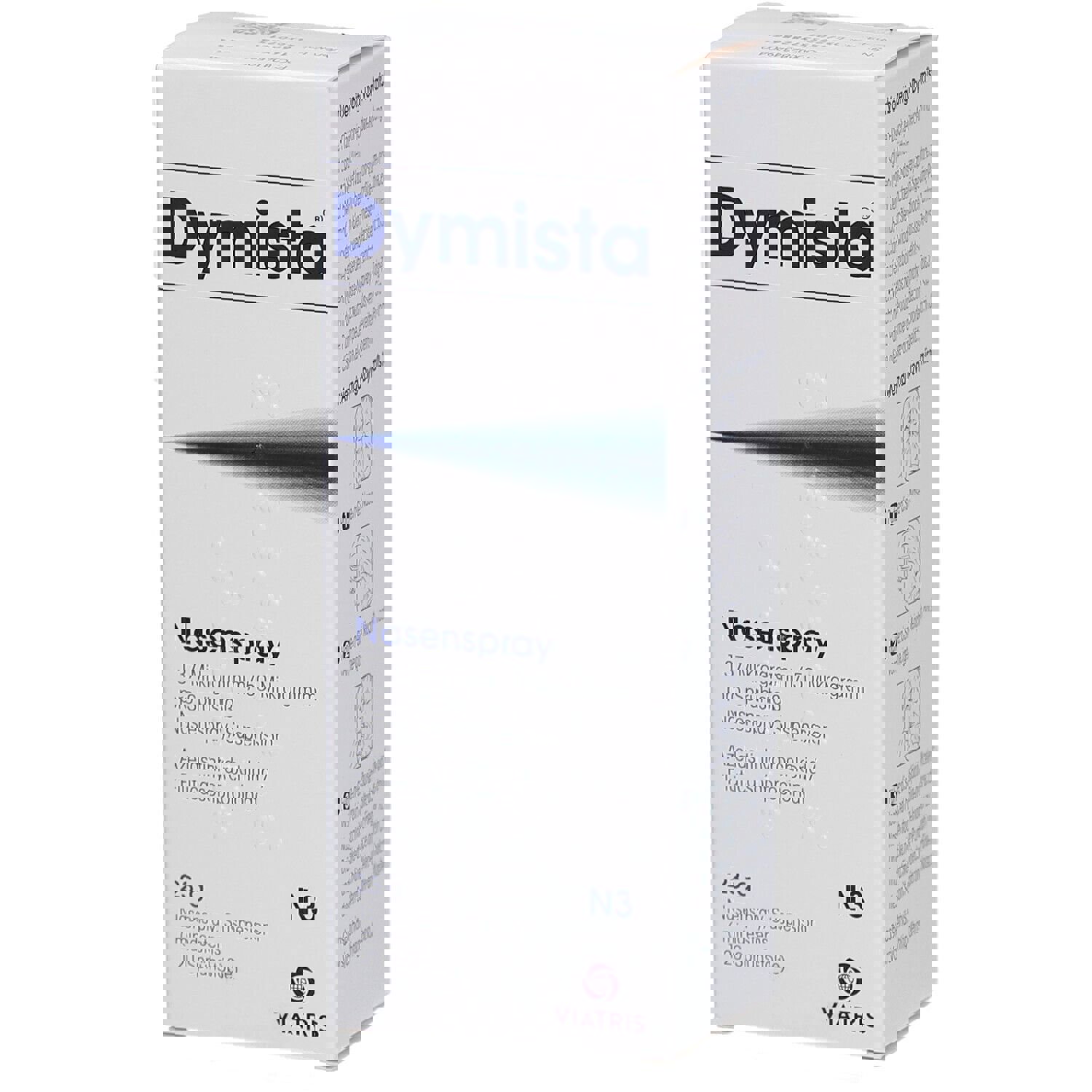
Dymista
Incl. online consultation, medicine and discreet delivery
View Options
The medical information on this site is provided for educational purposes. It does not replace a face-to-face consultation with your GP or specialist. Always follow the advice of your prescribing doctor and read the patient information leaflet supplied with your medication.
Choose Your Medicine
Select dosage and quantity
Online Consultation
Reviewed by a qualified physician
Fast, Discreet Delivery
Delivered to your door
Medical Information
About This Medicine
Dymista is a combination nasal spray. It contains two medicines in one device: azelastine (a topical antihistamine) and fluticasone propionate (an intranasal corticosteroid).
The two work in different ways. Azelastine acts fast. It eases allergy symptoms and inflammation within 15 minutes. Fluticasone propionate works more slowly.
It gives steady, long-lasting relief by calming the inflammation in the lining of your nose.
Clinical trials (MP4004 and others) showed that Dymista relieves symptoms much better than either medicine used on its own. It also starts working faster than fluticasone used alone.
Dymista is licensed to relieve moderate-to-severe seasonal and perennial allergic rhinitis (hay fever and year-round allergy symptoms).
It is for people whose symptoms are not well controlled by an intranasal antihistamine or corticosteroid used alone.
NICE and BSACI guidelines say intranasal corticosteroids should be the first choice for persistent allergic rhinitis. Dymista is a good option when a single medicine does not control symptoms enough.
One spray in each nostril, twice a day, gives steady cover over 12 hours. Very little of either medicine passes into the rest of the body through the nose.
Usage & Dosage
Shake the bottle gently before each use. If you are using it for the first time, or have not used it for more than 7 days, prime the pump with 6 sprays first. Blow your nose gently before you use it.
Tilt your head slightly forward. Put the nozzle into one nostril and close the other with a finger. Spray once while you breathe in gently through your nose. Repeat in the other nostril.
Wipe the nozzle clean after use. Use one spray in each nostril twice a day, in the morning and the evening. Do not use more than the recommended dose.
Do not aim the spray straight at the middle wall of your nose (the septum). Use Dymista regularly to get the best result.
You may feel some relief within 15 minutes, but the full anti-inflammatory effect of the corticosteroid builds up over several days of regular use.
Adults and teenagers aged 12 years and older: one spray in each nostril twice a day. This gives a total daily dose of azelastine 548 mcg and fluticasone propionate 200 mcg.
Dymista is not recommended for children under 12 years, as there is not enough safety data.
You do not need a different dose if you are elderly or have kidney or liver problems, because very little of the medicine is absorbed into the body.
For seasonal rhinitis, use Dymista only while you are exposed to the allergen. For perennial (year-round) rhinitis, you should have a regular review with your prescriber.
Side Effects
Side effects are listed by how often they happen, based on the SmPC.
Common (≥1/100 to <1/10): An unpleasant bitter taste (dysgeusia). This is the most commonly reported side effect. It comes from the azelastine and affects about 4-8% of patients.
Nosebleeds (epistaxis), which can happen with any intranasal corticosteroid. Headache. Discomfort in the nose.
Uncommon (≥1/1,000 to <1/100): A dry nose, sneezing after use, sores in the lining of the nose, throat irritation, drowsiness (from the azelastine), and nausea.
Rare (≥1/10,000 to <1/1,000): A hole in the wall between the nostrils (nasal septal perforation), which can occur with long-term corticosteroid use.
Allergic reactions and anaphylaxis (a severe allergic reaction). Glaucoma. Cataracts. Reduced activity of the adrenal glands (adrenal suppression).
This is only a theoretical risk, and only with very high total doses of corticosteroid taken by more than one route.
You can reduce the bitter taste. Do not sniff hard after spraying, as this pulls the liquid into your throat. Tilt your head slightly forward rather than back while you spray.
Warnings & Precautions
If you are switching from a steroid taken by mouth to an intranasal one, your prescriber should watch you for signs that your adrenal glands are underactive.
This is uncommon with Dymista at standard doses. Your prescriber should examine your nose before you start and from time to time during long-term use, to check for sores or changes to the septum.
Azelastine may make you a little drowsy. Take care with tasks that need full alertness until you know how it affects you.
Do not drink alcohol or take other medicines that slow the nervous system if you feel drowsy.
Intranasal corticosteroids may slow growth in children, so Dymista is not licensed for use under 12 years. If you have a history of glaucoma, your prescriber should check the pressure in your eyes.
Contraindications
Do not use Dymista if you are allergic to azelastine, fluticasone propionate, or any of the other ingredients. It is not recommended for children under 12 years.
You should also avoid it for now if you have an untreated nasal infection, have recently had nasal surgery or injury (until it has healed), or have active tuberculosis in the lungs.