Provera
Incl. online consultation, medicine and discreet delivery
View Options
The medical information on this site is provided for educational purposes. It does not replace a face-to-face consultation with your GP or specialist. Always follow the advice of your prescribing doctor and read the patient information leaflet supplied with your medication.
Choose Your Medicine
Select dosage and quantity
Online Consultation
Reviewed by a qualified physician
Fast, Discreet Delivery
Delivered to your door
Medical Information
About This Medicine
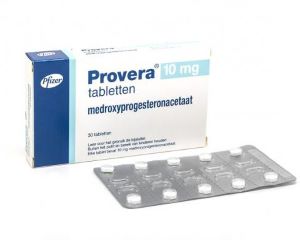
Provera contains medroxyprogesterone acetate (MPA), a synthetic progestogen used to treat a variety of gynaecological conditions.
It is prescribed for dysfunctional uterine bleeding, secondary amenorrhoea, endometriosis, and as the progestogen component in hormone replacement therapy to protect the endometrium in women taking oestrogen who have an intact uterus.
Medroxyprogesterone acts on the endometrium by converting oestrogen-stimulated proliferative tissue to a secretory pattern, preventing endometrial hyperplasia and reducing the risk of endometrial carcinoma in women receiving oestrogen therapy.
It also has antiandrogenic and mild glucocorticoid properties. In higher doses, it suppresses ovulation and is used in the management of hormone-sensitive conditions.
Provera tablets are available in several strengths, allowing flexible dosing across indications.
The oral formulation should be distinguished from depot medroxyprogesterone acetate (Depo-Provera), which is an injectable long-acting contraceptive.
Usage & Dosage
Take Provera tablets by mouth, with or without food, at the same time each day.
For dysfunctional uterine bleeding or secondary amenorrhoea, treatment is typically given for a defined number of days per cycle as directed by your prescriber.
For HRT use, follow the specific sequential or continuous regimen prescribed. Do not exceed the prescribed dose or duration.
If you miss a dose, take it as soon as you remember and return to your usual schedule.
Dysfunctional uterine bleeding: 2.5 to 10 mg daily for 5 to 10 days, starting on day 16 or 21 of the cycle. Secondary amenorrhoea: 2.
5 to 10 mg daily for 5 to 10 days, beginning on the presumed or calculated day 16 to 21. Endometriosis: 10 mg three times daily for 90 consecutive days.
HRT (combined with oestrogen): 5 to 10 mg daily for 12 to 14 days of the cycle. Doses vary by indication and should be individualised.
Side Effects
Common: breast tenderness, headache, nausea, mood changes (including depression), acne, weight fluctuation, irregular bleeding or spotting. Uncommon: dizziness, fatigue, bloating, alopecia, insomnia.
Rare: venous thromboembolism, jaundice, allergic reactions including urticaria and rash.
Long-term progestogen use as part of HRT carries a small increased risk of breast cancer, which should be discussed when weighing the benefits and risks of treatment.
Warnings & Precautions
Use the lowest effective dose for the shortest duration necessary. Progestogens may exacerbate depression, migraine, epilepsy, and asthma; monitor patients with these conditions closely.
Discontinue immediately if signs of venous thromboembolism (leg pain, chest pain, sudden breathlessness) develop. Regular medical review is advisable during long-term use.
MPA may impair glucose tolerance; diabetic patients should monitor blood glucose more frequently. Breakthrough bleeding may occur and should be investigated if persistent.
Contraindications
Contraindicated in known or suspected pregnancy, undiagnosed vaginal bleeding, breast cancer or other hormone-dependent malignancy, active or previous venous thromboembolism, severe hepatic impairment, missed abortion, and known hypersensitivity to medroxyprogesterone acetate or any excipient.