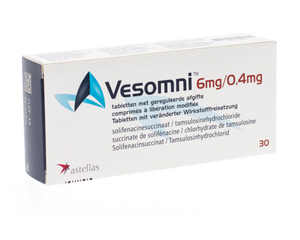
Vesomni
Incl. online consultation, medicine and discreet delivery
View Options
The medical information on this site is provided for educational purposes. It does not replace a face-to-face consultation with your GP or specialist. Always follow the advice of your prescribing doctor and read the patient information leaflet supplied with your medication.
Choose Your Medicine
Select dosage and quantity
Online Consultation
Reviewed by a qualified physician
Fast, Discreet Delivery
Delivered to your door
Medical Information
About This Medicine
Vesomni is a single tablet that combines two medicines: solifenacin succinate and tamsulosin hydrochloride. Doctors prescribe it for men with benign prostatic hyperplasia (BPH), an enlarged prostate.
It helps with moderate to severe storage symptoms, such as a sudden need to go, going often, and urge incontinence (leaking).
It also helps with voiding symptoms, such as trouble starting and a weak stream.
Tamsulosin is an alpha-1A adrenoceptor antagonist. In plain terms, it relaxes the muscle in the prostate and bladder neck. This lets urine flow more easily and eases the blockage.
Solifenacin is an antimuscarinic agent. It calms the bladder muscle (the detrusor) so it does not squeeze on its own.
This helps the storage symptoms that many men with BPH have alongside their flow problems.
Putting both medicines in one tablet treats both sides of these urinary problems. Two clinical trials, NEPTUNE and NEPTUNE II, tested the combination.
They showed a statistically significant improvement in both storage and voiding symptom scores compared with tamsulosin on its own.
Vesomni is for men whose alpha-blocker on its own has not eased their storage symptoms enough. It is not a first treatment.
Instead, it is a step-up option for when flow is under control but urgency, frequency, or waking at night to pass urine (nocturia) still bother you.
Usage & Dosage
Take one tablet a day, with or without food. Swallow it whole with water. Do not crush, chew, or split it, because the tamsulosin part has a modified-release coating.
Take your dose at about the same time each day. You can take it at any time of day. Unlike some tamsulosin-only products, you do not need to take it after a meal.
Keep taking it as your prescriber tells you. If you find it hard to pass urine, stop the tablet and get medical advice quickly.
The antimuscarinic part can sometimes make urinary retention (not being able to empty the bladder) worse.
Take one tablet a day. Each tablet contains solifenacin 6 mg and tamsulosin 0.4 mg (modified release). This is the only strength, so you cannot change the dose within the combination.
If you have moderate kidney problems or mild to moderate liver problems, you do not need a different dose, but use Vesomni with care.
It is not recommended if you have severe kidney problems (GFR below 30 mL/min), severe liver problems (Child-Pugh C), or if you take strong CYP3A4 inhibitors (medicines that slow how your body breaks down solifenacin).
Side Effects
Dry mouth is the most common side effect. About 7 to 10 per cent of men get it. Constipation, indigestion (dyspepsia), and feeling sick (nausea) are also linked to the solifenacin part.
Dizziness and a blocked nose come from the tamsulosin part. A small number of men have changes in ejaculation. This can mean less semen or retrograde ejaculation (semen going back into the bladder).
Blurred vision, dry eyes, and urinary tract infection have also been reported. Urinary retention (not being able to pass urine) is an important possible side effect.
It is more likely in men with a very large prostate or a serious blockage that was already there.
Like all antimuscarinic medicines, Vesomni can affect thinking. Confusion and hallucinations are a worry in older men.
QT prolongation, a change in the heart's electrical rhythm, has been seen rarely at higher solifenacin doses.
Intraoperative floppy iris syndrome can happen during cataract surgery. This is linked to the tamsulosin part.
Warnings & Precautions
Watch for signs of urinary retention, especially in the first few weeks.
If it gets harder to start passing urine, your stream gets much weaker, or you cannot pass urine at all, stop Vesomni and get medical help straight away.
Use with care if you have controlled narrow-angle glaucoma, a blockage in the gut, or a history of QT prolongation.
In older men who take several medicines, your doctor should check your anticholinergic burden (the total load of medicines that can affect the brain and bladder).
Tell your eye surgeon that you take tamsulosin before any cataract surgery. Talk to your prescriber if you have notable kidney or liver problems.
Contraindications
Do not take Vesomni if you have any of the following: urinary retention; a severe gut problem such as toxic megacolon; uncontrolled narrow-angle glaucoma; myasthenia gravis (a muscle-weakness disorder); severe liver problems; severe kidney problems; dialysis; a history of orthostatic hypotension (a drop in blood pressure on standing); or an allergy to any part of the tablet.
Do not take it with strong CYP3A4 inhibitors if you also have kidney or liver problems.