Aknemycin Plus
Incl. online consultation, medicine and discreet delivery
View Options
The medical information on this site is provided for educational purposes. It does not replace a face-to-face consultation with your GP or specialist. Always follow the advice of your prescribing doctor and read the patient information leaflet supplied with your medication.
Choose Your Medicine
Select dosage and quantity
Online Consultation
Reviewed by a qualified physician
Fast, Discreet Delivery
Delivered to your door
Medical Information
About This Medicine
Aknemycin contains erythromycin, a macrolide antibiotic, in a topical formulation used for the treatment of mild to moderate acne vulgaris.
It targets the bacterium Cutibacterium acnes (formerly Propionibacterium acnes), which plays a central role in the inflammatory component of acne.
Erythromycin inhibits bacterial protein synthesis by binding to the 50S ribosomal subunit, preventing the translocation step of peptide chain elongation.
When applied topically, it achieves effective concentrations in the pilosebaceous unit, reducing the bacterial population and the release of inflammatory mediators that contribute to papules, pustules, and comedones.
Topical antibiotics for acne are best used in combination with other agents, such as benzoyl peroxide or a topical retinoid, to reduce the risk of antibiotic resistance.
Monotherapy with topical erythromycin is generally discouraged for this reason, unless combination treatment is not tolerated.
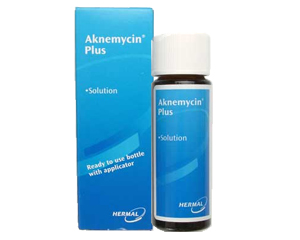
Aknemycin is available as a solution or ointment for direct application to acne-affected skin.
It is most effective for inflammatory acne (red spots and pus-filled spots) rather than purely comedonal acne (blackheads and whiteheads), which responds better to retinoids.
Usage & Dosage
Apply Aknemycin thinly to the entire acne-affected area once or twice daily after washing and drying the skin.
Do not apply to individual spots alone; treating the whole affected zone is more effective at preventing new lesions.
Wash your face with a gentle, non-abrasive cleanser before application. Allow the skin to dry fully before applying the medication.
If combining with benzoyl peroxide, apply them at different times of day (for example, erythromycin in the morning and benzoyl peroxide at night) to reduce irritation.
Results may take six to eight weeks to become apparent. Continue treatment for the full course prescribed, even if your skin improves earlier.
Apply a thin layer of Aknemycin solution or ointment to the affected areas once or twice daily. The precise amount depends on the size of the area being treated.
Avoid contact with the eyes, mouth, and mucous membranes.
Treatment courses typically last 8 to 12 weeks. Prolonged use beyond 12 weeks is not recommended as monotherapy due to increasing antibiotic resistance.
Your prescriber may combine erythromycin with benzoyl peroxide or a retinoid.
Side Effects
Skin dryness, peeling, and mild irritation at the application site are the most commonly reported effects.
A transient burning or stinging sensation may occur, particularly in the first few days of use.
Erythema and pruritus have been reported in a small percentage of patients. Allergic contact dermatitis is uncommon but possible.
Systemic side effects are negligible with topical application, as absorption through the skin is minimal.
Prolonged use increases the risk of colonisation with erythromycin-resistant bacteria, which may reduce the treatment's efficacy over time.
Rarely, patients may develop secondary fungal infection (such as candidiasis) due to disruption of the skin's normal microbial flora.
Warnings & Precautions
Topical erythromycin should ideally be used in combination with a non-antibiotic antimicrobial such as benzoyl peroxide to limit the development of antibiotic-resistant C. acnes strains.
Avoid concurrent use with topical clindamycin, as cross-resistance between macrolides and lincosamides is common.
If the acne does not respond to topical antibiotics after 12 weeks, or if it is severe, referral for oral treatment (such as oral antibiotics or isotretinoin) may be appropriate.
Inform your prescriber if you are pregnant or breastfeeding. Topical erythromycin is generally considered low risk in pregnancy but should be used only when necessary.
Contraindications
Aknemycin is contraindicated in individuals with known hypersensitivity to erythromycin or other macrolide antibiotics, or to any excipient in the formulation.
Avoid application to eczematous or significantly broken skin, as this may increase absorption and the risk of adverse effects.