Azyter
Incl. online consultation, medicine and discreet delivery
View Options
The medical information on this site is provided for educational purposes. It does not replace a face-to-face consultation with your GP or specialist. Always follow the advice of your prescribing doctor and read the patient information leaflet supplied with your medication.
Choose Your Medicine
Select dosage and quantity
Online Consultation
Reviewed by a qualified physician
Fast, Discreet Delivery
Delivered to your door
Medical Information
About This Medicine
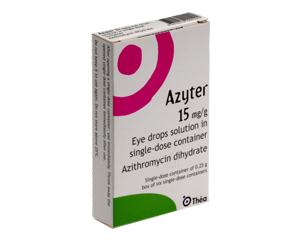
Azyter contains azithromycin 1.5%, a macrolide antibiotic formulated as preservative-free eye drops.
It is prescribed for the treatment of bacterial conjunctivitis caused by susceptible organisms, including trachomatous conjunctivitis caused by Chlamydia trachomatis in children and adults.
Azithromycin binds to the 50S ribosomal subunit of susceptible bacteria, inhibiting protein synthesis and exerting bacteriostatic or bactericidal activity depending on the concentration and organism.
When applied topically to the eye, it achieves high sustained tissue concentrations in the conjunctiva and meibomian glands due to its lipophilic properties and long tissue half-life.
Practical Advantages
Azyter requires only twice-daily dosing for three days, which is shorter and more convenient than most other topical ophthalmic antibiotics (typically four times daily for seven days).
This brevity improves adherence, particularly in children. The preservative-free single-dose containers also reduce the risk of ocular surface irritation.
Azyter is not suitable for viral or allergic conjunctivitis and should only be used when bacterial infection is suspected or confirmed.
Usage & Dosage
How to Use Azyter Eye Drops
Wash your hands. Tilt your head back and gently pull down the lower eyelid to create a small pocket. Squeeze one drop into the pocket. Close your eye gently for one to two minutes.
Do not blink vigorously. Repeat for the other eye if both are affected.
Dosing Schedule
Instil one drop in the affected eye(s) twice daily (morning and evening) for three days. The complete course is six doses.
Single-Dose Containers
Each container is for single use only. Discard any remaining solution after use. Do not store opened containers.
Contact Lenses
Remove contact lenses before instilling the drops. Do not reinsert lenses while symptoms of conjunctivitis are present.
Adults and Children (Including Neonates)
- 1 drop in the affected eye(s) twice daily for 3 days
Trachoma
- 1 drop in each eye twice daily for 3 days
- May be used in mass treatment programmes
No Dose Adjustment
- Systemic absorption is negligible; no dose adjustment for renal, hepatic, or age-related factors
Duration
- Do not extend beyond 3 days without clinical reassessment
- If symptoms persist after the course, consider alternative diagnosis or treatment
Side Effects
Common (up to 1 in 10 patients)
- Ocular discomfort (stinging, burning, or itching) immediately after instillation
- Blurred vision (transient, lasting a few minutes)
- Sticky sensation in the eye
Uncommon (up to 1 in 100 patients)
- Conjunctival hyperaemia (redness)
- Tearing (lacrimation)
- Eyelid oedema
Rare (up to 1 in 1,000 patients)
- Allergic conjunctivitis
- Corneal erosion (superficial punctate keratitis)
- Eczema of the eyelid
Very Rare (fewer than 1 in 10,000 patients)
- Angioedema
- Anaphylaxis
Transient blurred vision is the most commonly noticed effect and clears within a few minutes. Avoid driving immediately after instillation if vision is affected.
Warnings & Precautions
Not for Systemic Use
Azyter is for ocular (topical) use only. Do not swallow or inject.
Antibiotic Stewardship
Use only when bacterial conjunctivitis is clinically suspected. Most viral conjunctivitis resolves without antibiotics; unnecessary use promotes resistance.
Cross-Resistance
Azithromycin shares cross-resistance with erythromycin and other macrolides.
If the patient has recently used a macrolide antibiotic (including erythromycin eye ointment), susceptibility cannot be assumed.
Pregnancy and Breastfeeding
Systemic absorption from eye drops is minimal. Animal studies show no teratogenicity. Use during pregnancy only if clearly needed and discuss with your prescriber.
Azithromycin is excreted in breast milk in small amounts but systemic exposure from eye drops is negligible.
Contraindications
Do not use Azyter if you have a known hypersensitivity to azithromycin, any other macrolide antibiotic (e.g., erythromycin, clarithromycin), or any excipient in the formulation.
Azyter is for topical ophthalmic use only and must not be injected or ingested.
Do not use in viral conjunctivitis (e.g., adenoviral) or allergic conjunctivitis, as antibiotics are ineffective in these conditions and their use promotes resistance.