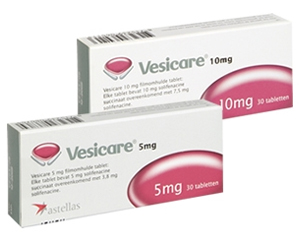
Vesicare
Incl. online consultation, medicine and discreet delivery
View Options
The medical information on this site is provided for educational purposes. It does not replace a face-to-face consultation with your GP or specialist. Always follow the advice of your prescribing doctor and read the patient information leaflet supplied with your medication.
Choose Your Medicine
Select dosage and quantity
Online Consultation
Reviewed by a qualified physician
Fast, Discreet Delivery
Delivered to your door
Medical Information
About This Medicine
Vesicare is the brand name for solifenacin succinate, an antimuscarinic medication prescribed for the symptomatic treatment of overactive bladder (OAB).
It is used to manage urinary urgency, increased urinary frequency, and urge incontinence in adults whose symptoms have not responded sufficiently to non-pharmacological measures.
Solifenacin works by selectively blocking muscarinic M3 receptors in the detrusor muscle of the bladder wall.
These receptors normally respond to acetylcholine by triggering involuntary bladder contractions.
By inhibiting this action, Vesicare reduces the frequency and intensity of uninhibited contractions, allowing the bladder to hold more urine and reducing the sensation of urgency.
Clinical studies have demonstrated that Vesicare significantly reduces the number of urgency episodes, micturitions, and incontinence episodes per day compared with placebo.
Patients typically begin to notice improvement within the first week of treatment, with the full therapeutic effect developing over several weeks of continued use.
Usage & Dosage
Take one Vesicare tablet by mouth once daily with a glass of water.
The tablet may be taken with or without food at any time of day, though taking it at the same time each day helps maintain consistent drug levels.
Swallow the tablet whole; do not crush, chew, or split it. Continue treatment as directed by your doctor, even if symptoms improve, as overactive bladder is a chronic condition.
The recommended starting dose is 5 mg once daily. If the response after 4 weeks is insufficient and the medication is well tolerated, your doctor may increase the dose to 10 mg once daily.
In patients with moderate hepatic impairment or severe renal impairment, the maximum dose is 5 mg. Vesicare should not be used in patients with severe hepatic impairment.
Side Effects
Very common (more than 1 in 10): dry mouth. Common (1 in 10 to 1 in 100): blurred vision, constipation, nausea, dyspepsia, abdominal pain.
Uncommon (1 in 100 to 1 in 1,000): urinary tract infection, drowsiness, dry eyes, gastro-oesophageal reflux, dry skin.
Rare (1 in 1,000 to 1 in 10,000): urinary retention, large bowel obstruction, faecal impaction. Very rare (less than 1 in 10,000): hallucinations, confusion, QT prolongation.
Dry mouth is the most frequently reported side effect but is usually mild.
Warnings & Precautions
Use with caution in patients with reduced gastrointestinal motility, risk of urinary retention (such as significant bladder outflow obstruction or benign prostatic hyperplasia), narrow-angle glaucoma, or hepatic and renal impairment.
Antimuscarinics may exacerbate cognitive impairment in elderly patients, particularly those with dementia. Monitor for signs of urinary retention and constipation.
If blurred vision or dizziness occurs, patients should exercise caution when driving or operating machinery.
Contraindications
Vesicare is contraindicated in patients with urinary retention, severe gastrointestinal conditions including toxic megacolon, uncontrolled narrow-angle glaucoma, myasthenia gravis, severe hepatic impairment, and in patients undergoing haemodialysis.
It must not be used in patients with a known hypersensitivity to solifenacin or any of the excipients.