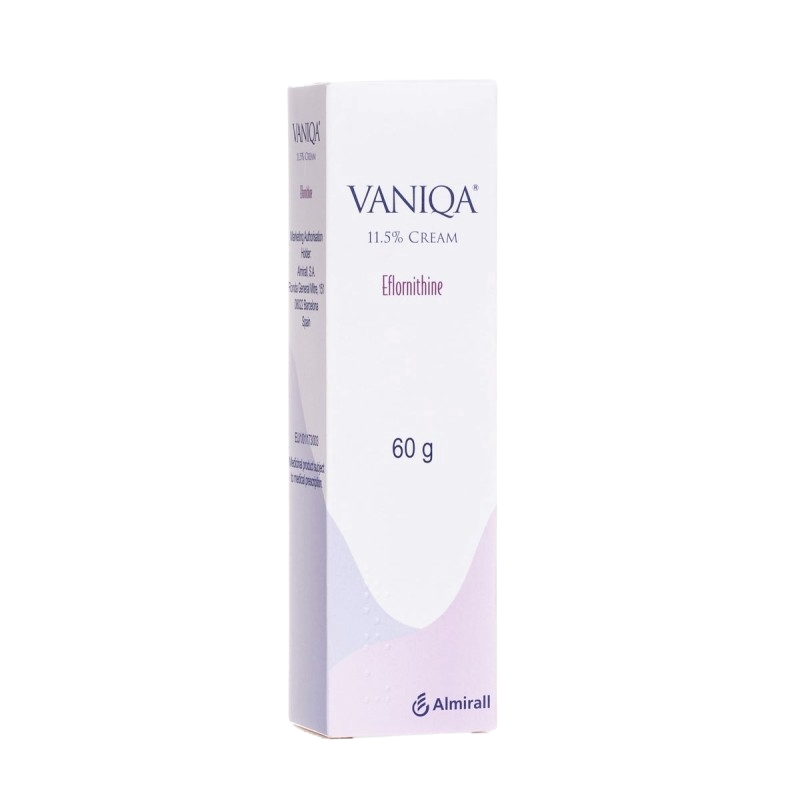
Vaniqa
Incl. online consultation, medicine and discreet delivery
View Options
The medical information on this site is provided for educational purposes. It does not replace a face-to-face consultation with your GP or specialist. Always follow the advice of your prescribing doctor and read the patient information leaflet supplied with your medication.
Choose Your Medicine
Select dosage and quantity
Online Consultation
Reviewed by a qualified physician
Fast, Discreet Delivery
Delivered to your door
Medical Information
About This Medicine
Vaniqa is a prescription cream containing eflornithine, an irreversible inhibitor of ornithine decarboxylase, an enzyme essential for hair follicle cell division and function.
It is licensed specifically for the treatment of facial hirsutism (excessive facial hair growth) in women.
Unlike hair removal methods that act on existing hair, eflornithine slows the rate of hair growth at the follicular level.
The cream is applied to affected areas of the face and adjacent chin and does not remove hair that is already present.
For this reason, patients should continue their usual hair removal method (such as shaving, threading, or waxing) while using Vaniqa.
Over time, most women notice that hair regrowth becomes finer, lighter, and slower, reducing the frequency and burden of hair removal.
Clinical trials demonstrated that approximately 60% of women treated with eflornithine cream showed clinically meaningful improvement after 24 weeks.
Improvement typically becomes noticeable after eight weeks of consistent use. If treatment is stopped, hair growth returns to its pre-treatment rate within about eight weeks.
Usage & Dosage
Apply a thin layer of cream to the affected areas of the face and under the chin twice daily, at least eight hours apart. Rub in thoroughly.
Do not wash the treated areas for at least four hours after application. Cosmetics and sunscreen may be applied over the cream once it has dried.
Continue your usual hair removal technique; you may apply the cream at least five minutes after shaving or other hair removal.
Treatment should be reassessed after four months; discontinue if no improvement is seen.
Apply approximately 0.5 g of cream (a thin layer) to each affected area of the face twice daily.
The maximum total daily application should not exceed the amount needed to cover the affected facial areas. Treatment is continuous; reassess at four months.
No dose adjustment is required for hepatic or renal impairment based on current data, as systemic absorption is low.
Side Effects
Common (1 in 10 to 1 in 100): acne, skin burning or stinging sensation on application.
Common: dry skin, hair loss (alopecia at application site, which is the intended effect), itching, redness, tingling, or rash. Uncommon: ingrown hairs, facial oedema, dermatitis.
Most local reactions are mild and transient.
If severe skin irritation develops or persists, reduce the frequency of application to once daily or discontinue temporarily until the irritation resolves.
Warnings & Precautions
Vaniqa is for facial use only; do not apply to other body areas. Avoid contact with eyes, nose, and mouth. If the cream gets into the eyes, rinse thoroughly with water.
The treatment is cosmetic rather than curative; hair growth will return to its previous rate if the cream is stopped.
Investigate the underlying cause of hirsutism, particularly in women with recent-onset or rapidly worsening symptoms, as this may indicate an androgen-producing disorder requiring further evaluation.
Contraindications
Contraindicated in patients with known hypersensitivity to eflornithine hydrochloride or any of the cream's excipients.
Not recommended for use in children or adolescents under 12 years of age due to lack of safety data. Not intended for use by men.