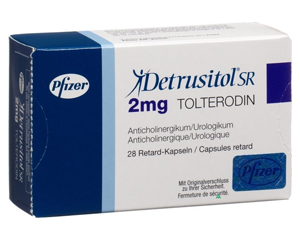
Detrusitol
Incl. online consultation, medicine and discreet delivery
View Options
The medical information on this site is provided for educational purposes. It does not replace a face-to-face consultation with your GP or specialist. Always follow the advice of your prescribing doctor and read the patient information leaflet supplied with your medication.
Choose Your Medicine
Select dosage and quantity
Online Consultation
Reviewed by a qualified physician
Fast, Discreet Delivery
Delivered to your door
Medical Information
About This Medicine
Detrusitol contains tolterodine tartrate. This is an antimuscarinic medicine, also called an anticholinergic. It calms the bladder. Doctors use it to treat an overactive bladder (OAB).
It helps with a sudden urge to pass urine, the need to go often, and leaks linked to that urge. It is one of the most widely prescribed bladder-calming medicines.
With an overactive bladder, the bladder muscle (the detrusor) squeezes when it should stay relaxed. This happens while the bladder is filling. It gives you a sudden, strong need to urinate.
Tolterodine blocks muscarinic receptors on this muscle. These are the tiny switches that make the muscle contract. Blocking them reduces the number and strength of unwanted squeezes.
Your bladder can then hold more urine.
Tolterodine is fairly selective for the bladder receptors over those in the salivary glands. In plain terms, it acts more on the bladder than on the glands that make saliva.
So it tends to cause less dry mouth than some older medicines, such as oxybutynin. It comes as an immediate-release tablet and an extended-release (XL) capsule.
Doctors usually prescribe Detrusitol after you have tried simpler steps first. These include bladder training, managing how much you drink, and pelvic floor exercises.
You may get more benefit if you keep up these habits while taking the medicine.
Usage & Dosage
For the immediate-release tablets: take one 2 mg tablet twice daily. You can take it with or without food. For the extended-release capsule (Detrusitol XL): take one 4 mg capsule once daily.
Swallow it whole with water. Do not crush or chew the extended-release capsule.
Take the medicine at the same time each day. Keep taking it for as long as your prescriber advises. If your symptoms do not get better after four to eight weeks, ask for a review of your treatment.
Cut down on caffeine and alcohol, as both can make bladder symptoms worse. Drink enough fluid, around 1.5 litres a day. This helps prevent urinary tract infections.
Immediate-release: 2 mg twice daily. Your prescriber may lower this to 1 mg twice daily if side effects bother you. Extended-release: 4 mg once daily. This can be lowered to 2 mg once daily if needed.
Some people need a lower dose. This applies if you have marked liver problems or severe kidney problems (a GFR below 30 mL/min).
In these cases the dose drops to 1 mg twice daily for the immediate-release form, or 2 mg once daily for the extended-release form.
A lower dose is also advised if you take tolterodine with strong CYP3A4 inhibitors. These are medicines that slow how your body breaks tolterodine down.
Side Effects
Dry mouth is the most common side effect. It affects about 20 to 30 per cent of people on the immediate-release form. The extended-release form causes it less often, in about 12 per cent of people.
Constipation, indigestion (dyspepsia), tummy pain, and headache are also common.
You may get dry eyes, blurred vision, or dizziness. Urinary retention can also happen. This means you cannot empty your bladder properly.
It may seem odd for a bladder medicine, but it can occur if the bladder muscle relaxes too much. It is more likely in men with an enlarged prostate.
Effects on the mind, such as confusion and memory problems, are a worry in older people. Hallucinations have been reported, but rarely.
A fast heartbeat (tachycardia) and swelling in the legs and feet (peripheral oedema) are uncommon effects on the heart and circulation.
Allergic reactions, including swelling under the skin (angioedema), are rare.
Warnings & Precautions
Use Detrusitol with care in older people. They have a higher risk of confusion, memory problems, and falls. Antimuscarinics can make existing memory decline worse.
In people with dementia, avoid this medicine or use the lowest dose.
Detrusitol is not suitable for some people.
Do not use it if you have urinary retention (you cannot pass urine), a severe blockage in the gut, uncontrolled narrow-angle glaucoma (a serious eye condition with raised pressure), or myasthenia gravis (a muscle-weakness disease).
If you have a history of QT prolongation, a heart rhythm change seen on an ECG, you need monitoring. At high doses tolterodine may prolong the QT interval.
Tell your prescriber about every other medicine you take. This is important for other anticholinergic medicines, because their effects can add up.
Contraindications
Do not use Detrusitol if you have any of the following.
These include urinary retention (you cannot pass urine), uncontrolled narrow-angle glaucoma (a serious eye condition with raised pressure), myasthenia gravis (a muscle-weakness disease), severe ulcerative colitis, or toxic megacolon.
Also avoid it if you are allergic to tolterodine or fesoterodine.
Do not use it if you have severe liver problems (Child-Pugh class C). Take care if you have marked kidney problems.