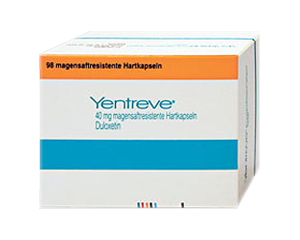
Yentreve
Incl. online consultation, medicine and discreet delivery
View Options
The medical information on this site is provided for educational purposes. It does not replace a face-to-face consultation with your GP or specialist. Always follow the advice of your prescribing doctor and read the patient information leaflet supplied with your medication.
Choose Your Medicine
Select dosage and quantity
Online Consultation
Reviewed by a qualified physician
Fast, Discreet Delivery
Delivered to your door
Medical Information
About This Medicine
Yentreve contains duloxetine, a serotonin and noradrenaline reuptake inhibitor (SNRI), licensed in this formulation for the treatment of moderate to severe stress urinary incontinence (SUI) in women.
It is prescribed when pelvic floor muscle training alone has not provided adequate symptom control.
Stress urinary incontinence is the involuntary leakage of urine during physical activities that increase abdominal pressure, such as coughing, sneezing, laughing, or lifting.
It results from weakness of the urethral sphincter and pelvic floor muscles, commonly following childbirth, menopause, or pelvic surgery.
Duloxetine increases the levels of serotonin and noradrenaline in the sacral spinal cord, which enhances the activity of the pudendal nerve and strengthens the contraction of the urethral striated sphincter during the storage phase of the bladder cycle.
This pharmacological action reduces the frequency of incontinence episodes.
Yentreve is intended as part of a comprehensive management plan that includes pelvic floor exercises.
Clinical trials have shown that duloxetine, combined with pelvic floor muscle training, significantly reduces incontinence episode frequency compared with either approach alone.
Usage & Dosage
Take one 40 mg capsule twice daily, swallowed whole with water. Do not open, crush, or chew the capsule, as the contents are enteric-coated. The medication may be taken with or without food.
Your prescriber may start you on a lower dose of 20 mg twice daily for the first two weeks to minimise side effects, before increasing to the full dose.
Continue taking Yentreve for as long as your prescriber recommends.
Do not stop taking Yentreve abruptly, as withdrawal symptoms such as dizziness, nausea, headache, and irritability may occur.
Your prescriber will advise a gradual dose reduction when discontinuing treatment.
The recommended dose is 40 mg twice daily. A starting dose of 20 mg twice daily for two weeks may be used to improve tolerability. The maximum dose is 40 mg twice daily.
Dose reduction may be necessary in patients with moderate hepatic impairment. Yentreve is not recommended in severe hepatic impairment or in patients with end-stage renal disease.
No dose adjustment is needed for mild to moderate renal impairment.
Side Effects
Nausea is the most frequently reported side effect, affecting up to 25 per cent of patients, particularly during the first weeks of treatment.
It is usually mild to moderate and tends to resolve with continued use.
Other common effects include dry mouth, constipation, dizziness, insomnia, fatigue, and headache. Decreased appetite, sweating, and tremor have also been reported.
Less commonly, patients may experience palpitations, blurred vision, increased blood pressure, or sexual dysfunction.
Rare but serious effects include hepatotoxicity, serotonin syndrome (particularly when combined with other serotonergic drugs), and suicidal ideation.
Abrupt discontinuation can cause a withdrawal syndrome characterised by dizziness, anxiety, nausea, diarrhoea, sensory disturbances, and sleep disruption.
Warnings & Precautions
Monitor blood pressure during treatment, as duloxetine may cause sustained increases in blood pressure. Patients with pre-existing hypertension should be managed carefully.
Yentreve should be used with caution in patients with a history of mania, seizures, glaucoma, or bleeding disorders.
Concurrent use of other serotonergic medications, including SSRIs, tramadol, and triptans, increases the risk of serotonin syndrome.
Do not combine Yentreve with monoamine oxidase inhibitors (MAOIs) or within 14 days of discontinuing an MAOI. Inform your prescriber if you are pregnant, planning a pregnancy, or breastfeeding.
Contraindications
Yentreve is contraindicated in patients with known hypersensitivity to duloxetine or any excipient.
It must not be used concurrently with MAOIs, fluvoxamine, ciprofloxacin, or enoxacin (potent CYP1A2 inhibitors).
It is contraindicated in patients with uncontrolled hypertension, severe hepatic impairment, or end-stage renal disease (creatinine clearance below 30 mL/min).