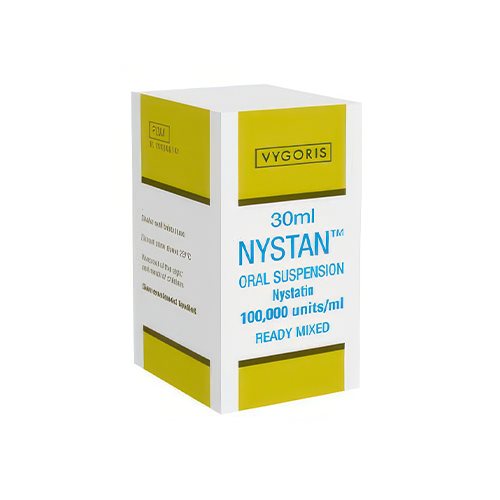
Nystan
Incl. online consultation, medicine and discreet delivery
View Options
The medical information on this site is provided for educational purposes. It does not replace a face-to-face consultation with your GP or specialist. Always follow the advice of your prescribing doctor and read the patient information leaflet supplied with your medication.
Choose Your Medicine
Select dosage and quantity
Online Consultation
Reviewed by a qualified physician
Fast, Discreet Delivery
Delivered to your door
Medical Information
About This Medicine
Nystatin is a polyene antifungal antibiotic used to treat infections caused by Candida species, most commonly oral thrush (oral candidiasis) and intestinal candidiasis.
It is derived from Streptomyces noursei and works by binding to ergosterol in the fungal cell membrane, creating pores that disrupt membrane integrity and lead to cell death.
Because nystatin is very poorly absorbed from the gastrointestinal tract, it acts locally within the mouth or gut lumen and carries virtually no systemic toxicity.
This makes it a particularly safe choice for treating mucosal candidiasis in a broad range of patients, including neonates, immunocompromised individuals, and those on prolonged antibiotic or corticosteroid therapy.
Nystatin is available as an oral suspension, pastilles, tablets, and topical preparations.
The oral suspension is the most widely used formulation for oropharyngeal thrush, and treatment is straightforward when the medication is used correctly and for the recommended duration.
Usage & Dosage
For oral thrush, use the suspension by placing the dose in the mouth, holding it there and swishing it around the oral cavity for as long as possible (ideally one to two minutes) before swallowing.
This ensures prolonged contact between the drug and the infected mucosal surfaces. Treat after meals and oral hygiene routines.
For pastilles, allow them to dissolve slowly in the mouth without chewing. Continue treatment for at least 48 hours after symptoms have resolved to reduce the risk of relapse.
Oral suspension for thrush in adults: 1 mL (100,000 units) four times daily, dropped into the mouth. In severe or refractory cases the dose may be increased to 5 mL (500,000 units) four times daily.
Pastilles: one pastille (100,000 units) four times daily after meals. For intestinal candidiasis: 500,000 units (tablets) three times daily. Courses typically last seven to fourteen days.
Side Effects
Common: nausea and vomiting at higher doses, mild gastrointestinal discomfort including diarrhoea. Uncommon: oral irritation or sensitisation, skin rash.
The side-effect profile is very favourable because systemic absorption is negligible. Serious adverse events are exceedingly rare.
Allergic reactions including angioedema have been reported on isolated occasions. If a rash or swelling develops, discontinue and seek medical advice.
Warnings & Precautions
Nystatin suspension often contains sucrose; patients with diabetes should be aware of the sugar content and may prefer pastilles or sugar-free formulations where available.
Denture wearers should remove dentures before applying the suspension and clean dentures thoroughly to prevent reinfection.
If symptoms persist beyond fourteen days despite appropriate use, reassess the diagnosis and consider systemic antifungal treatment.
Nystatin is not effective against dermatophyte infections or systemic fungal disease.
Contraindications
Contraindicated in patients with known hypersensitivity to nystatin or any of the excipients in the formulation.
There are no absolute contraindications relating to organ function, as systemic absorption is negligible.
However, nystatin should not be relied upon for invasive or systemic candidiasis, where intravenous antifungal agents are required.