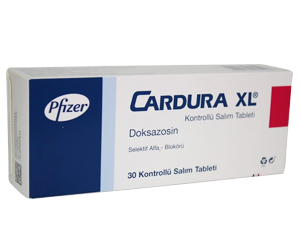
Cardura
Incl. online consultation, medicine and discreet delivery
View Options
The medical information on this site is provided for educational purposes. It does not replace a face-to-face consultation with your GP or specialist. Always follow the advice of your prescribing doctor and read the patient information leaflet supplied with your medication.
Choose Your Medicine
Select dosage and quantity
Online Consultation
Reviewed by a qualified physician
Fast, Discreet Delivery
Delivered to your door
Medical Information
About This Medicine
Cardura contains doxazosin, an alpha-1 adrenergic receptor antagonist used to treat hypertension (high blood pressure) and the urinary symptoms associated with benign prostatic hyperplasia (BPH).
It is one of the most commonly prescribed alpha-blockers for both of these conditions.
Doxazosin works by selectively blocking alpha-1 receptors in vascular smooth muscle and the prostate gland.
In the vasculature, this causes arterial and venous dilation, reducing peripheral vascular resistance and lowering blood pressure.
In the prostate, alpha-1 blockade relaxes smooth muscle in the prostate capsule, bladder neck, and prostatic urethra, improving urine flow and reducing symptoms of urinary obstruction.
Cardura is available as standard tablets (requiring once-daily dosing) and as modified-release (XL) tablets.
The XL formulation provides smoother blood levels throughout the day and is associated with a reduced incidence of first-dose hypotension compared to the standard tablet.
Doxazosin also has a favourable effect on lipid profiles, modestly reducing LDL cholesterol and triglycerides.
Usage & Dosage
Take once daily. Standard tablets can be taken with or without food.
The first dose should be taken at bedtime to minimise the risk of first-dose hypotension (a sudden drop in blood pressure upon standing).
Modified-release (XL) tablets should be swallowed whole - do not crush, chew, or break. The dose is titrated gradually upwards based on clinical response and tolerability.
Hypertension (standard tablets): start at 1 mg once daily, increase to 2 mg after 1-2 weeks, then to 4 mg if needed. Maximum: 16 mg daily.
BPH (standard tablets): start at 1 mg once daily, titrate to 2-4 mg; maximum 8 mg daily. Modified-release (XL): start at 4 mg once daily; may increase to 8 mg.
Standard and XL formulations are not interchangeable on a milligram-for-milligram basis.
Side Effects
Common (1 in 10 to 1 in 100): dizziness, headache, fatigue, peripheral oedema, and postural hypotension - particularly after the first dose or dose increases.
Uncommon (1 in 100 to 1 in 1,000): nausea, rhinitis, vertigo, palpitations, and drowsiness.
Rare (less than 1 in 1,000): priapism (painful, prolonged erection requiring urgent medical attention), intraoperative floppy iris syndrome (relevant if cataract surgery is planned), urinary incontinence, and hepatitis.
First-dose syncope (fainting) can occur but is reduced with bedtime dosing and gradual titration.
Warnings & Precautions
Take the first dose at bedtime and rise carefully the next morning. Postural hypotension can cause dizziness or fainting, especially at the start of treatment.
Inform your ophthalmologist before cataract surgery, as doxazosin can cause intraoperative floppy iris syndrome.
Use caution when driving or operating machinery until the effects of the medication are known. Concurrent use with PDE5 inhibitors (e.g., sildenafil) can enhance hypotensive effects.
Contraindications
Known allergy to doxazosin, other quinazoline derivatives, or any excipient. History of orthostatic hypotension.
Benign prostatic hyperplasia with concurrent upper urinary tract obstruction, chronic urinary tract infection, or bladder stones (these require surgical evaluation).
Monotherapy for overflow incontinence or anuria. Severe hepatic impairment.