Clenil Modulite
Incl. online consultation, medicine and discreet delivery
View Options
The medical information on this site is provided for educational purposes. It does not replace a face-to-face consultation with your GP or specialist. Always follow the advice of your prescribing doctor and read the patient information leaflet supplied with your medication.
Choose Your Medicine
Select dosage and quantity
Online Consultation
Reviewed by a qualified physician
Fast, Discreet Delivery
Delivered to your door
Medical Information
About This Medicine
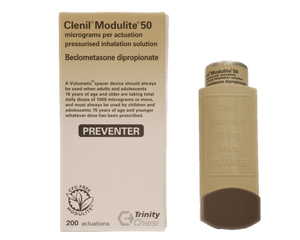
Clenil Modulite is a pressurised metered-dose inhaler containing beclometasone dipropionate, a corticosteroid used for the regular preventive management of asthma.
It is prescribed for adults and children who require ongoing anti-inflammatory treatment to control airway inflammation and reduce the frequency and severity of asthma attacks.
Beclometasone works by suppressing the inflammatory processes within the bronchial airways.
It reduces swelling, mucus production, and hypersensitivity of the air passages, making them less likely to constrict in response to triggers such as allergens, cold air, or exercise.
Because it acts locally within the lungs, systemic absorption is kept to a minimum at standard doses.
Clenil Modulite uses a CFC-free propellant (HFA-134a), which produces a finer aerosol mist compared with older formulations. This improves drug deposition in the lower airways.
Patients switching from older beclometasone inhalers should be aware that Clenil Modulite may deliver a different effective dose, and their prescriber will adjust accordingly.
As a preventer inhaler, Clenil Modulite must be used every day, even when you feel well.
It does not provide rapid relief during an acute asthma attack; a separate reliever inhaler such as salbutamol is needed for that purpose.
Usage & Dosage
Use Clenil Modulite regularly, twice daily, as directed by your prescriber. Shake the inhaler well before each use and breathe out gently before placing the mouthpiece between your lips.
Press the canister and breathe in slowly and deeply, then hold your breath for about ten seconds before exhaling normally.
Always rinse your mouth with water after each dose and spit it out. This reduces the risk of oral thrush and hoarseness.
If you have difficulty coordinating the press-and-breathe technique, your doctor or pharmacist may recommend using a spacer device.
Do not stop using Clenil Modulite without medical advice, even if your symptoms improve. Stopping abruptly can lead to a worsening of asthma control.
If you miss a dose, take it as soon as you remember unless it is nearly time for the next dose.
Adults typically use 200 to 400 micrograms daily, divided into two doses. In more severe asthma, the dose may be increased to up to 800 micrograms daily under specialist supervision.
Children aged 5 to 12 years usually receive 100 to 200 micrograms twice daily.
Your prescriber will set the lowest dose that effectively controls your symptoms. Dose adjustments should be reviewed every three months.
A spacer device is recommended for children and for adults using higher doses to improve lung deposition and reduce local side effects.
Side Effects
Oral thrush (candidiasis of the mouth and throat) affects roughly 5 to 10 per cent of users and is largely preventable by rinsing the mouth after each dose.
Hoarseness or dysphonia occurs in a similar proportion of patients and usually resolves with continued use or dose adjustment.
Less commonly, patients may experience throat irritation, cough immediately after inhalation, or a mild headache. Bruising of the skin has been reported occasionally.
At high doses used over prolonged periods, systemic effects become more relevant.
These include adrenal suppression, reduced bone mineral density, growth retardation in children, and posterior subcapsular cataracts. Such effects are uncommon at standard preventive doses.
Paradoxical bronchospasm is a rare but recognised reaction. If wheezing worsens immediately after inhalation, discontinue the inhaler and use your reliever. Seek medical review promptly.
Warnings & Precautions
Clenil Modulite is not designed to relieve acute bronchospasm. Always carry a short-acting bronchodilator for sudden symptoms.
If you find yourself needing your reliever inhaler more than twice a week, your asthma may be poorly controlled and you should seek a medical review.
Patients transferring from oral corticosteroids to inhaled therapy must have their steroid dose reduced gradually under supervision.
Abrupt withdrawal of oral steroids can cause adrenal insufficiency, which may be life-threatening during intercurrent illness or surgery.
Children on long-term inhaled corticosteroids should have their height monitored regularly.
Inform your doctor if you develop any signs of infection in the mouth or throat, visual disturbances, or unusual tiredness.
Contraindications
Clenil Modulite should not be used by individuals with a known hypersensitivity to beclometasone dipropionate or any of the inhaler's excipients.
It is not indicated as first-line treatment for acute asthma attacks or status asthmaticus.
Patients with active or quiescent pulmonary tuberculosis require careful assessment before starting inhaled corticosteroids.
The same applies to those with untreated fungal, bacterial, or viral infections of the airways.