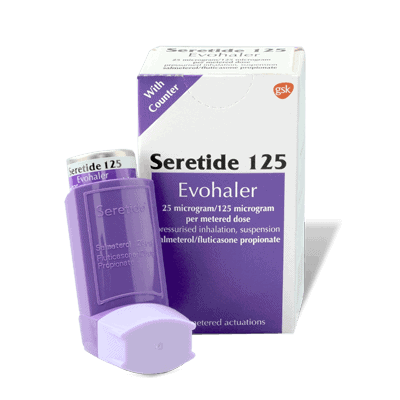
Seretide
Incl. online consultation, medicine and discreet delivery
View Options
The medical information on this site is provided for educational purposes. It does not replace a face-to-face consultation with your GP or specialist. Always follow the advice of your prescribing doctor and read the patient information leaflet supplied with your medication.
Choose Your Medicine
Select dosage and quantity
Online Consultation
Reviewed by a qualified physician
Fast, Discreet Delivery
Delivered to your door
Medical Information
About This Medicine
Seretide is a combination inhaler. It contains two medicines: fluticasone propionate (an inhaled corticosteroid, or ICS) and salmeterol (a long-acting beta-2 agonist, or LABA).
Together they tackle the two main problems in asthma and chronic obstructive pulmonary disease (COPD): swollen, inflamed airways and tight, narrowed airways.
Fluticasone calms inflammation in the airways. This reduces swelling of the lining, cuts back excess mucus, and makes the airways less twitchy. Salmeterol keeps the airways open for about 12 hours.
It does this by acting on beta-2 receptors in the muscle around your airways.
UK guidelines from BTS/SIGN and NICE advise adding a LABA to an ICS (step 3) when a low-dose ICS on its own does not control asthma well enough.
Seretide comes as a metered-dose inhaler (Evohaler) and a dry powder inhaler (Accuhaler), in several strengths. It is one of the most prescribed combination inhalers in the UK.
More than two decades of use have given it a well-established record for long-term safety and effectiveness. Seretide does not replace a reliever inhaler for a sudden tight chest.
Usage & Dosage
Use Seretide regularly twice a day, in the morning and the evening, about 12 hours apart. Use it even when you feel well. This is a preventer, or controller, medicine.
You must take it every day, not just when symptoms flare up. For the Evohaler (the pressurised inhaler): shake it well before each use. Breathe out fully. Put the mouthpiece between your lips.
Press the canister as you breathe in slowly and deeply. Hold your breath for 10 seconds, then breathe out gently. Use a spacer device if you find the timing hard.
For the Accuhaler (the dry powder inhaler): slide the lever to load a dose. Breathe out away from the device. Breathe in hard and deeply through the mouthpiece. Hold your breath for 10 seconds.
Rinse your mouth with water after each use and spit it out. This lowers the risk of oral thrush (candidiasis) and a hoarse voice from the steroid.
Asthma (adults): Seretide 100 Accuhaler (fluticasone 100 mcg with salmeterol 50 mcg) is one inhalation twice a day for mild to moderate asthma.
For moderate to severe asthma, use the Seretide 250 or 500 Accuhaler. Evohaler strengths are 50/25, 125/25, or 250/25 mcg, taken as two puffs twice a day.
COPD: Seretide 500 Accuhaler is one inhalation twice a day. It is licensed for COPD when FEV1 is below 60% predicted and exacerbations keep coming back.
Use the lowest strength that keeps your asthma under control. Your prescriber should try stepping the dose down after 3 months of good control. Do not take more than the prescribed dose.
No dose change is needed for older patients or for mild to moderate kidney or liver problems.
Strong CYP3A4 inhibitors, such as ritonavir or ketoconazole, can raise the amount of fluticasone in your body. Avoid taking them together where possible.
Side Effects
Side effect data comes from the SmPC and clinical trials.
Very common (affects more than 1 in 10): headache and the common cold (nasopharyngitis).
Common (affects 1 in 100 to 1 in 10): thrush in the mouth or throat (oropharyngeal candidiasis), a hoarse voice (dysphonia), a sore throat, muscle cramps, shaking (tremor), a pounding heartbeat (palpitations), and bruising.
Uncommon (affects 1 in 1,000 to 1 in 100): thrush in the mouth, a fast heartbeat (tachycardia), anxiety, trouble sleeping, changes in behaviour (mainly in children), high blood sugar (hyperglycaemia), rash, cataracts, and glaucoma.
Rare (affects 1 in 10,000 to 1 in 1,000): weakened adrenal glands (with long-term, high-dose ICS), slowed growth in children, thinning bones (osteoporosis), sudden airway tightening (paradoxical bronchospasm), a severe allergic reaction (anaphylaxis), Churg-Strauss syndrome (when a steroid dose is reduced), and low potassium (hypokalaemia, more likely with high LABA doses or overuse of another beta-2 agonist).
The risk of steroid effects throughout the body rises with higher ICS doses and longer use. Rinsing your mouth after each dose greatly cuts the chance of thrush.
Warnings & Precautions
Seretide does not relieve a sudden tight chest. You must keep a short-acting reliever inhaler, such as salbutamol, with you at all times.
Using your reliever more often means your asthma is getting worse, so see your doctor. Do not stop Seretide suddenly if you have switched from steroid tablets.
Your adrenal glands may not cope (adrenal insufficiency). Children on long-term ICS should have their growth checked. The MHRA advises that patients on high-dose ICS carry a steroid emergency card.
Taking Seretide with strong CYP3A4 inhibitors (ritonavir, cobicistat, itraconazole, ketoconazole) can cause steroid effects in the body, including Cushing's syndrome and weakened adrenal glands.
Avoid taking them together where possible. Patients with active or dormant lung tuberculosis need a specialist check before using an ICS.
Contraindications
Do not use Seretide if you are allergic to fluticasone propionate, salmeterol, or any other ingredient.
The lactose in the Accuhaler contains milk protein, so it is not suitable if you have a severe milk allergy. Seretide should not be the first treatment you try for asthma.
NICE and BTS advise trying an ICS on its own first, then stepping up. A LABA on its own, without an ICS, must not be used for asthma. Older studies linked this to a higher risk of death.