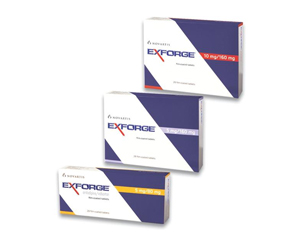
Exforge
Incl. online consultation, medicine and discreet delivery
View Options
The medical information on this site is provided for educational purposes. It does not replace a face-to-face consultation with your GP or specialist. Always follow the advice of your prescribing doctor and read the patient information leaflet supplied with your medication.
Choose Your Medicine
Select dosage and quantity
Online Consultation
Reviewed by a qualified physician
Fast, Discreet Delivery
Delivered to your door
Medical Information
About This Medicine
Exforge is a fixed-dose combination antihypertensive tablet containing amlodipine, a dihydropyridine calcium channel blocker, and valsartan, an angiotensin II receptor blocker (ARB).
The combination targets two complementary mechanisms of blood pressure regulation, providing greater efficacy than either component alone and allowing more patients to reach their blood pressure targets with a single tablet.
Amlodipine relaxes vascular smooth muscle by blocking L-type calcium channels, causing peripheral arterial vasodilatation and reducing vascular resistance.
Valsartan selectively blocks the angiotensin II type 1 (AT1) receptor, preventing the vasoconstrictive, aldosterone-stimulating, and sodium-retaining effects of angiotensin II.
The combination also has the practical benefit of reducing the ankle oedema commonly associated with amlodipine monotherapy, as the venodilatory and natriuretic effects of valsartan partially offset the arteriolar dilatation caused by amlodipine.
Exforge is available in several strength combinations, allowing dose titration to suit individual patient needs.
It is intended for patients whose blood pressure is not adequately controlled on monotherapy or as initial therapy in patients likely to require multiple agents.
Usage & Dosage
Take one tablet once daily at the same time each day, with or without food. Swallow whole with water. Do not split, crush, or chew the tablet.
If you miss a dose, take it as soon as you remember unless it is close to the next scheduled dose; do not take a double dose.
Continue treatment even if you feel well, as hypertension is usually asymptomatic. Attend regular blood pressure checks as advised by your doctor.
Available as amlodipine/valsartan 5 mg/80 mg, 5 mg/160 mg, 10 mg/160 mg, and other combinations. The dose should be individualised based on prior monotherapy response or the severity of hypertension.
Usual starting dose: 5 mg/80 mg once daily, titrated as needed at intervals of one to two weeks. Maximum dose: amlodipine 10 mg / valsartan 320 mg daily.
Dose adjustment may be needed in hepatic impairment (amlodipine clearance is reduced). No dose adjustment required in mild to moderate renal impairment.
Side Effects
Common (1 in 10 to 1 in 100): peripheral oedema (less than with amlodipine alone), headache, nasopharyngitis, influenza-like symptoms, dizziness, fatigue.
Uncommon: postural hypotension, palpitations, nausea, abdominal pain, elevated serum creatinine, hyperkalaemia, back pain.
Rare: angioedema (associated with valsartan), hepatic dysfunction, myalgia, arthralgia. Very rare: gingival hyperplasia (amlodipine-related), erythema multiforme.
The incidence of ankle oedema is notably lower with the combination than with amlodipine monotherapy.
Warnings & Precautions
Monitor blood pressure during dose titration.
Valsartan can cause hyperkalaemia, especially in patients with renal impairment, diabetes, or those taking potassium-sparing agents; monitor potassium and renal function.
Discontinue immediately if angioedema occurs. Amlodipine clearance is reduced in hepatic impairment; start with a lower dose. Do not use with aliskiren in diabetic patients.
If surgery under general anaesthesia is planned, inform the anaesthetist. NSAIDs may reduce the antihypertensive effect and increase renal risk.
Contraindications
Contraindicated in pregnancy (valsartan is fetotoxic and teratogenic in the second and third trimesters), severe hepatic impairment, biliary cirrhosis, cholestasis, known hypersensitivity to amlodipine, valsartan, or other dihydropyridines, severe aortic stenosis, and concomitant use with aliskiren in patients with diabetes or renal impairment (eGFR below 60).