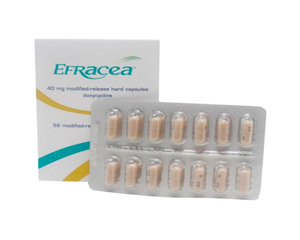
Efracea
Incl. online consultation, medicine and discreet delivery
View Options
The medical information on this site is provided for educational purposes. It does not replace a face-to-face consultation with your GP or specialist. Always follow the advice of your prescribing doctor and read the patient information leaflet supplied with your medication.
Choose Your Medicine
Select dosage and quantity
Online Consultation
Reviewed by a qualified physician
Fast, Discreet Delivery
Delivered to your door
Medical Information
About This Medicine
Efracea (known as Oracea in some markets) contains a sub-antimicrobial dose of doxycycline in a modified-release formulation, specifically designed for the treatment of inflammatory lesions (papules and pustules) of rosacea in adults.
At 40 mg daily, the doxycycline concentration remains below the threshold needed for antimicrobial activity, thereby avoiding the risks of antibiotic resistance and gastrointestinal flora disruption associated with standard antibiotic dosing.
The anti-inflammatory mechanism of sub-antimicrobial dose doxycycline involves the inhibition of matrix metalloproteinases (MMPs), particularly MMP-9, and the suppression of pro-inflammatory cytokines.
These enzymes and mediators play a central role in the tissue damage and inflammation seen in rosacea.
By targeting the inflammatory pathway rather than bacteria, Efracea addresses the pathophysiology of rosacea more precisely.
Clinical studies have demonstrated significant reductions in inflammatory lesion counts after 12 to 16 weeks of treatment.
Efracea does not address the erythema (redness) or telangiectasia of rosacea directly, but by reducing papulopustular inflammation, overall facial appearance often improves substantially.
Usage & Dosage
Take one capsule (40 mg) once daily in the morning on an empty stomach, ideally at least one hour before or two hours after food. Swallow whole with a full glass of water.
Remain upright for at least 30 minutes after taking the capsule to reduce the risk of oesophageal irritation. Treatment duration is typically 12 to 16 weeks.
Continue using any prescribed topical rosacea treatments alongside Efracea as directed by your prescriber.
One modified-release capsule (40 mg doxycycline) once daily.
The modified-release formulation delivers 30 mg as an immediate-release component and 10 mg as delayed release, maintaining steady sub-antimicrobial blood levels.
Standard treatment course is 12 to 16 weeks. Courses may be repeated under medical supervision. No dose adjustment is needed for renal impairment. Avoid in severe hepatic impairment.
Side Effects
Common (1 in 10 to 1 in 100): headache, nausea, diarrhoea, abdominal pain, nasopharyngitis, sinus congestion.
Uncommon: photosensitivity (less than with standard-dose doxycycline but still possible), oesophagitis, vulvovaginal candidiasis, dry mouth, fatigue, elevated liver enzymes.
Rare: benign intracranial hypertension (pseudotumour cerebri), especially if combined with retinoids; photoonycholysis.
The sub-antimicrobial dose minimises the gastrointestinal disturbance commonly seen with higher-dose tetracyclines.
Warnings & Precautions
Avoid excessive sun and UV exposure during treatment and use high-factor sunscreen, as doxycycline increases photosensitivity.
Do not lie down within 30 minutes of taking the capsule to prevent oesophageal ulceration.
Do not use concurrently with oral retinoids (isotretinoin, acitretin), as both can cause raised intracranial pressure.
Antacids, calcium, iron, and dairy products reduce absorption; separate by at least two to three hours.
Although the dose is sub-antimicrobial, Efracea is still classified as a tetracycline and should be avoided in children under 12 and during pregnancy.
Contraindications
Contraindicated in pregnancy (risk of permanent tooth discolouration and impaired bone development in the foetus), breastfeeding, children under 12 years of age, known hypersensitivity to doxycycline or other tetracyclines, and concurrent use with oral retinoids.
Avoid in patients with systemic lupus erythematosus, as tetracyclines may exacerbate the condition.