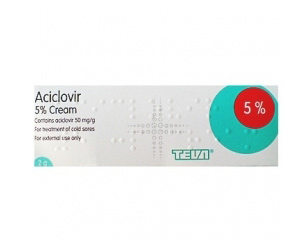
Aciclovir Cream
Incl. online consultation, medicine and discreet delivery
View Options
The medical information on this site is provided for educational purposes. It does not replace a face-to-face consultation with your GP or specialist. Always follow the advice of your prescribing doctor and read the patient information leaflet supplied with your medication.
Choose Your Medicine
Select dosage and quantity
Online Consultation
Reviewed by a qualified physician
Fast, Discreet Delivery
Delivered to your door
Medical Information
About This Medicine
Aciclovir cream is a topical antiviral preparation used for the treatment of herpes simplex virus (HSV) infections of the skin, most commonly cold sores (herpes labialis).
Aciclovir is a nucleoside analogue that, once phosphorylated by viral thymidine kinase and subsequently by host cell enzymes, inhibits viral DNA polymerase, halting viral replication within infected cells.
The topical cream delivers aciclovir directly to the site of infection, where it is selectively activated in virus-infected cells.
Because uninfected cells lack the viral thymidine kinase needed for the first phosphorylation step, aciclovir has a highly favourable selectivity profile with minimal toxicity to normal tissue.
Topical application provides localised antiviral activity without the systemic exposure associated with oral formulations.
For maximum benefit, aciclovir cream should be applied as early as possible in the course of a cold sore outbreak, ideally during the prodromal stage (tingling, itching, or burning sensation) before blisters have formed.
Early treatment can reduce the duration and severity of the episode and may prevent full blister formation in some cases.
Usage & Dosage
Apply a thin layer of cream to the affected area and immediately surrounding skin five times daily, approximately every four hours during waking hours.
Continue treatment for five days; if healing has not occurred, extend to a maximum of ten days.
Start treatment at the earliest sign of a cold sore, ideally when the tingling or burning sensation begins.
Wash hands before and after application to avoid spreading the virus to other sites or to other people.
Apply to the affected area five times daily at approximately four-hourly intervals (omitting the overnight dose). Standard treatment duration is five days.
If the lesion has not healed by day five, treatment may be continued for up to a further five days (total ten days).
For recurrent cold sores, patients should keep a supply of cream available to commence treatment immediately at the first sign of recurrence.
Side Effects
Common: transient burning or stinging sensation on application. Uncommon: mild drying or flaking of the skin at the application site, erythema, pruritus.
Rare: contact dermatitis (allergic reaction to aciclovir or the cream base, particularly propylene glycol).
Systemic absorption from topical application is negligible, and systemic side effects do not occur. If significant local irritation develops, discontinue use and consult your prescriber.
Warnings & Precautions
Aciclovir cream is for cutaneous use only; do not apply to mucous membranes including inside the mouth, nose, or eyes, and do not use intravaginally.
The cream is not effective for genital herpes (oral aciclovir is required).
Immunocompromised patients with recurrent or extensive herpes simplex should be assessed for systemic antiviral therapy rather than relying on topical treatment alone. Avoid applying near the eyes.
The cream does not prevent transmission of HSV to others.
Contraindications
Contraindicated in patients with known hypersensitivity to aciclovir, valaciclovir, or any excipient of the cream (commonly propylene glycol, which is a known sensitiser in a small proportion of individuals).
Not suitable for the treatment of ophthalmic herpes (herpes keratitis).