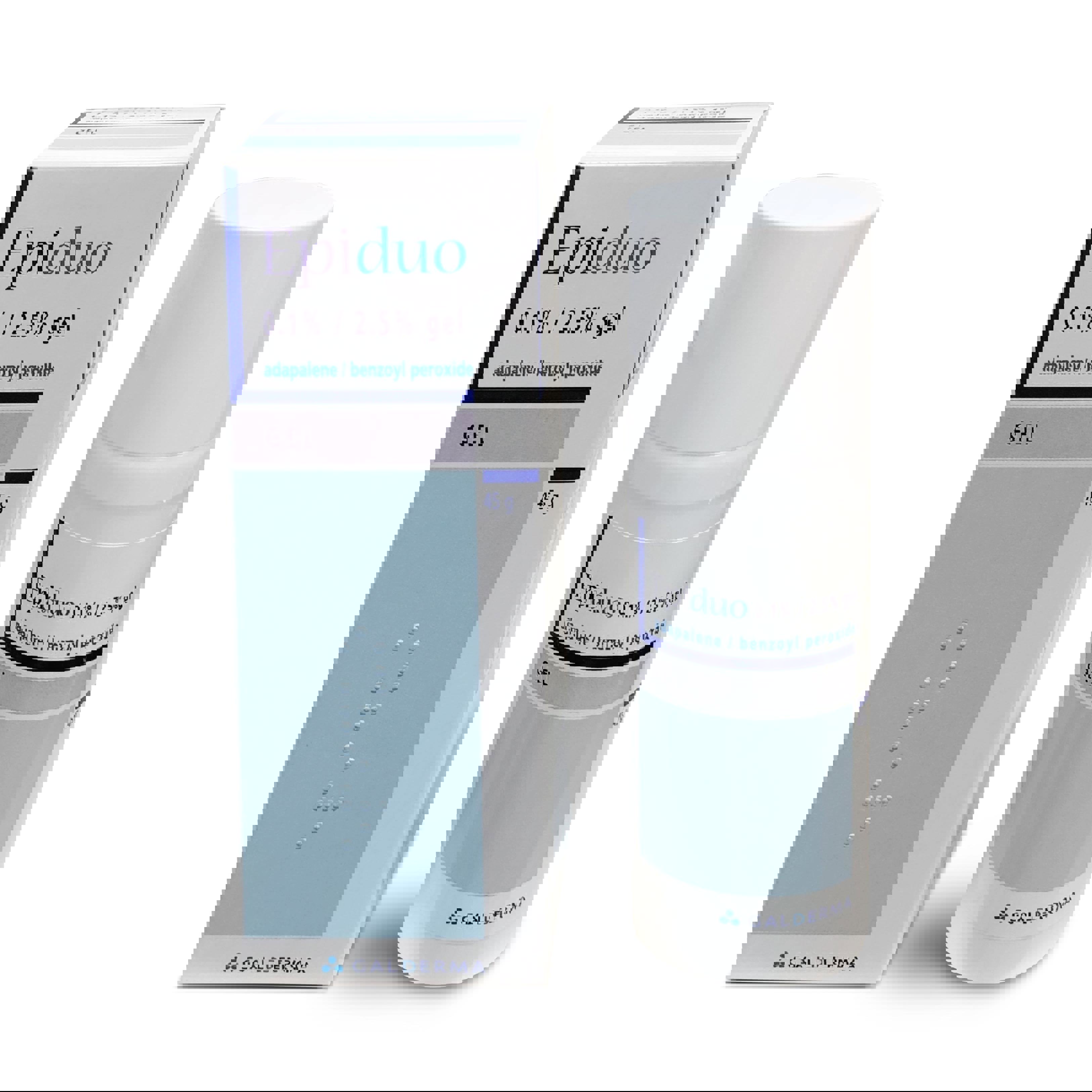
Epiduo
Incl. online consultation, medicine and discreet delivery
View Options
The medical information on this site is provided for educational purposes. It does not replace a face-to-face consultation with your GP or specialist. Always follow the advice of your prescribing doctor and read the patient information leaflet supplied with your medication.
Choose Your Medicine
Select dosage and quantity
Online Consultation
Reviewed by a qualified physician
Fast, Discreet Delivery
Delivered to your door
Medical Information
About This Medicine
Epiduo Gel is a fixed-dose combination topical treatment for acne vulgaris containing adapalene, a third-generation retinoid, and benzoyl peroxide, an antimicrobial and keratolytic agent.
The two components target different aspects of acne pathogenesis and together provide superior efficacy compared with either ingredient alone.
Adapalene modulates keratinocyte differentiation and reduces microcomedone formation, addressing the earliest stage of acne development.
It also has anti-inflammatory properties, reducing the production of inflammatory mediators in the skin.
Benzoyl peroxide kills Cutibacterium acnes through oxidative release of free radicals and helps prevent the development of antibiotic resistance, which is an important consideration in modern acne management.
Clinical trials have demonstrated that Epiduo Gel produces a faster onset of action and greater reductions in both inflammatory and non-inflammatory lesions compared with adapalene or benzoyl peroxide monotherapy.
It is suitable for mild to moderate acne and can be used as the topical backbone of acne treatment, with or without an oral antibiotic for more extensive disease.
Usage & Dosage
Apply a thin layer to the entire affected area once daily in the evening, after cleansing and drying the skin thoroughly. Use a gentle, non-abrasive cleanser.
Avoid the eyes, lips, angles of the nose, and mucous membranes. Expect some dryness and peeling during the first two to four weeks as the skin acclimatises.
Use a lightweight non-comedogenic moisturiser if irritation is bothersome. Apply sunscreen daily, as retinoids increase photosensitivity. Benzoyl peroxide can bleach fabrics.
One application (a pea-sized amount per affected facial zone) once daily in the evening.
If significant irritation develops, reduce to every other day for two weeks before increasing back to daily application. Treatment is typically continued for at least 12 weeks to judge effectiveness.
Long-term maintenance use of adapalene alone or the combination at reduced frequency may be appropriate under medical supervision.
Side Effects
Very common: dryness, erythema, scaling, and a burning or stinging sensation at the application site, especially during the first two to four weeks.
Common (1 in 10 to 1 in 100): pruritus, sunburn, contact dermatitis. Uncommon: skin discolouration, worsening of acne (initial purging, which usually resolves within the first month).
These local reactions are expected and generally subside as the skin adapts. Systemic side effects are negligible due to minimal absorption.
Warnings & Precautions
Avoid excessive sun exposure and use broad-spectrum sunscreen daily, as adapalene increases the skin's sensitivity to ultraviolet light.
Do not use simultaneously with other retinoids or harsh topical exfoliants. Take care to avoid contact with the eyes and lips. Benzoyl peroxide can bleach hair and coloured fabrics.
If severe irritation persists beyond the initial adjustment period, consider reducing the frequency of application or temporarily stopping treatment. Do not apply to broken or eczematous skin.
Contraindications
Contraindicated in known hypersensitivity to adapalene, benzoyl peroxide, or any excipient.
Not recommended in pregnancy due to the retinoid component (adapalene is category X in some classification systems, though systemic absorption is very low).
Women of childbearing potential should use effective contraception during treatment.