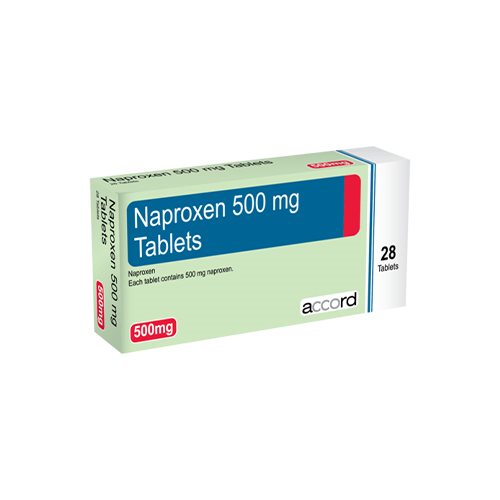
Naproxen
Incl. online consultation, medicine and discreet delivery
View Options
The medical information on this site is provided for educational purposes. It does not replace a face-to-face consultation with your GP or specialist. Always follow the advice of your prescribing doctor and read the patient information leaflet supplied with your medication.
Choose Your Medicine
Select dosage and quantity
Online Consultation
Reviewed by a qualified physician
Fast, Discreet Delivery
Delivered to your door
Medical Information
About This Medicine
Naproxen is a non-steroidal anti-inflammatory drug (NSAID) of the propionic acid class. It is a painkiller that also reduces swelling. Doctors prescribe it to ease pain, inflammation, and stiffness.
It helps with many muscle, joint, and inflammatory problems.
These include rheumatoid arthritis, osteoarthritis, ankylosing spondylitis (a type of spine arthritis), acute gout, tendinitis, bursitis, dysmenorrhoea (period pain), and sudden muscle or joint pain.
Naproxen works by blocking two enzymes called cyclo-oxygenase-1 (COX-1) and cyclo-oxygenase-2 (COX-2). These enzymes help the body make prostaglandins.
Prostaglandins are fat-like chemicals that cause inflammation, pain, and fever. When tissue is hurt, naproxen lowers prostaglandin levels there.
This is why it eases inflammation, relieves pain, and brings down a fever.
Naproxen stays in the body for a fairly long time. Its half-life is 12 to 17 hours. That is longer than other NSAIDs such as ibuprofen.
So you can take it twice a day, and it keeps relieving symptoms for longer. Studies of large groups suggest naproxen may carry a lower heart risk than some other NSAIDs.
This makes it a good choice for people who need long-term treatment and who already have heart risk factors.
Usage & Dosage
Take naproxen with or after food. This lowers the chance of stomach upset. Swallow the tablets whole with a glass of water. Use the lowest dose that works, for the shortest time you need it.
If you take it twice a day, leave about 12 hours between doses. Do not lie down for at least 30 minutes after a dose. This protects your oesophagus (the tube to your stomach) from irritation.
Your prescriber may also give you a proton pump inhibitor to protect your stomach. If so, take it as directed.
For muscle and joint problems: 500 mg to 1,000 mg a day, in one or two split doses. The most you can take is 1,250 mg on the first day. After that, the limit drops to 1,000 mg a day.
For acute gout: start with 750 mg, then 250 mg every 8 hours until the attack settles. For period pain: start with 500 mg, then 250 mg every 6 to 8 hours as needed.
Older patients should use the lowest dose that works. Their kidney and stomach function should be checked.
Side Effects
Common (1 in 10 to 1 in 100): indigestion, nausea, stomach pain, constipation, diarrhoea, headache, dizziness, drowsiness, tinnitus (ringing in the ears), and oedema (swelling from fluid).
Uncommon (1 in 100 to 1 in 1,000): ulcers in the stomach or duodenum, bleeding in the gut, rash, itching, stomatitis (sore mouth), reduced kidney function, raised liver enzymes, and sight problems.
Rare (1 in 1,000 to 1 in 10,000): aplastic anaemia and agranulocytosis (both serious blood problems), hepatitis (liver inflammation), Stevens-Johnson syndrome and toxic epidermal necrolysis (both severe skin reactions), interstitial nephritis (kidney inflammation), aseptic meningitis, and anaphylaxis (a severe allergic reaction).
All NSAIDs carry a dose-related risk of gut problems and of blood clots affecting the heart.
Warnings & Precautions
Use naproxen at the lowest dose that works, for the shortest time you can. It may raise the risk of blood clots that affect the heart. This risk is higher with high doses and long-term use.
Even so, it seems lower than with some other NSAIDs. Ulcers and bleeding in the gut can happen without warning.
For people with risk factors, the prescriber may add a proton pump inhibitor to protect the stomach.
Take care if you have asthma, high blood pressure, heart failure, reduced kidney function, or reduced liver function. Do not use naproxen in the third trimester of pregnancy.
Contraindications
Do not take naproxen if you have an active peptic ulcer or bleeding in the gut. Also avoid it if you have had gut bleeding or a tear caused by a past NSAID.
Do not use it if you have severe heart failure, severe liver problems, or severe kidney problems (creatinine clearance below 30 ml/min). Do not take it in the third trimester of pregnancy.
Avoid it if you are allergic to naproxen or any NSAID. This includes people who have had asthma, hives, or a runny nose set off by aspirin or other NSAIDs.
Frequently Asked Questions
Can I take naproxen with paracetamol?
Is naproxen safer for the heart than ibuprofen?
Can I drink alcohol while taking naproxen?
How long does naproxen take to work?
Can I take naproxen long-term?
Related articles: Naproxen
Naproxen Side Effects: What You Need to Know
Naproxen commonly causes stomach discomfort, heartburn and headache. Serious but rare side effects include gastrointestinal bleeding, cardiovascular events and kidney problems. Most mild side effects settle within a few days of starting treatment.
dosageNaproxen Dosage: How Much to Take and When
The standard adult dose of naproxen is 250 mg to 500 mg twice daily, with a maximum of 1,000 mg in 24 hours. Elderly patients should use the lowest effective dose. Always take naproxen with or after food to reduce stomach irritation.
interactionNaproxen and Alcohol: Risks, Safety and Practical Advice
Drinking alcohol while taking naproxen increases the risk of stomach irritation, gastrointestinal bleeding and kidney strain. Occasional light drinking may be acceptable for some patients, but regular or heavy alcohol use should be avoided during treatment.
interactionNaproxen and Paracetamol: Combining Two Painkillers Safely
Yes, naproxen and paracetamol can be taken together safely. They work by different mechanisms and combining them often provides better pain relief than either drug alone. Stick to the recommended doses of both and avoid adding ibuprofen on top.
interactionNaproxen and Ibuprofen: Why You Should Not Take Both
You should not take naproxen and ibuprofen together. Both are NSAIDs and combining them doubles the risk of stomach bleeding, kidney injury and cardiovascular side effects without improving pain relief. Use one or the other, not both.
overviewNaproxen: Comprehensive NHS-Aligned Information
Naproxen is a prescription NSAID used to treat pain, inflammation and fever. It is commonly prescribed for arthritis, period pain, musculoskeletal injuries and gout. Take it with food, use the lowest effective dose and be aware of GI and cardiovascular risks.