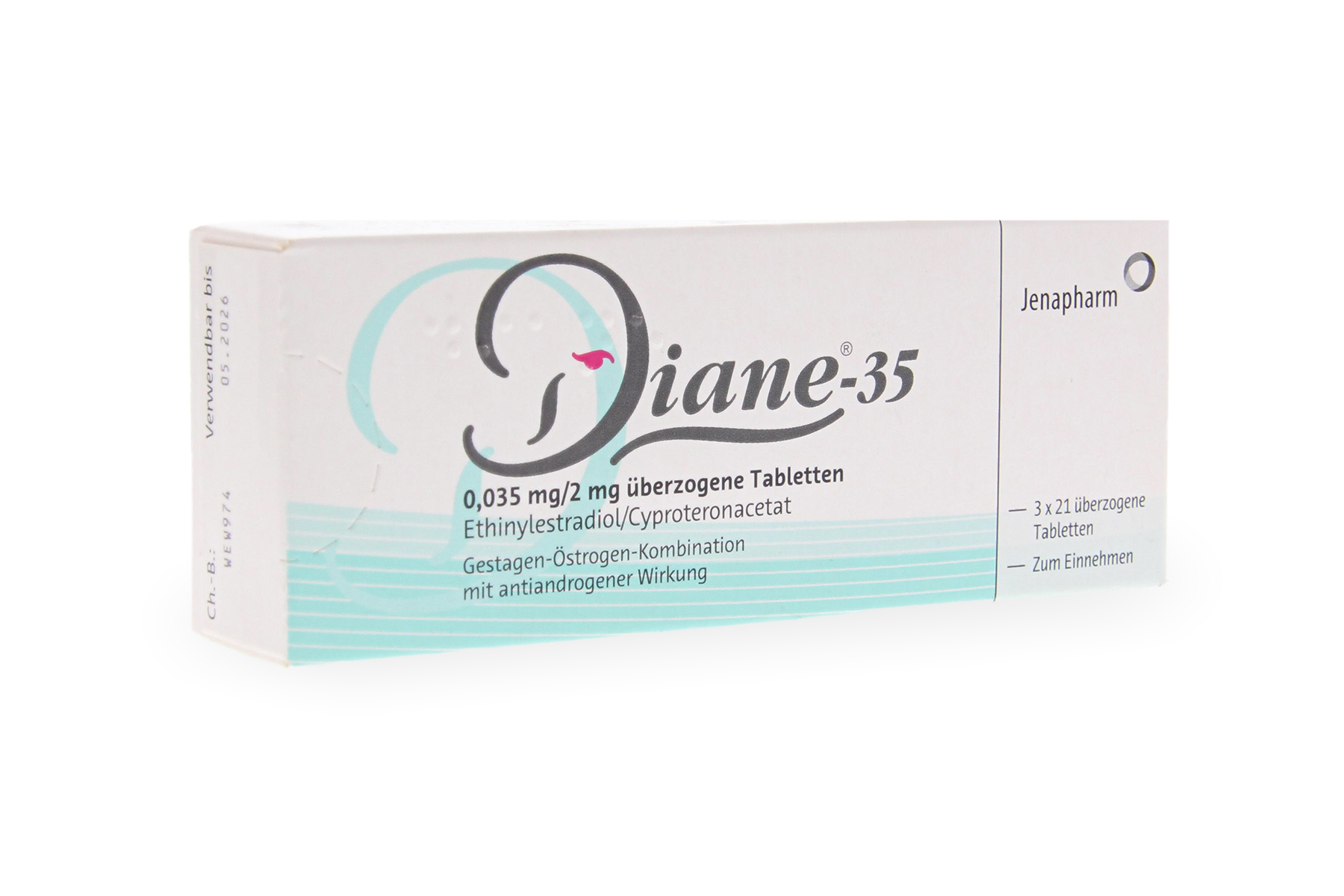
Diane-35
Incl. online consultation, medicine and discreet delivery
View Options
The medical information on this site is provided for educational purposes. It does not replace a face-to-face consultation with your GP or specialist. Always follow the advice of your prescribing doctor and read the patient information leaflet supplied with your medication.
Choose Your Medicine
Select dosage and quantity
Online Consultation
Reviewed by a qualified physician
Fast, Discreet Delivery
Delivered to your door
Medical Information
About This Medicine
Dianette is a combined hormonal medicine. It contains cyproterone acetate and ethinylestradiol. It works as a contraceptive, but that is not its main job.
Doctors mainly prescribe it for moderate to severe acne in women of childbearing age. It is for women whose acne has not improved with skin creams (topical treatments) or with antibiotic tablets.
It also treats moderately severe hirsutism, which is unwanted excess hair growth. Take it for acne or hirsutism, not just as a contraceptive.
Cyproterone acetate is a strong anti-androgen. It blocks male hormones, called androgens, from acting on your skin. Androgens make the skin's oil glands (sebaceous glands) more active.
Too much oil (sebum) helps cause acne. In women with hirsutism, high androgen levels drive extra hair growth.
Cyproterone acetate blocks the androgen receptors and lowers the release of hormones that control them. So your skin makes less oil, acne clears, and unwanted hair grows more slowly.
Ethinylestradiol is the oestrogen part. It controls your cycle and stops ovulation, so no egg is released. It also raises a blood protein called sex hormone-binding globulin (SHBG).
This protein binds androgens, so fewer of them circulate freely. Together, these effects make Dianette a focused treatment for androgen-related skin problems in women.
Usage & Dosage
Take one tablet daily for 21 days in a row. Then take a seven-day break with no tablets. During this break you usually get a withdrawal bleed, like a period.
Start each new strip on the same day of the week. Take the tablet at about the same time each day with water. If you miss a tablet, follow the missed-pill rules in the patient leaflet.
Stop taking Dianette once your acne or hirsutism has fully cleared. For acne, this is usually after three to four 21-day cycles.
Do not keep taking Dianette only for contraception after your skin has cleared. Switch to a standard combined oral contraceptive instead.
Take one tablet daily for 21 days, then have a seven-day break. Treatment for acne usually lasts three to four cycles. A specialist may extend this if your acne has not fully cleared.
For hirsutism, you may need a longer course of six to twelve months to see a clear benefit. Do not take Dianette together with other hormonal contraceptives. You cannot adjust the dose.
The medicine comes only as a single fixed-dose combination.
Side Effects
Common side effects affect more than 1 in 100 women. They include headache, tender breasts, mood changes, nausea, fluid retention, and changes in body weight.
You may also get breakthrough bleeding or spotting in the first few cycles.
Uncommon side effects include migraine, lower sex drive, skin rash, and changes in cervical fluid. Rarely, you may get chloasma, which is dark patches on the face. Sunlight makes it worse.
Dianette also carries serious risks. One is venous thromboembolism, meaning blood clots in the veins. These can form in the leg (deep vein thrombosis) or the lungs (pulmonary embolism).
This risk is higher with Dianette than with many standard combined pills, because of the cyproterone acetate.
Arterial thromboembolism, such as a stroke or heart attack (myocardial infarction), is a rare but life-threatening risk.
Very rarely, long-term use has been linked to liver tumours, including liver cancer (hepatocellular carcinoma).
Cyproterone acetate has also been linked to meningioma, a brain tumour, mainly at higher doses and with long-term use.
Warnings & Precautions
The risk of blood clots in the veins with Dianette is higher than with most combined pills. For this reason, you should not use it only for contraception.
Stop using it once your acne or hirsutism has cleared. Switch to another contraceptive if you still need one.
Get medical help at once if you have a sudden severe headache, chest pain, breathlessness, a swollen leg, or problems with your vision.
Women who smoke and are over the age of 35 should not use Dianette. Tell your prescriber if you or your family have a history of blood clots, migraines with aura, or liver disease.
Contraindications
Do not use Dianette if you have, or have had, blood clots in the veins or arteries (venous or arterial thromboembolism).
Also avoid it with a known clotting disorder (thrombophilia), migraine with aura, or severe or multiple cardiovascular risk factors.
Other reasons are severe liver disease, liver tumours, and a known or suspected oestrogen-dependent cancer.
It is also unsuitable if you have unexplained vaginal bleeding, a known or suspected pregnancy, or a known or current meningioma (a type of brain tumour).
Do not use it alongside other hormonal contraceptives.