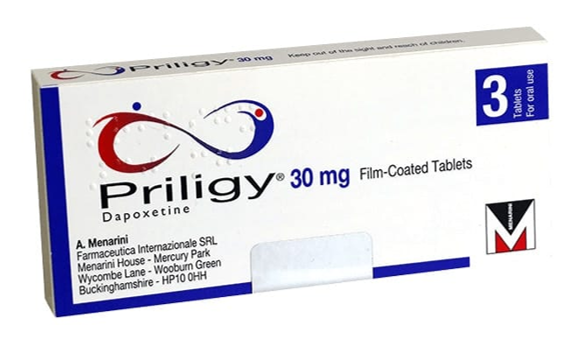
Priligy
Incl. online consultation, medicine and discreet delivery
View Options
The medical information on this site is provided for educational purposes. It does not replace a face-to-face consultation with your GP or specialist. Always follow the advice of your prescribing doctor and read the patient information leaflet supplied with your medication.
Choose Your Medicine
Select dosage and quantity
Online Consultation
Reviewed by a qualified physician
Fast, Discreet Delivery
Delivered to your door
Medical Information
About This Medicine
Priligy contains dapoxetine. This is a short-acting selective serotonin reuptake inhibitor (SSRI), a medicine that raises serotonin levels in the body.
It was made for the on-demand treatment of premature ejaculation (PE) in men aged 18-64 years. Unlike SSRIs used for depression, dapoxetine is taken up and cleared by the body quickly.
This makes it suitable for use only when needed, prior to sexual activity, rather than every day.
Premature ejaculation means ejaculation that happens with little stimulation before, on, or shortly after penetration.
It happens before the person wishes it, and they have little or no control over it.
In phase III clinical trials, dapoxetine increased the time to ejaculation during sex (intravaginal ejaculatory latency time, or IELT) by about 2.5 to 3-fold compared to the start.
It also clearly improved how much control men reported over ejaculation, their sexual satisfaction, and their personal distress. Dapoxetine is the only licensed medicine for PE in Europe.
It does not treat erectile dysfunction. You should not use it at the same time as other SSRIs, SNRIs, or tricyclic antidepressants. The BNF lists dapoxetine under drugs used in premature ejaculation.
Usage & Dosage
Take one tablet with a full glass of water, 1-3 hours before you expect sexual activity. Do not take more than one dose in 24 hours. You can take dapoxetine with or without food.
A high-fat meal does not change how the drug works in the body much, but it may delay how long it takes to reach its peak level. Avoid alcohol while taking dapoxetine.
The combination raises the risk of fainting (syncope) and other effects on the brain. Stand up slowly from sitting or lying down.
This lowers the risk of a drop in blood pressure when you stand (orthostatic hypotension).
If you faint or feel warning signs such as lightheadedness, nausea, or sweating, lie down at once with your legs raised. Do not start dapoxetine again without speaking to a prescriber.
The recommended starting dose is 30 mg, taken when needed 1-3 hours before sexual activity.
If the 30 mg dose does not work well enough and you tolerate it without major side effects, the dose can go up to 60 mg. Take it no more than once daily.
You do not need to change the dose for mild kidney problems (renal impairment). Dapoxetine is not recommended if you have moderate-to-severe kidney problems.
You must not take it if you have moderate or severe liver problems (hepatic impairment).
You must not take it with strong CYP3A4 inhibitors (for example ketoconazole) or CYP2D6 inhibitors (for example fluoxetine).
These are drugs that slow how the body breaks dapoxetine down, so they raise its levels.
Side Effects
These side effects come from the combined phase III clinical trial database.
Very common (≥1/10): Dizziness (6-11%, higher with a higher dose), headache (6-9%), nausea (11-22%, the most often reported side effect, higher with a higher dose).
Common (≥1/100 to <1/10): Drowsiness, trouble sleeping, anxiety, agitation, restlessness, erectile dysfunction (which is unexpected in some cases), diarrhoea, dry mouth, tiredness, blocked nose, irritability.
Uncommon (≥1/1,000 to <1/100): Fainting and near-fainting, blurred vision, ringing in the ears (tinnitus), low blood pressure, flushing, blocked sinuses, stomach pain, heavy sweating, tingling (paraesthesia), mood changes.
Rare (≥1/10,000 to <1/1,000): Thoughts of suicide (as with all serotonin-acting drugs, though the risk is very low with on-demand dosing).
Fainting or vasovagal episodes have been reported in about 0.06-0.23% of patients. A prescriber may choose to check your blood pressure and heart rate while standing after the first dose.
Warnings & Precautions
You must not combine dapoxetine with other serotonin-acting drugs (SSRIs, SNRIs, MAOIs, tricyclics, triptans, tramadol, lithium, St John's Wort). This carries a risk of serotonin syndrome.
That is a condition that can be life-threatening, with agitation, muscle twitching (clonus), high body temperature, and unstable body functions.
Leave a 14-day gap after stopping an MAOI, and 7 days after stopping an SSRI, before you start dapoxetine. The other way round, wait 7 days after stopping dapoxetine before you start an SSRI or SNRI.
A drop in blood pressure on standing and fainting are known risks. Drink enough fluids, and take care with alpha-blockers or blood pressure medicines.
Dapoxetine is not recommended in men with serious heart disease. Prescribers should check for any underlying psychiatric conditions before starting treatment.
Contraindications
You must not take Priligy if you are allergic to dapoxetine or any other ingredient. You must not take it if you have serious heart conditions.
These include heart failure (NYHA II-IV), problems with the heart's electrical signals (such as AV block or sick sinus syndrome), serious reduced blood flow to the heart (ischaemic heart disease), or serious heart valve disease.
You must not take it if you have a history of fainting, or moderate or severe liver problems (hepatic impairment).
You must not take it if you use, or have recently used, MAOIs (within 14 days), SSRIs, SNRIs, tricyclic antidepressants, thioridazine, or strong CYP3A4 inhibitors (for example ketoconazole, ritonavir, nelfinavir).