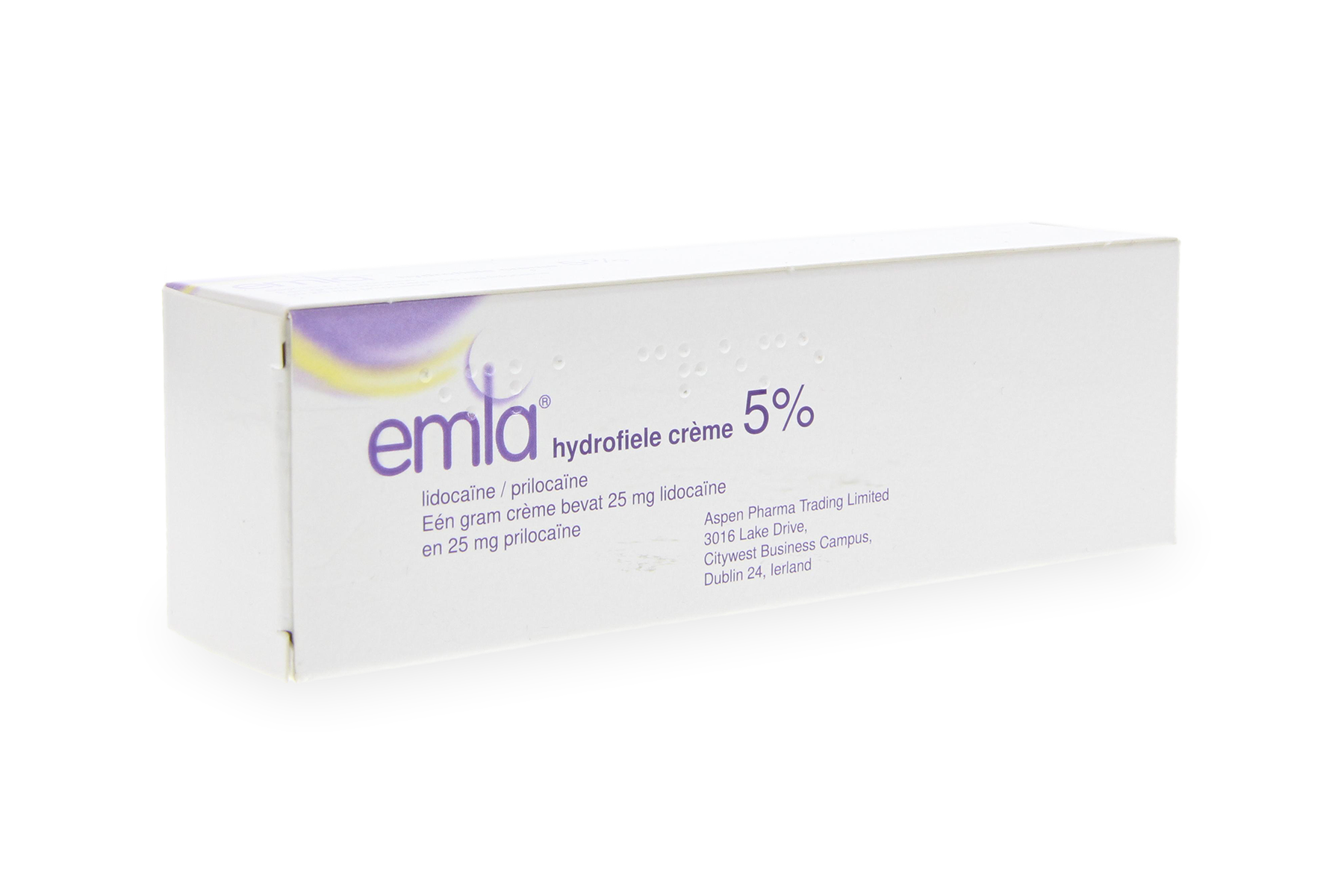
Emla Cream
Incl. online consultation, medicine and discreet delivery
View Options
The medical information on this site is provided for educational purposes. It does not replace a face-to-face consultation with your GP or specialist. Always follow the advice of your prescribing doctor and read the patient information leaflet supplied with your medication.
Choose Your Medicine
Select dosage and quantity
Online Consultation
Reviewed by a qualified physician
Fast, Discreet Delivery
Delivered to your door
Medical Information
About This Medicine
EMLA Cream is a topical anaesthetic preparation containing a eutectic mixture of lidocaine and prilocaine.
It is applied to intact skin to provide local anaesthesia prior to needle procedures, minor superficial surgical procedures, and dermatological treatments.
EMLA stands for Eutectic Mixture of Local Anaesthetics.
The eutectic mixture allows the two local anaesthetics to exist in liquid form at room temperature despite both having melting points above 30 degrees Celsius individually.
This liquid formulation enables effective penetration through the intact skin barrier, which solid or crystalline preparations would achieve far less readily.
Once absorbed, lidocaine and prilocaine block sodium channels in nerve fibres, preventing the initiation and conduction of pain impulses.
EMLA Cream is widely used in clinical settings for venepuncture, cannulation, vaccination, laser therapy, and minor dermatological procedures.
It is also available for self-application by patients before attending appointments. Adequate application time and an occlusive dressing are essential to achieve effective anaesthesia of intact skin.
Usage & Dosage
Apply a thick layer of EMLA Cream to the area of intact skin where the procedure will take place.
Cover the cream with the provided occlusive dressing (Tegaderm) to prevent evaporation and enhance absorption. For minor procedures such as venepuncture, leave in place for at least 60 minutes.
For deeper procedures, application time may need to be extended to 120 minutes or longer. Remove the dressing and wipe away excess cream immediately before the procedure.
Anaesthesia persists for approximately one to two hours after removal.
Adults: apply approximately 1.5 to 2 g per 10 cm2 of skin. Maximum application area: 600 cm2 for adults. Application time: 60 minutes for venepuncture; up to 120 minutes for deeper procedures.
In children, the dose and application area are based on age and weight: neonates up to 3 months, maximum 1 g over 10 cm2 for 1 hour; 3-12 months, maximum 2 g over 20 cm2 for 1 hour; 1-6 years, maximum 10 g over 100 cm2 for up to 5 hours.
Side Effects
Very common (more than 1 in 10): transient local skin reactions at the application site, including pallor, erythema, and oedema.
Common (1 in 10 to 1 in 100): burning, itching, or warmth at the application site.
Uncommon (1 in 100 to 1 in 1,000): purpuric or petechial reactions (particularly in children with atopic dermatitis).
Rare (1 in 1,000 to 1 in 10,000): methaemoglobinaemia (primarily in neonates or young infants, or in patients concurrently taking methaemoglobin-inducing agents), allergic contact dermatitis, systemic toxicity (only with grossly excessive application).
Local blanching is a normal pharmacological response and resolves spontaneously.
Warnings & Precautions
Do not apply EMLA Cream to broken skin, mucous membranes (except the genital mucosa in adults for specific procedures), or open wounds, as rapid absorption may lead to systemic toxicity.
Use with caution in neonates, particularly those born prematurely, and those receiving concurrent methaemoglobin-inducing drugs (such as sulphonamides, dapsone, or nitrates), as prilocaine can cause methaemoglobinaemia.
Avoid contact with the eyes. Patients with glucose-6-phosphate dehydrogenase (G6PD) deficiency are at increased risk of methaemoglobinaemia.
Contraindications
EMLA Cream is contraindicated in patients with known hypersensitivity to lidocaine, prilocaine, or other amide-type local anaesthetics, or to any excipient.
It is also contraindicated in patients with congenital or idiopathic methaemoglobinaemia. It must not be applied to the tympanic membrane in patients with a perforated ear drum.