Sumatriptan
Incl. online consultation, medicine and discreet delivery
View Options
The medical information on this site is provided for educational purposes. It does not replace a face-to-face consultation with your GP or specialist. Always follow the advice of your prescribing doctor and read the patient information leaflet supplied with your medication.
Choose Your Medicine
Select dosage and quantity
Online Consultation
Reviewed by a qualified physician
Fast, Discreet Delivery
Delivered to your door
Medical Information
About This Medicine
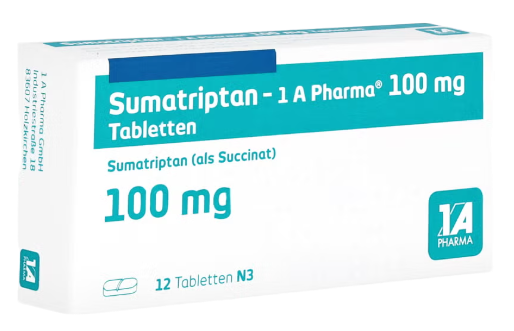
Sumatriptan is a triptan, a selective serotonin (5-HT1B/1D) receptor agonist. It was developed to treat migraine attacks once they start. It works in three ways.
It narrows the widened arteries in the head (vasoconstriction). It stops trigeminal nerve endings from releasing vasoactive neuropeptides, the substances that drive migraine pain.
And it blocks pain signals in the trigeminal nucleus caudalis, a part of the brainstem. Sumatriptan was the first triptan on the market.
It is still the most prescribed acute migraine treatment in the world.
In clinical trials, about 50-60% of patients felt clear relief from headache, nausea, light sensitivity (photophobia), and sound sensitivity (phonophobia) within 2 hours at the 100 mg dose.
It works for migraine with aura and without aura. The BNF lists sumatriptan as a first-line treatment for moderate to severe migraine when simple painkillers are not enough.
The NICE Clinical Knowledge Summary advises taking a triptan as early as possible in the attack for the best result.
Sumatriptan is also licensed for cluster headache, given as a subcutaneous injection (under the skin). It does not prevent migraine attacks, and it does not help tension-type headache.
Usage & Dosage
Take one 50 mg or 100 mg tablet as early as you can once the migraine headache starts. Swallow it whole with water. If the first dose helps but the headache comes back, you can take a second dose.
Wait at least 2 hours between doses. Do not take more than 300 mg in any 24-hour period. If the first dose does not help at all, do not take a second dose for the same attack.
Instead, talk to your prescriber about a different treatment. Sumatriptan does not work if you take it during the aura phase, before the headache begins.
Do not take it within 24 hours of any other triptan or of ergotamine. You can take it with or without food.
During a migraine the stomach empties more slowly (gastric stasis), so the tablet may be absorbed more slowly.
The usual starting dose is 50 mg. You can raise this to 100 mg if 50 mg does not give enough relief. Some patients do well on 25 mg. The most you can take by mouth in 24 hours is 300 mg.
With mild hepatic impairment (mild liver problems), the largest single dose is 50 mg. Sumatriptan is not advised in severe hepatic impairment.
You do not need to change the dose for renal impairment (kidney problems). If you take a MAO-A inhibitor such as moclobemide, the largest dose is 50 mg, and you should use it with care.
Strong CYP3A4 inhibitors do not change sumatriptan much, because the body breaks it down mainly through MAO-A.
Side Effects
Side effects are listed below by how often they happen, based on the SmPC.
Common (≥1/100 to <1/10): Tingling, paraesthesia (pins and needles), a sense of heaviness, warm or hot feelings, flushing, dizziness, drowsiness, a brief rise in blood pressure, dyspnoea (shortness of breath), nausea, vomiting (may also be migraine-related), muscle pain, and fatigue.
Uncommon (≥1/1,000 to <1/100): Bradycardia (slow heartbeat), tachycardia (fast heartbeat), palpitations, low blood pressure, Raynaud's phenomenon, and visual disturbances.
Rare (≥1/10,000 to <1/1,000): Coronary artery vasospasm (spasm of the heart arteries), myocardial infarction (heart attack, in isolated reports in patients with heart risk factors), seizures, anaphylaxis (severe allergic reaction), and serotonin syndrome, mainly with serotonergic drugs.
Chest symptoms: About 3-5% of patients feel tightness, heaviness, or pressure in the chest and throat. This is usually not from the heart.
It often comes from spasm of the skeletal muscle or the oesophagus. But in at-risk people, the doctor should rule out a heart cause.
Warnings & Precautions
Do not give sumatriptan to patients with uncontrolled high blood pressure, ischaemic heart disease, cerebrovascular disease, peripheral vascular disease, or Wolff-Parkinson-White syndrome.
Check the heart and circulation before prescribing to patients with several cardiovascular risk factors.
These include smoking, high blood pressure, hyperlipidaemia, diabetes, a strong family history, men over 40, and postmenopausal women.
In these cases, the first dose may be given under medical supervision. Medication overuse headache (MOH) can develop if triptans are used on more than 10 days per month.
This needs a prescriber review and a managed withdrawal. Do not take sumatriptan with ergotamine; leave a 24-hour gap. Do not take it with other triptans either.
There is a risk of serotonin syndrome with SSRIs, SNRIs, or MAOIs. Watch for symptoms such as agitation, myoclonus, hyperthermia, and hyperreflexia.
Contraindications
Do not take sumatriptan if you are hypersensitive (allergic) to sumatriptan or any excipient.
Avoid it with ischaemic heart disease, including angina, a past heart attack (MI), or documented silent ischaemia.
Also avoid coronary vasospasm (Prinzmetal's angina), cerebrovascular disease (past stroke or TIA), or peripheral vascular disease.
Do not take it with moderate to severe hypertension, uncontrolled mild hypertension, or severe hepatic impairment. Do not take it with ergotamine or other triptans within 24 hours.
Also avoid recent MAOIs: within 2 weeks of irreversible MAOIs, or 24 hours of reversible MAO-A inhibitors.