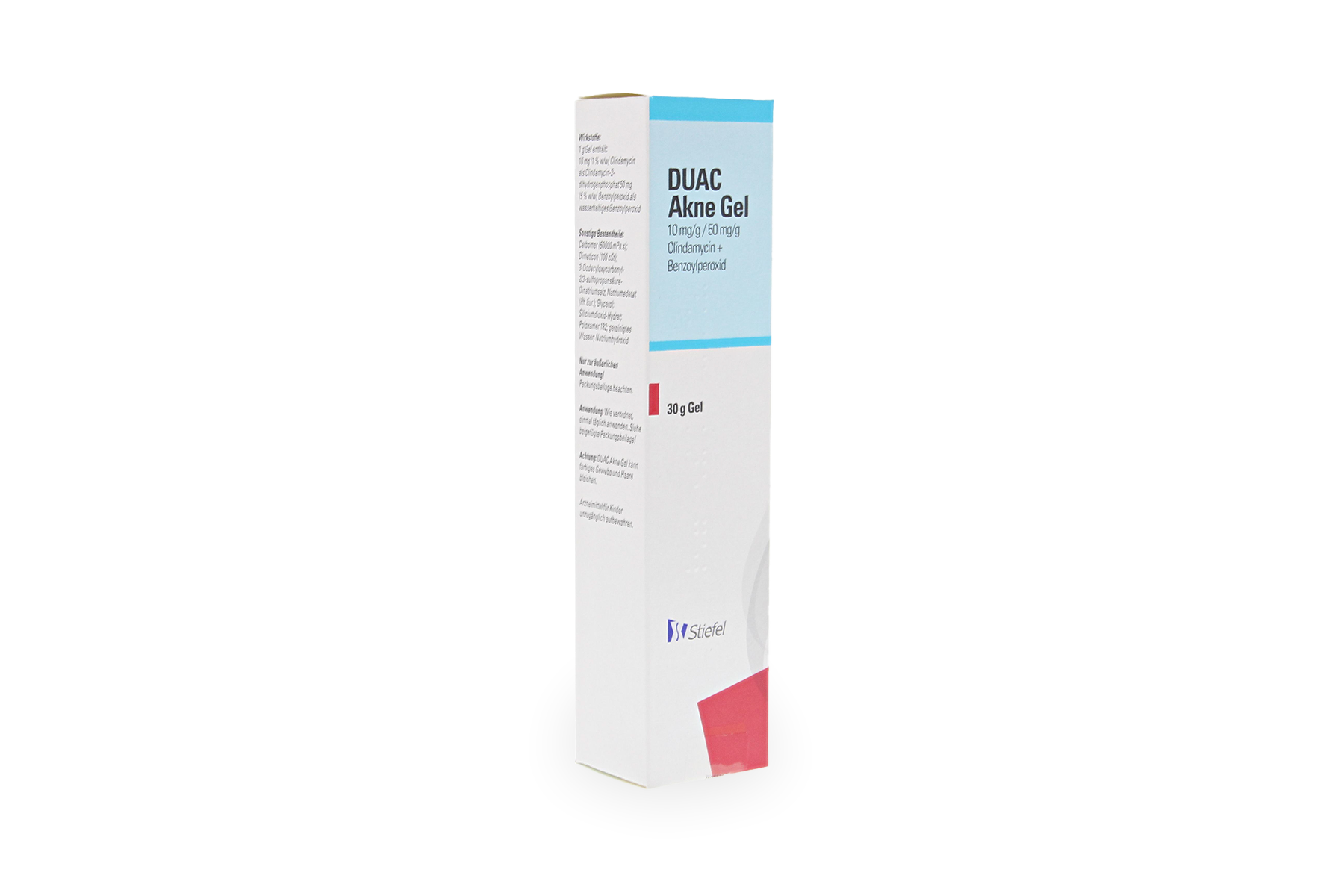
Duac
Incl. online consultation, medicine and discreet delivery
View Options
The medical information on this site is provided for educational purposes. It does not replace a face-to-face consultation with your GP or specialist. Always follow the advice of your prescribing doctor and read the patient information leaflet supplied with your medication.
Choose Your Medicine
Select dosage and quantity
Online Consultation
Reviewed by a qualified physician
Fast, Discreet Delivery
Delivered to your door
Medical Information
About This Medicine
Duac Gel is a combination topical treatment for mild to moderate acne vulgaris. It contains clindamycin, a lincosamide antibiotic, and benzoyl peroxide, a keratolytic and antimicrobial agent.
The two active ingredients work through complementary mechanisms to target the key pathological processes underlying acne.
Clindamycin inhibits bacterial protein synthesis and is effective against Cutibacterium acnes (formerly Propionibacterium acnes), the bacterium implicated in inflammatory acne lesions.
Benzoyl peroxide has a broader antimicrobial action through the release of free-radical oxygen, which destroys bacteria on contact.
Importantly, benzoyl peroxide also reduces the risk of antibiotic resistance developing to clindamycin, which is why this combination is preferred over clindamycin monotherapy.
The gel reduces the number of inflammatory papules and pustules, lessens comedone formation, and can improve the overall appearance of acne-affected skin over a course of treatment.
It is applied once daily and is generally well tolerated, though some local skin irritation is expected during the initial weeks.
Usage & Dosage
Apply a thin layer of gel to the entire affected area once daily in the evening, after washing and gently drying the skin. Do not apply to individual spots alone; treat the whole acne-prone zone.
Avoid the eyes, lips, and mucous membranes. If excessive dryness or peeling occurs, reduce application to every other day until the skin adjusts. Use a non-comedogenic moisturiser if needed.
Benzoyl peroxide can bleach fabrics, so take care around clothing, towels, and bedding.
One application (a pea-sized amount per facial zone) once daily in the evening. Treatment duration is usually up to 12 weeks.
If significant improvement is seen, your prescriber may advise stepping down to a maintenance regimen or switching to benzoyl peroxide alone.
Do not use for longer than 12 weeks continuously without medical review, primarily to limit antibiotic exposure.
Side Effects
Very common: erythema, peeling, dryness, and a burning or stinging sensation at the application site during the first two to four weeks.
Common (1 in 10 to 1 in 100): increased skin sensitivity to sunlight, pruritus. Uncommon: contact dermatitis, worsening of acne in the first week (a purging effect that usually settles).
Rare: pseudomembranous colitis has been reported with topical clindamycin use, though this is exceedingly uncommon.
Discontinue and seek advice if severe or prolonged diarrhoea develops during treatment.
Warnings & Precautions
Avoid excessive sun exposure during treatment; use a broad-spectrum sunscreen daily.
Do not combine with other topical retinoids, salicylic acid preparations, or abrasive cleansers unless directed by a clinician, as this may increase irritation.
Do not apply to broken, eczematous, or sunburnt skin. Store the gel in the refrigerator (2 to 8 degrees Celsius) and discard after the expiry date indicated.
If severe or persistent diarrhoea occurs, stop the gel and contact your doctor, as this may indicate Clostridioides difficile infection.
Contraindications
Contraindicated in patients with known hypersensitivity to clindamycin, lincomycin, benzoyl peroxide, or any excipient of the gel.
Do not use in patients with a history of antibiotic-associated colitis or Clostridioides difficile-associated disease.
Not recommended for severe or nodular acne, which typically requires systemic treatment.